Li₄O₁₆Si₄Sm₂Y₂
rare earth oxide · rare earth ceramicLi4O16Si4Sm2Y2 is a rare earth oxide suitable as rare earth ceramic. Color: neutral. Fired at 1200°C from 4 precursors (Sm2O3, SiO2, Y2O3). Workshop batch: 100g at €18.34. Compressive strength ~500 MPa; estimated 0.90 kg CO₂/kg (+309% vs clay brick). Notable: uv luminescent. Confidence: medium.
- forms at
- 1200 °C · high-fire
- replaces
- clay brick
- CO₂
- 309% higher than clay brick (0.90 vs 0.22 kg CO₂/kg; 4.1× higher)
- energy
- 100% higher than clay brick (6.00 vs 3.00 MJ/kg; 2.0× higher)
- compressive
- 500 MPa
- density
- 4.15 g/cm³
- crystal
- monoclinic
- band gap
- 5.03 eV
- cost
- €183.40/kg · €18.34 / 100 g batch
- confidence
- medium (synthesis route)
- potential
- 0.36 · env 0.00 · novel 0.50 · struct 1.00 · lineage 0.50 · supply 0.10
- flags
- uv luminescent: Converts invisible ultraviolet into visible light. Signage panels, low-energy wayfinding tiles, emergency markings that draw their illumination from daylight rather than mains power.
Architectural potential
A yttrium-samarium lithium silicate whose architectural argument is entirely carried by its luminescence: above daylight it reads a neutral sintered ceramic; under near-UV excitation it converts invisible ultraviolet into visible light and emits. At 500 MPa of compression the body could in principle carry load, but the CO₂ balance rules out bulk use — embodied carbon runs over four times that of a fired clay brick, so any specification has to pay for the emission with a functional role rather than a structural one. Natural placements are signage panels in public wayfinding systems that draw their illumination from ambient daylight UV, emergency-marking tiles in corridors and stair-cores, inset tread-edge markers in exhibition architecture, and accent cladding plaques at thresholds where a named moment is wanted. The 300 g workshop ceiling keeps the specification at plaque and patch scale rather than wall scale. The real caveat is double: samarium and yttrium sit inside the rare-earth supply bottleneck with a supply-chain score around 0.14, and €18.34 per 100 g is light-signalling cost, not cladding cost. Specify it the way one specifies a bronze dedication plaque — a single named location where the luminescent signal is the whole point of the piece.
Material character
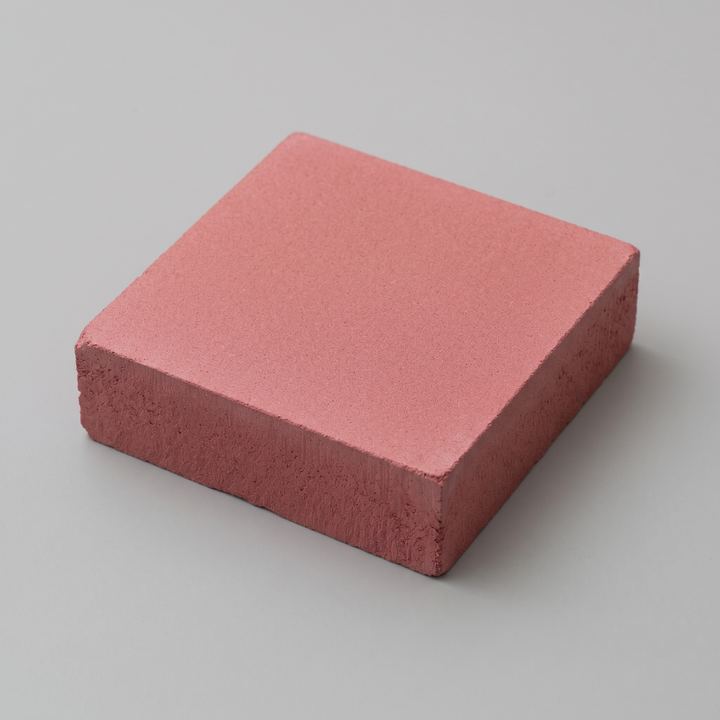
The 85×85×33 mm slab reads a neutral cool white under daylight — the samarium-yttrium matrix has a very slight pinkish bloom only at direct grazing light. Under 365 nm excitation the face lifts into a pale peach-to-orange glow, the Sm³⁺ emission signature distinct from the blue-white of yttrium-only silicates. Surface vitrified matte from the 1200 °C fire; edges cold-cut with fine diamond-saw powder left in the kerf. At 4.15 g/cm³ the slab lifts two-handed — denser in hand than a clay brick of the same footprint, closer to a dense architectural stone, with a clean ceramic ring under the tap.
Recipe
100 g batch · peak 1200 °C| element | precursor | formula | mass | safety |
|---|---|---|---|---|
| Li | lithium carbonate | Li2CO3 | 15.35 g | safe |
| Si | quartz flour / silica | SiO2 | 24.96 g | safe |
| Sm | samarium oxide | Sm2O3 | 36.23 g | moderate |
| Y | yttrium oxide | Y2O3 | 23.46 g | moderate |
- 1Ramp
- 2Hold
- 3Ramp
- 4Ramp
- 5Hold
- 6Ramp
- 7Ramp
UV-luminescent — emits visible light under 365 nm UV