Fe₄Mn₂O₁₆P₄
iron oxide ceramic · structural ceramicFe4Mn2O16P4 is a iron oxide ceramic suitable as structural-ceramic. Color: purple-brown. Fired at 1100°C from 3 precursors (Ca3(PO4)2, Fe2O3, MnO2). Workshop batch: 1000g at €28.66. Compressive strength ~100 MPa; estimated 0.79 kg CO₂/kg (+258% vs clay brick). Notable: no special functions flagged. Confidence: high.
- forms at
- 1100 °C · high-fire
- replaces
- clay brick
- CO₂
- 258% higher than clay brick (0.79 vs 0.22 kg CO₂/kg; 3.6× higher)
- energy
- 75% higher than clay brick (5.25 vs 3.00 MJ/kg; 1.8× higher)
- compressive
- 100 MPa
- density
- 3.34 g/cm³
- crystal
- monoclinic
- band gap
- 3.11 eV
- cost
- €28.66/kg · €28.66 / 1000 g batch
- confidence
- high (synthesis route)
- potential
- 0.20 · env 0.00 · novel 0.00 · struct 0.30 · lineage 1.00 · supply 0.00
Architectural potential
An iron-manganese-phosphate ceramic in the dense-fired load-bearing block register, reaching only 100 MPa of compression at 3.34 g/cm³. That compression figure is modest for the fired-ceramic structural family, placing it closer to extruded engineering brick than to high-strength ceramic-beam territory; the architectural specification is block-work and structural tile rather than primary beam or column. Natural placements are compressive vault elements in experimental masonry, extruded post pieces in low-rise structural walls, fire-resistant block-work in kitchens and boiler rooms, and heavy facing tiles on load-bearing interior walls. The purple-brown colour comes from the iron-manganese phosphate matrix and reads as a signature tone — closer to weathered basalt than to standard red clay. Against clay brick the CO₂ penalty is prohibitive — plus 258 per cent — so any specification must pay for the environmental cost with a functional argument: higher fire-resistance than standard clay, a non-standard colour for architectural effect, or vault-geometry capability that thin-section clay cannot reach. The 1000 g batch and 5000 g workshop ceiling put the piece realistically into block-and-tile production. The caveat is embodied carbon: specification makes sense only where colour or fire-resistance earns the CO₂ cost, not as a general brick replacement.
Material character
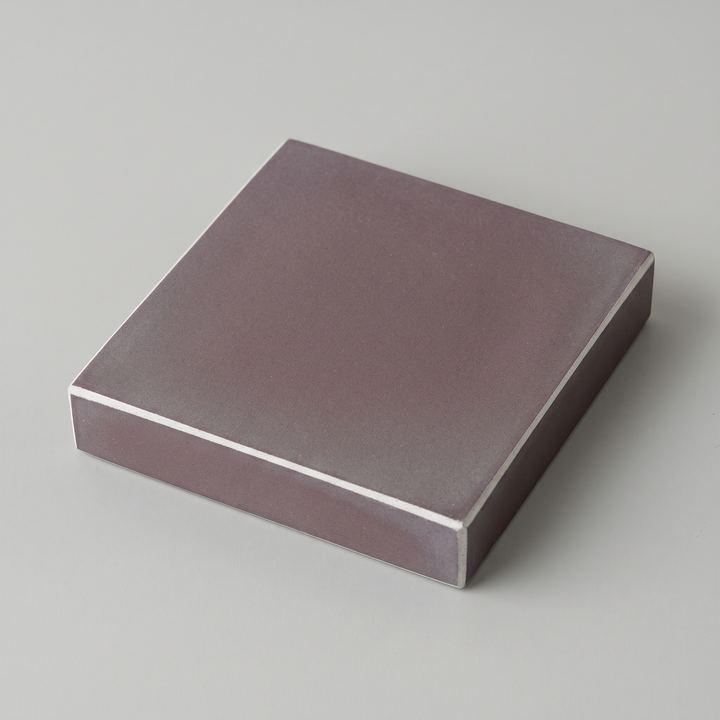
An 85×85×41 mm slab reading a deep purple-brown, the iron-manganese phosphate matrix giving a saturated darker tone than any standard terracotta — closer to weathered volcanic basalt than to fired clay. At 3.34 g/cm³ the piece sits firm two-handed, a weight register matching dense stoneware. Surface fires to a vitrified skin with partial glaze-edge sheen where the phosphate flux has run; edges cold-cut, kerf pale against the dark body. Tap response rings mid-pitch, between clay brick and porcelain. Against a standard red-fired clay brick of equivalent volume the body reads noticeably darker and denser, and the colour carries the iron-manganese signature as a figure rather than as a surface pigment.
Recipe
1000 g batch · peak 1100 °C| element | precursor | formula | mass | safety |
|---|---|---|---|---|
| Fe | iron(III) oxide (red) | Fe2O3 | 28.68 g | safe |
| Mn | manganese dioxide | MnO2 | 15.61 g | moderate |
| P | tricalcium phosphate | Ca3(PO4)2 | 55.71 g | safe |
- 1Ramp
- 2Hold
- 3Ramp
- 4Hold
- 6Ramp
- 7Hold