Gd₄O₁₂Zr₃
heavy oxide ceramic · thermal mass ceramicGd4O12Zr3 is a heavy oxide ceramic suitable as thermal mass ceramic. Color: neutral. Fired at 1250°C from 2 precursors (Gd2O3, ZrO2). Workshop batch: 200g at €70.30. Compressive strength ~300 MPa; estimated 0.94 kg CO₂/kg (+326% vs clay brick). Notable: uv luminescent. Confidence: medium.
- forms at
- 1250 °C · high-fire
- replaces
- clay brick
- CO₂
- 326% higher than clay brick (0.94 vs 0.22 kg CO₂/kg; 4.3× higher)
- energy
- 108% higher than clay brick (6.25 vs 3.00 MJ/kg; 2.1× higher)
- compressive
- 300 MPa
- density
- 6.83 g/cm³
- crystal
- triclinic
- band gap
- 3.34 eV
- cost
- €351.50/kg · €70.30 / 200 g batch
- confidence
- medium (synthesis route)
- potential
- 0.32 · env 0.00 · novel 0.57 · struct 0.60 · lineage 0.50 · supply 0.05
- flags
- uv luminescent: Converts invisible ultraviolet into visible light. Signage panels, low-energy wayfinding tiles, emergency markings that draw their illumination from daylight rather than mains power.
Architectural potential
A gadolinium-zirconate ceramic fired at 1250 °C, 300 MPa of compression, and a UV-luminescent chemistry that draws visible glow from daytime ultraviolet charging. The combination shifts the thermal-mass role sideways: this is still a slow-release ceramic battery, but one that also holds an after-dark light signature without any mains supply. Natural placements are wayfinding tiles in stairwells of public buildings where emergency lighting draws its charge from the day, perimeter markers in high-mass courtyard paving, feature plinths in crematoria and memorial halls where a soft twilight glow carries ritual register, and signal tiles at lecture-hall thresholds that read amber in dusk hours. Against clay brick the embodied CO₂ runs 326 per cent higher and the energy 108 per cent higher, so specification is strictly signature-element — the UV channel has to be the architectural argument, not an accent. The caveat compounds: €70.30 per 200 g batch is the highest in this group, gadolinium supply is concentrated and the chain score sits at 0.14, and at 500 g maximum workshop throughput even a large project runs at the tile rather than the panel scale.
Material character
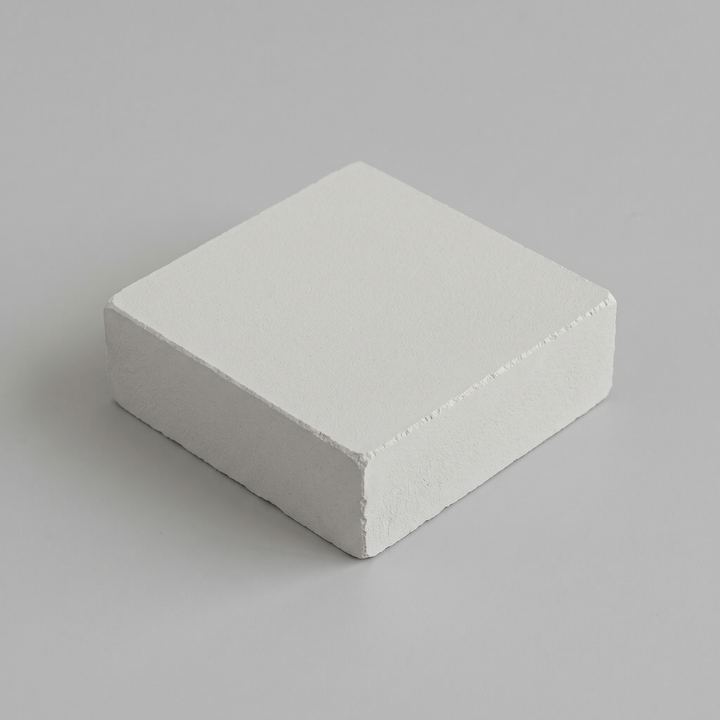
A neutral cream-white body at daylight, shifting to a faint green-amber luminescence under UV excitation — the zirconate host holds the emission cleaner than a silicate sibling of the same rare-earth loading. At 6.84 g/cm³ and 70×70×30 mm the slab is the heaviest in this batch for its footprint, decisively two-handed, close in lift register to a basalt block of the same thickness. Surface vitrified skin, satin-matte with a fine sinter grain under raking light. Edges cold-cut, kerf bright-white and dusty. Against the tungstate-gadolinium sibling the body is denser in hand, cleaner in emission under UV, and rings distinctly sharper under tap.
Recipe
200 g batch · peak 1250 °C| element | precursor | formula | mass | safety |
|---|---|---|---|---|
| Gd | gadolinium oxide | Gd2O3 | 66.23 g | moderate |
| Zr | zirconium dioxide | ZrO2 | 33.77 g | safe |
- 1Ramp
- 2Hold
- 3Ramp
- 4Ramp
- 5Hold
- 6Ramp
- 7Ramp
UV-luminescent — emits visible light under 365 nm UV