Ca₁₃OSi₁₄
calcium silicate · cement alternativeCa13O1Si14 is a calcium silicate suitable as cement-alternative. Color: white-grey. Fired at 1100°C from 2 precursors (CaCO3, SiO2). Workshop batch: 1000g at €5.51. Compressive strength ~50 MPa; estimated 0.68 kg CO₂/kg (-19% vs Portland cement). Notable: no special functions flagged. Confidence: high.
- forms at
- 1100 °C · high-fire
- replaces
- portland cement
- CO₂
- 18.7% lower than Portland cement (0.68 vs 0.83 kg CO₂/kg)
- energy
- 18.2% lower than Portland cement (4.50 vs 5.50 MJ/kg)
- compressive
- 50 MPa
- density
- 2.43 g/cm³
- crystal
- monoclinic
- band gap
- —
- cost
- €5.51/kg · €5.51 / 1000 g batch
- confidence
- high (synthesis route)
- potential
- 0.39 · env 0.23 · novel 0.00 · struct 0.15 · lineage 1.00 · supply 1.00
Architectural potential
A calcium-silicate binder pushed to 1100 °C, with a nineteen-per-cent cut in embodied CO₂ against Portland cement and perfect supply-chain and safety scores drawn from nothing more exotic than limestone and silica sand. Fifty megapascals of compression keeps it in the mortar, screed and non-reinforced slab register rather than primary structure — so natural placements are floor toppings in retrofit, prefab cladding panels on steel or timber frames, site-cast landscape walls and garden-room blocks, and repair mortars on historic masonry where Portland's aggressive salts would damage soft stone. Workshop batches run a full kilogram and scale to five kilograms — genuinely usable quantities for a small wall or a set of panels rather than a single tile. Against Portland cement the environmental argument is real but modest: a nineteen-per-cent reduction justifies specification on projects already committed to embodied-carbon accounting, not on conventional jobs where Portland's cost keeps the decision trivial. The replacement framing is one-to-one in thin, non-reinforced work; it cannot yet carry reinforced structural concrete's role. The caveat is firing: vitrification at 1100 °C means the kiln-free argument does not apply, and the energy saving against Portland is only eighteen per cent — so the binder trades a modest CO₂ cut for full structural familiarity in pouring, formwork and placing.
Material character
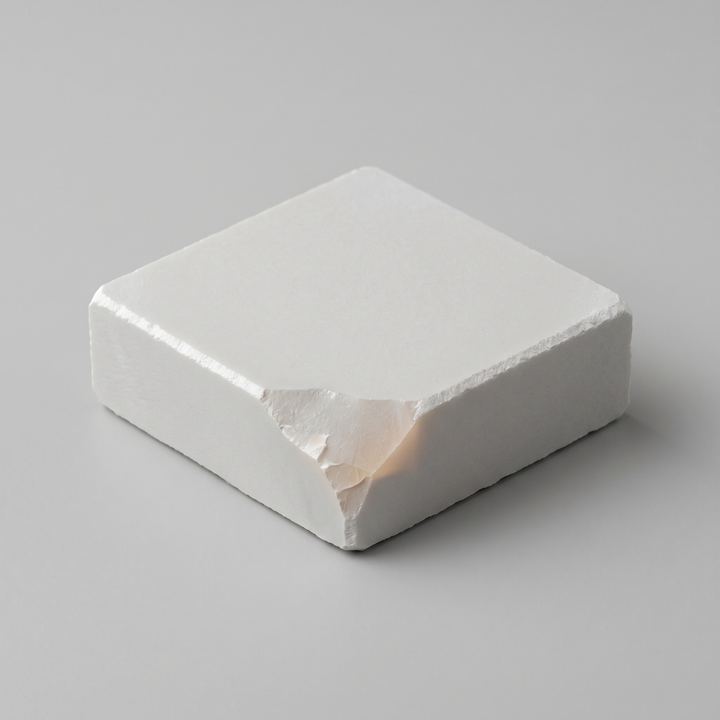
The slab reads a clean white-grey, distinctly paler than a Portland mortar sibling and without the iron-warm cast that haunts the fluxed potassium-silicate variants — a near-neutral body close to the colour of freshly cured lime plaster. At 2.43 g/cm³ over 100×100×41 mm the piece sits firmly on the bench and lifts with a two-finger grip on one edge. Surface vitrified matte from the fire, slightly glazed where the calcium flux concentrated at the crown; edges cold-cut, kerf-whitened. Fully opaque. Rings clear and high when tapped — a specific dry, stone-like acoustic that separates it from both Portland concrete and standard brick.
Recipe
1000 g batch · peak 1100 °C| element | precursor | formula | mass | safety |
|---|---|---|---|---|
| Ca | calcium carbonate / limestone | CaCO3 | 60.74 g | safe |
| Si | quartz flour / silica | SiO2 | 39.26 g | safe |
- 1Ramp
- 2Hold
- 3Ramp
- 4Hold
- 6Ramp
- 7Hold