Gd₇O₁₂V
rare earth oxide · rare earth ceramicGd7O12V1 is a rare earth oxide suitable as rare earth ceramic. Color: grey-blue. Fired at 1200°C from 2 precursors (Gd2O3, V2O5). Workshop batch: 100g at €47.88. Compressive strength ~100 MPa; estimated 0.90 kg CO₂/kg (+309% vs clay brick). Notable: uv luminescent, visible absorber. Confidence: medium.
- forms at
- 1200 °C · high-fire
- replaces
- clay brick
- CO₂
- 309% higher than clay brick (0.90 vs 0.22 kg CO₂/kg; 4.1× higher)
- energy
- 100% higher than clay brick (6.00 vs 3.00 MJ/kg; 2.0× higher)
- compressive
- 100 MPa
- density
- 7.32 g/cm³
- crystal
- trigonal
- band gap
- 2.14 eV
- cost
- €478.80/kg · €47.88 / 100 g batch
- confidence
- medium (synthesis route)
- potential
- 0.37 · env 0.00 · novel 1.00 · struct 0.20 · lineage 0.50 · supply 0.10
- flags
- uv luminescent: Converts invisible ultraviolet into visible light. Signage panels, low-energy wayfinding tiles, emergency markings that draw their illumination from daylight rather than mains power. visible absorber: A real-colour solar-gain control layer. Where the body takes visible light into itself rather than reflecting it, the material becomes a selective heat collector — useful on thermal-mass walls, absorber panels, and warm-toned cladding.
Architectural potential
A gadolinium-heavy rare-earth oxide whose architectural argument is entirely carried by its dual luminescent-absorber chemistry: ultraviolet excitation converts invisible UV into visible emission, and a visible-absorber band in the body lets it double as a selective solar-gain collector on tinted surfaces. At three-times the embodied CO₂ of a fired clay brick and only 100 MPa of compression, this is not a volume material — it belongs as small-area overlay tile at the detail scale. Natural placements are emergency-wayfinding patches in stair cores and ramped foyers that draw their illumination from daylight-built UV, low-energy signage panels in galleries and archives where mains-wiring is disruptive, and accent tiles on south-facing warm-toned cladding where the visible-absorber band does slow radiant-heat collection through the afternoon. The closest-analog comparison is to clay brick, and against that baseline the material cannot be argued for on any carbon basis — its place has to be paid for by the specific functional behaviours. The caveat is severe: a supply-chain score near 0.14, €48 per 100 g workshop batch, 1200 °C peak firing, and gadolinium availability that rules out any use beyond the signature patch.
Material character
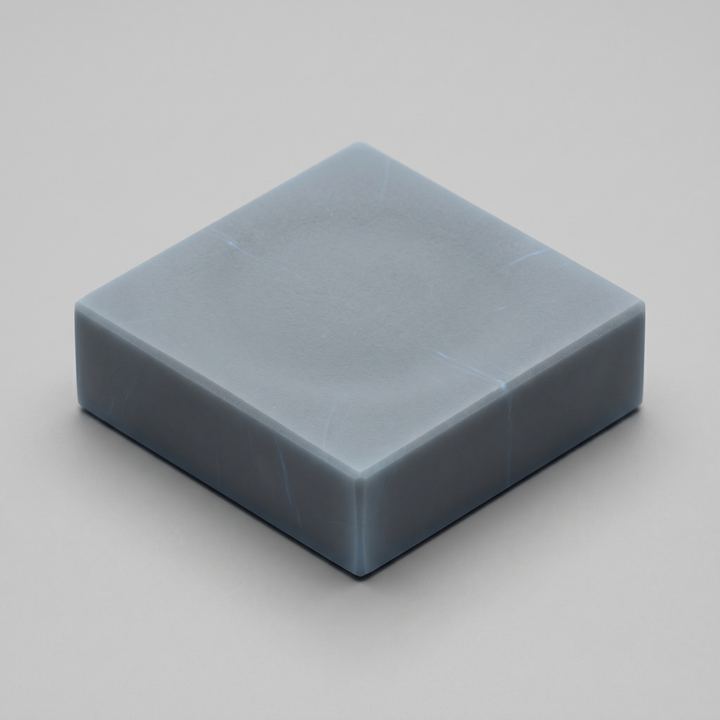
The body reads a cool grey-blue — gadolinium's pale matrix cooled further by the vanadium dopant, with a slight violet undertone along shadow edges that distinguishes it from the more mineral neodymium sibling in this batch. At 7.32 g/cm³ and 70×70×28 mm the slab is heavy for its size, two-handed off the bench and closer to a dense architectural stone than to a standard fired tile. Skin is vitrified matte from the 1200 °C fire, the glaze-edge sheen not quite crossing into full gloss. Edges cold-cut, kerf powder-whitened. Under 365 nm UV the face shifts to a warm orange glow — the camera wants both states.
Recipe
100 g batch · peak 1200 °C| element | precursor | formula | mass | safety |
|---|---|---|---|---|
| Gd | gadolinium oxide | Gd2O3 | 93.31 g | moderate |
| V | vanadium pentoxide | V2O5 | 6.69 g | moderate |
- 1Ramp
- 2Hold
- 3Ramp
- 4Ramp
- 5Hold
- 6Ramp
- 7Ramp
UV-luminescent — emits visible light under 365 nm UV
Visible absorber — saturated color from bandgap in the visible range