Mn₄Na₈O₂₀Si₆
alkali silicate glass · structural translucent glassMn4Na8O20Si6 is a alkali silicate glass suitable as structural translucent glass. Color: purple-brown. Fired at 1150°C from 4 precursors (Na2CO3, SiO2, MnO2). Workshop batch: 400g at €4.05. Compressive strength ~500 MPa; estimated 0.84 kg CO₂/kg (-2% vs float glass). Notable: no special functions flagged. Confidence: high.
- forms at
- 1150 °C · high-fire
- replaces
- float glass
- CO₂
- 1.9% lower than float glass (0.84 vs 0.86 kg CO₂/kg)
- energy
- 62.5% lower than float glass (5.62 vs 15.00 MJ/kg)
- compressive
- 500 MPa
- density
- 2.96 g/cm³
- crystal
- monoclinic
- band gap
- 2.42 eV
- cost
- €10.12/kg · €4.05 / 400 g batch
- confidence
- high (synthesis route)
- potential
- 0.68 · env 0.78 · novel 0.00 · struct 1.00 · lineage 1.00 · supply 1.00
Architectural potential
A manganese-modified soda-silicate glass fired at 1150 °C, carrying 500 MPa of compressive strength and the full supply-chain and safety scores of ordinary float-glass practice. Embodied CO₂ is within two per cent of float, but the energy overhead runs sixty-two per cent lower thanks to the manganese flux depressing the working temperature. That combination places this glass directly in the structural-translucent register against float: pressed stair treads in a gallery mezzanine, floor panels walked on from above in a reading-room mezzanine, transparent partitions in an operating-theatre ante-room where a tinted purple-brown filter is wanted without adding a separate interlayer, light wells above a cloistered courtyard, and column-like light-admitting piers for a pavilion where the tinted body reads as built colour rather than applied film. The HIGH-confidence rating on the compression figure and the full supply-chain score make this one of the more specifiable translucent structural candidates in the atlas. The caveat is colour commitment: the purple-brown body is intrinsic to the manganese loading, not an interlayer, so a specification sees the tint everywhere — edges, crown, entire footprint — and cannot be reversed in fabrication.
Material character
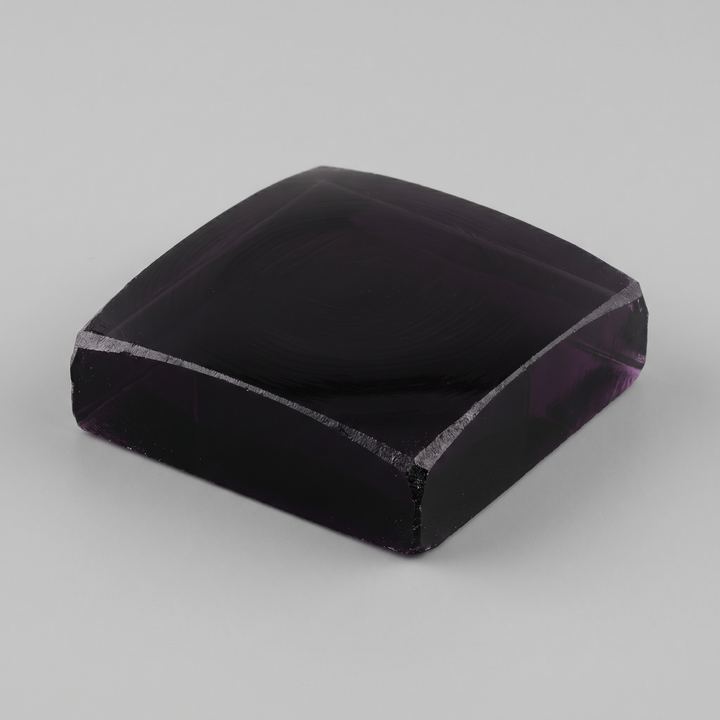
A purple-brown transmitted face with amber undertones where the slab thickens along the 47 mm edge — manganese-stained glass in the historical sense, shifted warmer by the soda-silicate host. Fully translucent rather than transparent: silhouettes read through, detail does not. At 2.96 g/cm³ and 85×85×47 mm the slab is firm two-handed, lighter than the borosilicate family at the same footprint. Surface carries the pressed-glass striation — three faint anneal lines close to one long edge — and the crown sits under a low convex rise. Edges cold-cut, lapidary-bloomed. Against ordinary float the body is thicker, warmer, and holds its own under side-lighting.
Recipe
400 g batch · peak 1150 °C| element | precursor | formula | mass | safety |
|---|---|---|---|---|
| Mn | manganese dioxide | MnO2 | 30.72 g | moderate |
| Na | sodium carbonate / soda ash | Na2CO3 | 37.45 g | safe |
| Si | quartz flour / silica | SiO2 | 31.84 g | safe |
- 1Ramp
- 2Hold
- 3Ramp
- 4Hold
- 5Ramp
- 6Hold