Ca₁₆O₄₈P₈Si₄Sr₄
calcium phosphate · bioceramic whiteCa16O48P8Si4Sr4 is a calcium phosphate suitable as bioceramic-white. Color: white. Fired at 1100°C from 4 precursors (CaCO3, Ca3(PO4)2, SrCO3). Workshop batch: 500g at €11.93. Compressive strength ~100 MPa; estimated 0.82 kg CO₂/kg (-1% vs Portland cement). Notable: bioactive. Confidence: medium.
- forms at
- 1100 °C · high-fire
- replaces
- portland cement
- CO₂
- 0.6% lower than Portland cement (0.82 vs 0.83 kg CO₂/kg)
- energy
- matches Portland cement (5.50 MJ/kg)
- compressive
- 100 MPa
- density
- 3.19 g/cm³
- crystal
- orthorhombic
- band gap
- —
- cost
- €23.86/kg · €11.93 / 500 g batch
- confidence
- medium (synthesis route)
- potential
- 0.46 · env 0.01 · novel 0.80 · struct 0.20 · lineage 0.80 · supply 0.70
- flags
- bioactive: Actively hosts or supports biological activity on its surface. Bioreceptive cladding for moss and lichen, soil-contact interfaces that do not sterilise their neighbours, health-interior surfaces tuned for microbiome balance.
Architectural potential
A strontium-doped calcium phosphate-silicate tuned for the living-surface register — a bone- and tissue-compatible ceramic with an active surface that does not reject biological contact. The architectural argument sits on the living-surface potential: walls that host microflora, floors that support root anchors in interior planting, courtyard linings that invite colonisation rather than sterilising their edges, and healthcare interiors where the skin of the building is understood as a contact zone for the human microbiome rather than a chemical barrier. Natural placements are clinical-interior wall tiles in hospitals and operating-theatre support areas, bioreceptive cladding on north-facing walls in humid courtyards where moss and lichen are wanted, planter-linings in roof-gardens, and threshold plaques in healthcare architecture where the first touch wants to be tissue-friendly rather than antiseptic. Against Portland cement the embodied CO₂ is effectively flat and the firing energy matches exactly, so the environmental argument is neutral; the case for this material is biological rather than carbonaceous. The 100 MPa compression and two-kilogram workshop ceiling suit tile and panel-insert scale, not structural use. The caveat is fire discipline: 1100 °C peak keeps it in a ceramic-capable kiln, and the apatite-silicate chemistry needs a verified firing profile to preserve the bioactive surface — an under-fire or over-fire shifts the surface chemistry and kills the biological argument.
Material character
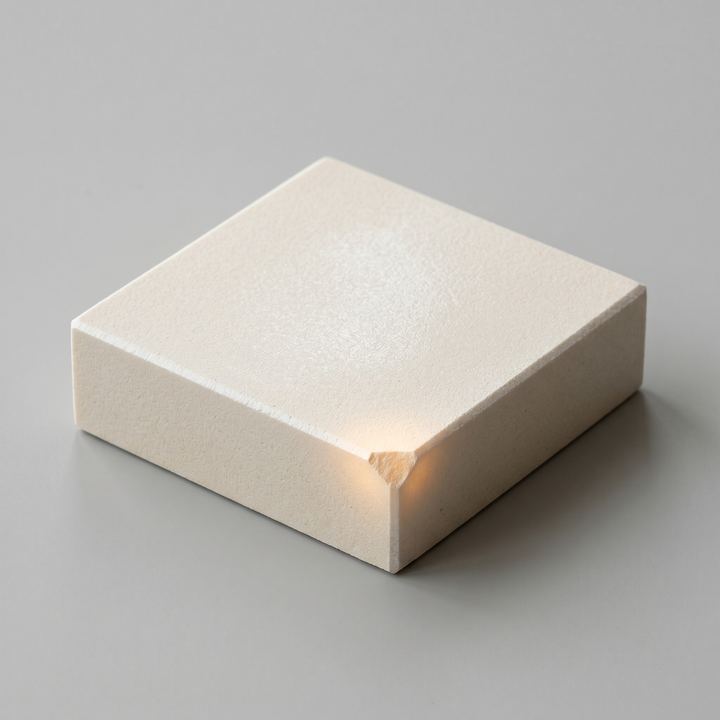
The 85×85×43 mm slab reads a clean bone-white with the faint pearl cast typical of a strontium-substituted apatite — a specific biological-ceramic signature, cooler than a calcium-only white and subtly warmer than a pure hydroxyapatite. Surface vitrified-matte from the 1100 °C fire with a microscopic porosity that reads as a slight velvet under raking light — the texture that hosts biological colonisation. Edges cold-cut, kerf-whitened. At 3.19 g/cm³ the slab lifts two-handed with a firm grip — close to a conventional stoneware tile register, lighter in hand than the denser rare-earth siblings and heavier than a porous terracotta of the same footprint. Rings bright and clean under a tap.
Recipe
500 g batch · peak 1100 °C| element | precursor | formula | mass | safety |
|---|---|---|---|---|
| Ca | calcium carbonate / limestone | CaCO3 | 43.6 g | safe |
| P | tricalcium phosphate | Ca3(PO4)2 | 33.78 g | safe |
| Si | quartz flour / silica | SiO2 | 6.54 g | safe |
| Sr | strontium carbonate | SrCO3 | 16.08 g | safe |
- 1Ramp
- 2Hold
- 3Ramp
- 4Hold
- 5Ramp
- 6Hold
Bioactive — biocompatible, antibacterial (Cu-doped silicocarnotite)