Ca₈La₂OSi₆
calcium silicate · cement alternativeCa8La2O1Si6 is a calcium silicate suitable as cement-alternative. Color: white-grey. Fired at 1100°C from 3 precursors (CaCO3, SiO2, La2O3). Workshop batch: 1000g at €24.23. Compressive strength ~50 MPa; estimated 0.68 kg CO₂/kg (-19% vs Portland cement). Notable: no special functions flagged. Confidence: high.
- forms at
- 1100 °C · high-fire
- replaces
- portland cement
- CO₂
- 18.7% lower than Portland cement (0.68 vs 0.83 kg CO₂/kg)
- energy
- 18.2% lower than Portland cement (4.50 vs 5.50 MJ/kg)
- compressive
- 50 MPa
- density
- 2.95 g/cm³
- crystal
- orthorhombic
- band gap
- 0.01 eV
- cost
- €24.23/kg · €24.23 / 1000 g batch
- confidence
- high (synthesis route)
- potential
- 0.35 · env 0.23 · novel 0.00 · struct 0.15 · lineage 0.70 · supply 1.00
Architectural potential
A calcium-silicate binder in the post-Portland workshop register, close in chemistry to the atlas's flagship Portland-substitute but distinct in two ways: the lanthanum content drives a cleaner white-grey colour and the strength register sits at 50 MPa rather than 500. That lower compression puts this firmly in the screed, mortar and thin-panel role rather than in the slab-and-block role. The nineteen-per-cent CO₂ cut against Portland is modest but real and comes with the full workshop infrastructure of a familiar binder: pour like concrete, form like concrete, cure like concrete, fire once at 1100 °C. Natural placements are floor-topping screeds in gallery and retail retrofit, non-reinforced pavilion-wall infills, thin cladding panels on prefab façades, repair mortars in masonry restoration, and garden-wall blocks where the clean white-grey reads as part of the project surface. The lanthanum gives the body a slightly brighter, colder tone than a pure calcium-silicate, which changes the architectural conversation — this is a pigmented binder by chemistry rather than by additive. The 1 kg batch scaling to 5 kg gives it real workshop viability for panel-scale work. The caveat is cost: €24.23 per 1 kg batch is nearly six times the cost of the manganese-silicate variant, and the lanthanum pushes supply-chain logistics past the ordinary cement-replacement workshop.
Material character
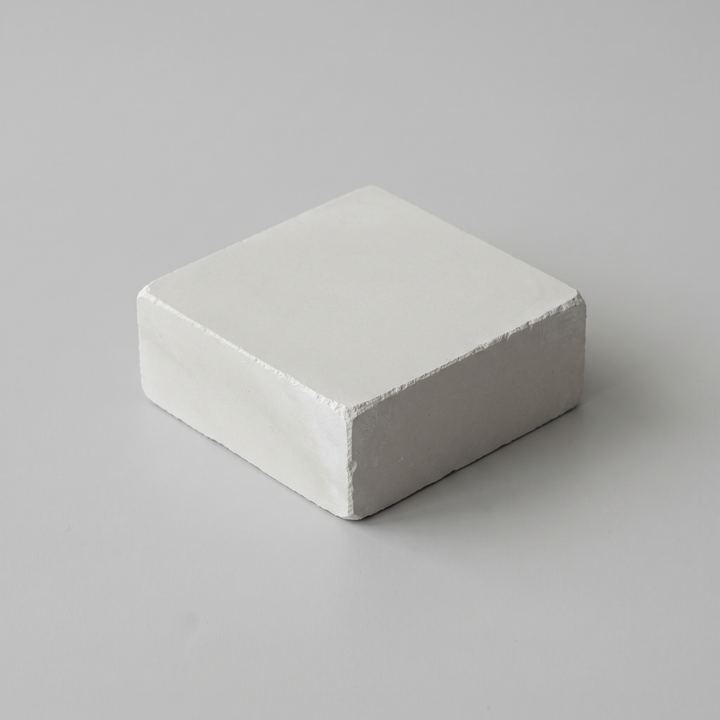
The slab reads a clean white-grey with a faint cool undertone from the lanthanum content — whiter than the manganese-silicate sibling, cooler than a Portland grey, closer in first reading to a high-grade plaster or a fine lime render. At 2.95 g/cm³ and 85×85×47 mm the tile lifts with a steady two-hand grip at the full kilo weight, handling closer to a fired porcelain than to a stone. Surface finishes vitrified-matte from the 1100 °C fire, with a fine even grain that holds light softly; edges cold-cut, kerf-whitened. The colour runs uniformly through the slab so cut edges read the same white-grey as the face.
Recipe
1000 g batch · peak 1100 °C| element | precursor | formula | mass | safety |
|---|---|---|---|---|
| Ca | calcium carbonate / limestone | CaCO3 | 53.85 g | safe |
| La | lanthanum oxide | La2O3 | 21.91 g | moderate |
| Si | quartz flour / silica | SiO2 | 24.24 g | safe |
- 1Ramp
- 2Hold
- 3Ramp
- 4Hold
- 6Ramp
- 7Hold