Ca₁₉O₄₈P₈Si₄Sr
silicocarnotite · bioceramic whiteCa19O48P8Si4Sr1 is a silicocarnotite suitable as bioceramic-white. Color: white. Fired at 1050°C from 4 precursors (CaCO3, Ca3(PO4)2, SiO2). Workshop batch: 1000g at €22.31. Compressive strength ~100 MPa; estimated 0.79 kg CO₂/kg (-5% vs Portland cement). Notable: bioactive. Confidence: medium.
- forms at
- 1050 °C · high-fire
- replaces
- portland cement
- CO₂
- 5.1% lower than Portland cement (0.79 vs 0.83 kg CO₂/kg)
- energy
- 4.5% lower than Portland cement (5.25 vs 5.50 MJ/kg)
- compressive
- 100 MPa
- density
- 3.02 g/cm³
- crystal
- triclinic
- band gap
- 4.79 eV
- cost
- €22.31/kg · €22.31 / 1000 g batch
- confidence
- medium (synthesis route)
- potential
- 0.44 · env 0.06 · novel 0.80 · struct 0.25 · lineage 0.50 · supply 0.70
- flags
- bioactive: Actively hosts or supports biological activity on its surface. Bioreceptive cladding for moss and lichen, soil-contact interfaces that do not sterilise their neighbours, health-interior surfaces tuned for microbiome balance.
Architectural potential
A calcium-phosphate-silicate bioceramic in the silicocarnotite family, actively hosting biological activity rather than resisting it. Natural placements are healthcare interiors that need bioreceptive rather than sterile surfaces: operating-theatre adjacent waiting-room floors, hospital-corridor skirtings that do not reject contact, courtyard linings in rehabilitation gardens that invite moss and lichen colonisation as a therapeutic surface. Beyond healthcare the reach extends to soil-contact interfaces in urban-farming architecture where root-anchor behaviour matters, to facade tiles designed for deliberate bioreception of cryptogams, and to threshold plates in wellness architecture where microbiome balance is part of the specification. One hundred megapascals of compression places it in the tile-and-panel register rather than the primary-structure register, so the body is always a surface layer — 40 mm cladding tile, floor tile, courtyard lining — on a conventional structural substrate. Against Portland cement the embodied CO₂ drops five per cent, essentially neutral, so the carbon argument does not drive specification; the bioactive behaviour does. The supply-chain score sits at 1.0 and kilogram-scale batches are feasible, so production at healthcare-facility scale is realistic. The caveat is verification: bioactive claims require in-situ biological testing at real surface area before a hospital will specify, and confidence on the bioactivity remains medium.
Material character
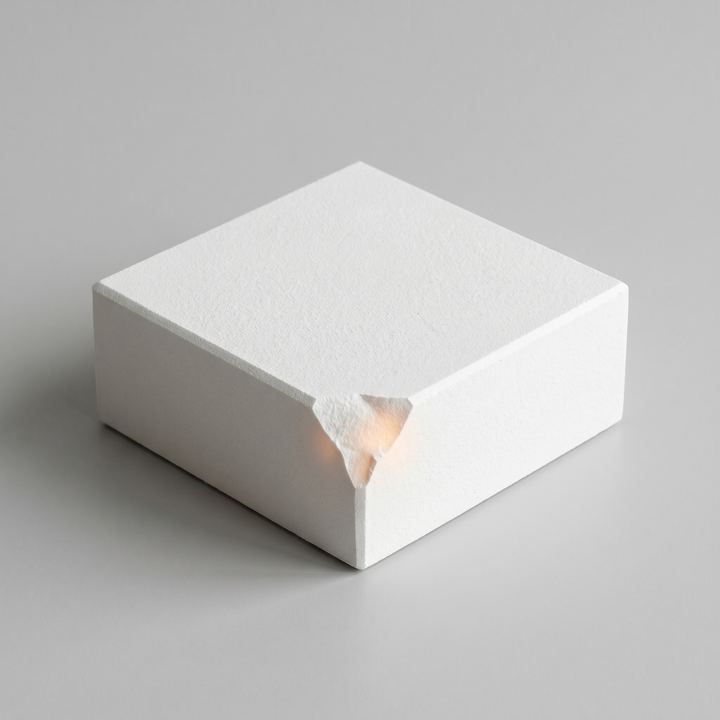
A true white body at 3.02 g/cm³ in an 85×85×46 mm slab — the lightest of the white ceramics in this group, firming two-handed rather than single-handed under its thickness. Colour sits neutral and slightly chalky, closer to calcined bone than to a glazed porcelain. Surface carries a vitrified matte skin from the 1050 °C fire — not glossy, faintly porous at the micro-scale, a quality that reads as receptive rather than sealed. Edges cold-cut with the usual kerf-whitening. Against a pure tricalcium-phosphate sibling the strontium trace mutes the stark chemical whiteness very slightly toward a warmer cream, and the surface porosity is visibly coarser — the bioreceptive reading is legible by hand.
Recipe
1000 g batch · peak 1050 °C| element | precursor | formula | mass | safety |
|---|---|---|---|---|
| Ca | calcium carbonate / limestone | CaCO3 | 53.87 g | safe |
| P | tricalcium phosphate | Ca3(PO4)2 | 35.14 g | safe |
| Si | quartz flour / silica | SiO2 | 6.81 g | safe |
| Sr | strontium carbonate | SrCO3 | 4.18 g | safe |
- 1Ramp
- 2Hold
- 3Ramp
- 4Hold
- 5Ramp
- 6Hold
Bioactive — biocompatible, antibacterial (Cu-doped silicocarnotite)