Nd₈O₂₄Ru₃V
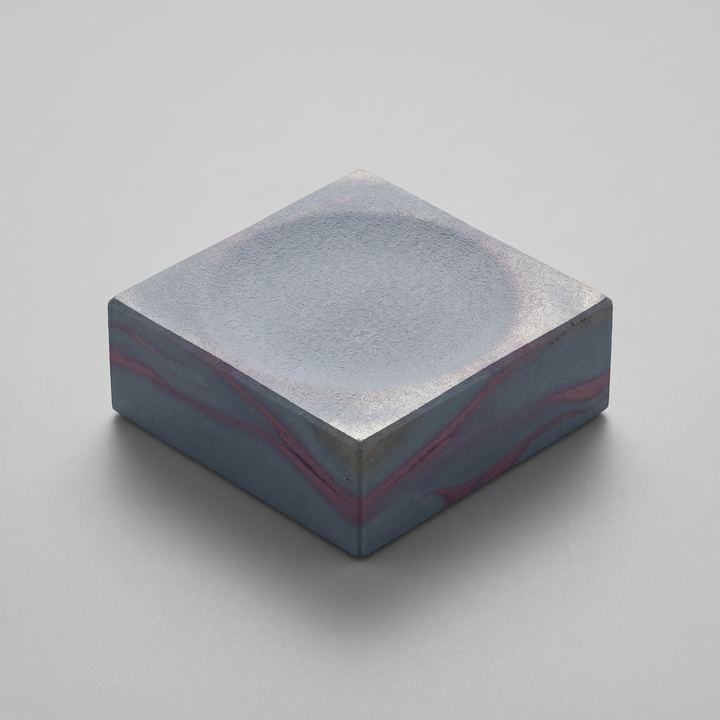
rare earth oxide · rare earth ceramicNd8O24Ru3V1 is a rare earth oxide suitable as rare earth ceramic. Color: grey-blue. Fired at 1200°C from 2 precursors (Nd2O3, V2O5). Workshop batch: 100g at €14.74. Compressive strength ~100 MPa; estimated 0.90 kg CO₂/kg (+309% vs clay brick). Notable: thermochromic VO2. Confidence: medium.
- forms at
- 1200 °C · high-fire
- replaces
- clay brick
- CO₂
- 309% higher than clay brick (0.90 vs 0.22 kg CO₂/kg; 4.1× higher)
- energy
- 100% higher than clay brick (6.00 vs 3.00 MJ/kg; 2.0× higher)
- compressive
- 100 MPa
- density
- 6.05 g/cm³
- crystal
- triclinic
- band gap
- 0.00 eV
- cost
- €147.40/kg · €14.74 / 100 g batch
- confidence
- medium (synthesis route)
- potential
- 0.34 · env 0.00 · novel 0.90 · struct 0.20 · lineage 0.50 · supply 0.09
- flags
- thermochromic VO2: Passive thermal-optical switching: transmission shifts near 68 °C without any driving signal. At building scale this gives a window that darkens as it heats, reducing solar gain without wiring or sensors.
Architectural potential
A neodymium-ruthenate rare-earth ceramic whose primary architectural argument is the thermochromic vanadium-dioxide behaviour rather than mass. At 100 MPa compression and 309 per cent higher embodied CO₂ than fired clay brick, bulk use is forbidden, and the specification has to be paid for by the passive thermal-optical signal: above 68 °C the vanadium site shifts from semiconductor to metal and the body darkens visibly; cooling back through the threshold, it clears. Natural placements are small-area overlays on conventional glazing or stone cladding where the self-regulating signal is the point: south-facing solar-gain tiles around skylight perimeters, greenhouse and conservatory inserts that cloud as the afternoon heats, ceiling tile patches in atria that shift tone through the day, active thermal markers in south-elevation bath-house architecture. Against fired clay brick the argument is not volume but capability — the surface reports its own heat, without wiring or sensors, a building that reads itself. The caveat is reach and supply: 100 g per batch, 300 g workshop ceiling, a 1200 °C fire, and a supply-chain score of 0.14 from neodymium and ruthenium availability. Specification belongs to the thermally-active accent patch, never the cladding run.
Material character
At room temperature the slab reads a cool, desaturated grey-blue with faint violet undertones from the neodymium content — a specific rare-earth signature, lighter in cast than the deeper vanadium-titanate perovskite blues. At 6.05 g/cm³ in a 70×70×34 mm piece, the slab lifts two-handed and sits heavier than its dimensions suggest, closer in register to architectural stone than to conventional sintered tile. Skin matte from the sinter; edges cold-cut, diamond-saw powder whitening the kerf. Fully opaque through the full depth. The room-temperature state is the base reading; a heated companion shot across the 68 °C threshold belongs alongside it to record the darkening transition.
Recipe
100 g batch · peak 1200 °C| element | precursor | formula | mass | safety |
|---|---|---|---|---|
| Nd | neodymium oxide | Nd2O3 | 93.67 g | moderate |
| V | vanadium pentoxide | V2O5 | 6.33 g | moderate |
- 1Ramp
- 2Hold
- 3Ramp
- 4Ramp
- 5Hold
- 6Ramp
- 7Ramp
Thermochromic — VO₂ metal-insulator switch at ~68 °C