Ca₂LaNdO₁₂V₄
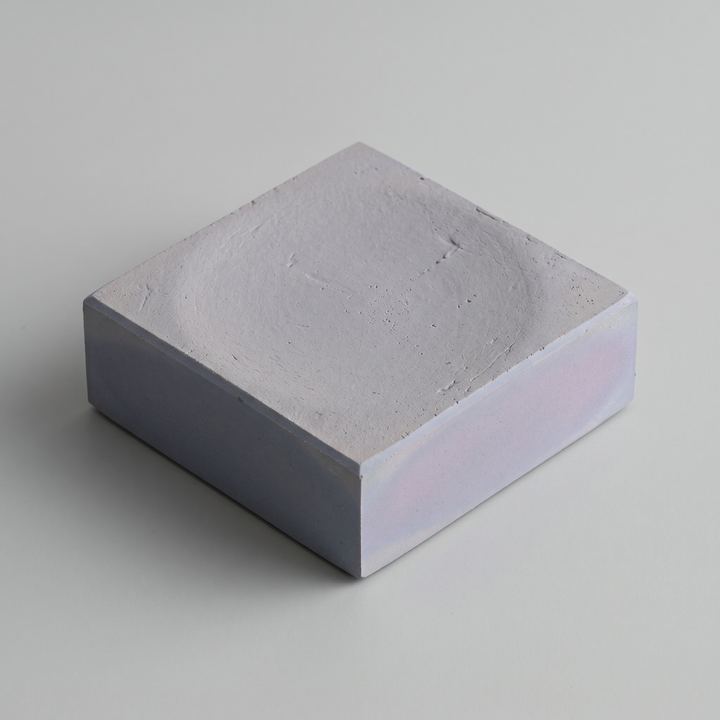
rare earth oxide · rare earth ceramicCa2La1Nd1O12V4 is a rare earth oxide suitable as rare earth ceramic. Color: grey-blue. Fired at 1200°C from 4 precursors (V2O5, CaCO3, Nd2O3). Workshop batch: 100g at €10.36. Compressive strength ~100 MPa; estimated 0.90 kg CO₂/kg (+309% vs clay brick). Notable: thermochromic VO2. Confidence: medium.
- forms at
- 1200 °C · high-fire
- replaces
- clay brick
- CO₂
- 309% higher than clay brick (0.90 vs 0.22 kg CO₂/kg; 4.1× higher)
- energy
- 100% higher than clay brick (6.00 vs 3.00 MJ/kg; 2.0× higher)
- compressive
- 100 MPa
- density
- 5.29 g/cm³
- crystal
- monoclinic
- band gap
- 0.80 eV
- cost
- €103.60/kg · €10.36 / 100 g batch
- confidence
- medium (synthesis route)
- potential
- 0.34 · env 0.00 · novel 0.90 · struct 0.20 · lineage 0.50 · supply 0.10
- flags
- thermochromic VO2: Passive thermal-optical switching: transmission shifts near 68 °C without any driving signal. At building scale this gives a window that darkens as it heats, reducing solar gain without wiring or sensors.
Architectural potential
A rare-earth ceramic with a thermochromic vanadium-dioxide overlay: above sixty-eight degrees celsius the V-site flips and the body darkens visibly, returning below that threshold. The lanthanum-neodymium pair gives the body a colder, more mineral blue than the strontium variants and deepens the contrast between the two thermal states. This is a self-sensing passive tile — no wiring, no driver — and its architectural argument is that a single small-area element replaces a wiring-plus-sensor-plus-shading assembly. Natural placements are south-facing greenhouse glazing inserts where the tile darkens through the midday hours and clears at evening, rooftop skylight perimeter tiles that signal solar-gain events to occupants below, and atrium ceiling patches in gallery roofs where the state-shift becomes part of the diurnal spatial reading. Compression at 100 MPa keeps the material firmly in the overlay register. The three-hundred-per-cent CO₂ cost against clay brick means the piece is bought for the behaviour, not for volume — it is a small-area passive sensor carried in ceramic form. The caveat is rarity and scale: €10.36 per 100 g batch, 300 g workshop maximum, supply-chain score near zero, and untested at repeated-tile scale in architectural production. Specification belongs to prototype solar-control tile arrays and one-off pavilion work.
Material character
At room temperature the body reads a cool grey-blue with a faint mauve cast from the neodymium — a mineral blue, closer to slate than to cobalt, distinct from the vanadium-titanate blues elsewhere in the palette. At 5.29 g/cm³ and 70×70×39 mm the slab handles with rare-earth heaviness for its small footprint, a firm two-finger lift. Surface finishes sintered matte from the 1200 °C hold, the grain fine and even; edges cold-cut with diamond-saw kerf along the arris. Past the 68 °C transition the face darkens to a near-charcoal slate, uniformly across the body, with no patchiness at the phase boundary.
Recipe
100 g batch · peak 1200 °C| element | precursor | formula | mass | safety |
|---|---|---|---|---|
| Ca | calcium carbonate / limestone | CaCO3 | 22.36 g | safe |
| La | lanthanum oxide | La2O3 | 18.2 g | moderate |
| Nd | neodymium oxide | Nd2O3 | 18.8 g | moderate |
| V | vanadium pentoxide | V2O5 | 40.64 g | moderate |
- 1Ramp
- 2Hold
- 3Ramp
- 4Ramp
- 5Hold
- 6Ramp
- 7Ramp
Thermochromic — VO₂ metal-insulator switch at ~68 °C