Ca₄Fe₂Mn₂O₁₆Si₄
calcium silicate · cement alternativeCa4Fe2Mn2O16Si4 is a calcium silicate suitable as cement-alternative. Color: purple-brown. Fired at 1100°C from 4 precursors (CaCO3, SiO2, Fe2O3). Workshop batch: 1000g at €4.59. Compressive strength ~50 MPa; estimated 0.68 kg CO₂/kg (-19% vs Portland cement). Notable: no special functions flagged. Confidence: medium.
- forms at
- 1100 °C · high-fire
- replaces
- portland cement
- CO₂
- 18.7% lower than Portland cement (0.68 vs 0.83 kg CO₂/kg)
- energy
- 18.2% lower than Portland cement (4.50 vs 5.50 MJ/kg)
- compressive
- 50 MPa
- density
- 3.41 g/cm³
- crystal
- monoclinic
- band gap
- 2.64 eV
- cost
- €4.59/kg · €4.59 / 1000 g batch
- confidence
- medium (synthesis route)
- potential
- 0.30 · env 0.23 · novel 0.00 · struct 0.15 · lineage 0.80 · supply 0.60
Architectural potential
A calcium-iron-manganese silicate tuned as a low-CO₂ binder in the post-Portland workshop register — same pouring, same formwork, with an eighteen-per-cent cut in embodied carbon against ordinary Portland cement. Fifty megapascals of compression is the real number to design with: it rules out reinforced primary-structure use but sits comfortably in mortars, screeds, repair patches, non-reinforced slab-work, thermal-wall infills, prefabricated cladding panels, and landscape walls. Natural placements are garden-room plinths, courtyard paving in heritage contexts where a mineral register close to the original mortar is wanted, cladding panels for pavilion architecture, and floor toppings in retrofit where the existing structure carries the load and the topping only has to wear. The kilogram batch size and five-kilogram workshop ceiling make panel-size pours feasible without specialist equipment, and the 1.0 supply-chain score confirms all precursors sit inside standard ceramic procurement. Against an ambient binder the trade is honest: this material pays for its structural performance with 1100 °C of firing energy, so the kiln-free argument does not apply. The caveat is safety: the manganese and iron precursor dusts require respiratory protection at mix stage, pushing fabrication closer to a supervised ceramic studio than to an open site-cast operation.
Material character
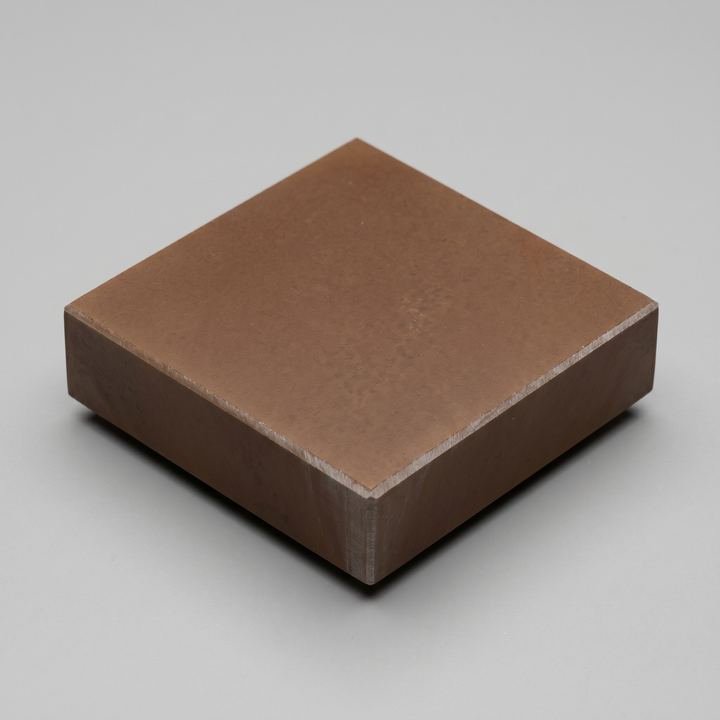
The 85×85×41 mm slab reads a warm purple-brown, manganese driving a dominant mulberry tone while the iron contributes rust-red shadow edges — closer in register to a dense engineering brick than to a grey concrete pour. Surface finishes vitrified-matte from the 1100 °C fire, with a faint glaze-threshold sheen where the calcium-silicate flux approached partial melt. Edges cold-cut, kerf-whitened, showing the transition from coloured body to the paler sub-surface. At 3.41 g/cm³ the slab resists a one-handed lift — firmer in hand than a Portland concrete sibling of the same footprint, and rings noticeably cleaner and higher under the tap than a grey-cement sample.
Recipe
1000 g batch · peak 1100 °C| element | precursor | formula | mass | safety |
|---|---|---|---|---|
| Ca | calcium carbonate / limestone | CaCO3 | 41.09 g | safe |
| Fe | iron(III) oxide (red) | Fe2O3 | 16.39 g | safe |
| Mn | manganese dioxide | MnO2 | 17.85 g | moderate |
| Si | quartz flour / silica | SiO2 | 24.67 g | safe |
- 1Ramp
- 2Hold
- 3Ramp
- 4Hold
- 6Ramp
- 7Hold