Er₂Fe₂O₁₂Te₂
rare earth oxide · rare earth ceramicEr2Fe2O12Te2 is a rare earth oxide suitable as rare earth ceramic. Color: amber-brown. Fired at 1200°C from 2 precursors (Er2O3, Fe2O3). Workshop batch: 100g at €77.18. Compressive strength ~100 MPa; estimated 0.90 kg CO₂/kg (+309% vs clay brick). Notable: uv luminescent, visible absorber. Confidence: medium.
- forms at
- 1200 °C · high-fire
- replaces
- clay brick
- CO₂
- 309% higher than clay brick (0.90 vs 0.22 kg CO₂/kg; 4.1× higher)
- energy
- 100% higher than clay brick (6.00 vs 3.00 MJ/kg; 2.0× higher)
- compressive
- 100 MPa
- density
- 6.54 g/cm³
- crystal
- trigonal
- band gap
- 2.50 eV
- cost
- €771.80/kg · €77.18 / 100 g batch
- confidence
- medium (synthesis route)
- potential
- 0.36 · env 0.00 · novel 1.00 · struct 0.20 · lineage 0.50 · supply 0.05
- flags
- uv luminescent: Converts invisible ultraviolet into visible light. Signage panels, low-energy wayfinding tiles, emergency markings that draw their illumination from daylight rather than mains power. visible absorber: A real-colour solar-gain control layer. Where the body takes visible light into itself rather than reflecting it, the material becomes a selective heat collector — useful on thermal-mass walls, absorber panels, and warm-toned cladding.
Architectural potential
An erbium-iron-tellurium rare-earth oxide fired at 1200 °C, carrying 100 MPa of compression and two stacked optical functions — a visible-absorber body and an ultraviolet-luminescent surface. The CO₂ runs at four times that of a fired clay brick, and at €77.18 per 100 g the material is among the most expensive in the atlas, so specification is reserved for accent-scale work where the two functions are designed to be read. The erbium fraction shifts invisible UV into the visible band, producing a panel that draws its own illumination from daylight and glows at dusk without mains power. Natural placements are emergency wayfinding tiles in evacuation corridors where mains supply is not guaranteed, signage panels in museum and library interiors where the UV response becomes a ritual of twilight, accent border courses in garden walls catching evening UV, and luminescent thresholds in memorial architecture. The amber-brown body means the daytime presence is warm and opaque rather than thin and glassy. The caveat is rarity and batch ceiling: 100 g per batch, a 300 g workshop ceiling, a supply-chain score at 0.14, and erbium availability tied to heavy-rare-earth mining geopolitics that architectural specification cannot smooth over.
Material character
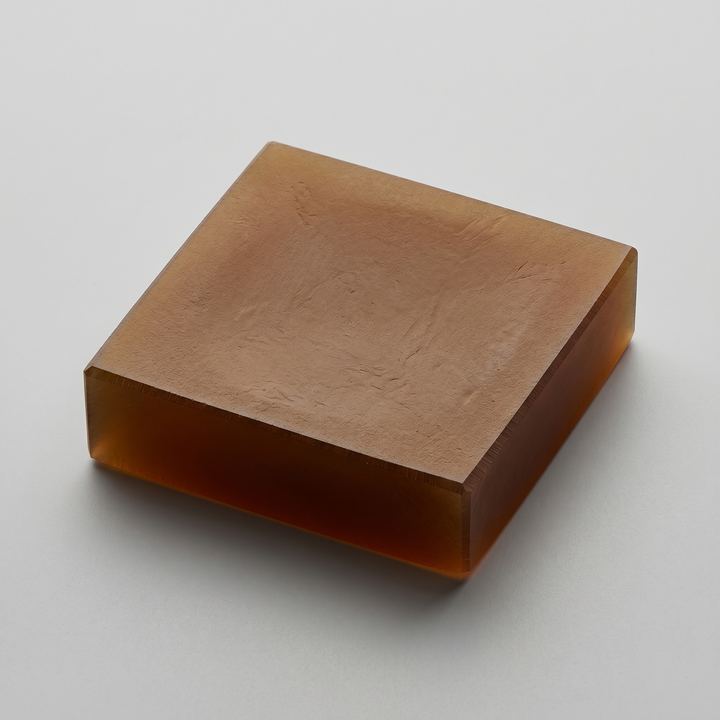
The slab reads a deep amber-brown by day, its 2.50 eV absorption edge giving the body a warmth closer to smoked amber than to clay-brick red. At 6.54 g/cm³ in a 70×70×31 mm format the piece is heavy for its thinness, a deliberate two-handed bench lift that outweighs its clay-brick analog clearly. Surface vitrified matte from the 1200 °C fire; edges cold-cut, the diamond-saw kerf powder left pale along the rim. Under 365 nm excitation the body emits a soft green-amber glow through the top face. Against the La-Mn-W-Y heavy-oxide sibling the erbium signature is immediately the brighter, more specific optical read.
Recipe
100 g batch · peak 1200 °C| element | precursor | formula | mass | safety |
|---|---|---|---|---|
| Er | erbium oxide | Er2O3 | 70.55 g | moderate |
| Fe | iron(III) oxide (red) | Fe2O3 | 29.45 g | safe |
- 1Ramp
- 2Hold
- 3Ramp
- 4Ramp
- 5Hold
- 6Ramp
- 7Ramp
UV-luminescent — emits visible light under 365 nm UV
Visible absorber — saturated color from bandgap in the visible range