Ca₂O₂₆Pr₂Si₆Y₆
rare earth oxide · rare earth ceramicCa2O26Pr2Si6Y6 is a rare earth oxide suitable as rare earth ceramic. Color: neutral. Fired at 1200°C from 4 precursors (Y2O3, SiO2, Pr6O11). Workshop batch: 100g at €10.67. Compressive strength ~50 MPa; estimated 0.90 kg CO₂/kg (+309% vs clay brick). Notable: uv luminescent. Confidence: medium.
- forms at
- 1200 °C · high-fire
- replaces
- clay brick
- CO₂
- 309% higher than clay brick (0.90 vs 0.22 kg CO₂/kg; 4.1× higher)
- energy
- 100% higher than clay brick (6.00 vs 3.00 MJ/kg; 2.0× higher)
- compressive
- 50 MPa
- density
- 4.56 g/cm³
- crystal
- hexagonal
- band gap
- 4.74 eV
- cost
- €106.70/kg · €10.67 / 100 g batch
- confidence
- medium (synthesis route)
- potential
- 0.32 · env 0.00 · novel 0.50 · struct 0.10 · lineage 0.50 · supply 0.70
- flags
- uv luminescent: Converts invisible ultraviolet into visible light. Signage panels, low-energy wayfinding tiles, emergency markings that draw their illumination from daylight rather than mains power.
Architectural potential
A yttrium-praseodymium silicate with UV-luminescent behaviour — the compression capacity drops to 50 MPa, so this material sits firmly outside any structural argument and belongs entirely to the surface and inlay register. Against clay brick the embodied CO₂ is four times higher, but the supply-chain score is 1.0 — yttrium and praseodymium precursors are commercially available — so the specification case is less rare than the thulium-bearing sibling. Natural placements are single-tile luminescent accents: wayfinding inlays at stair nosings, emergency egress patches along corridor thresholds, signage letterforms in museum and memorial interiors, low-power night markings in ritual and contemplative architecture where the praseodymium emission reads as a held glow rather than an illumination. The neutral body colour is an architectural argument in itself: unlike the purple-brown Mn-Pr-Se sibling or the grey-blue Sr-Tm-V cousin, this tile reads as a plain ceramic in daylight and reveals its luminescent behaviour only under UV excitation. The surprise is deliberate. Workshop batch reaches 100 g at a 300 g maximum, and €10.67 per batch is relatively modest by rare-earth oxide standards. The caveat is compression: 50 MPa forbids any walked-on or load-bearing specification, so placement must remain on wall and tile-inlay surfaces, not on floor or tread.
Material character
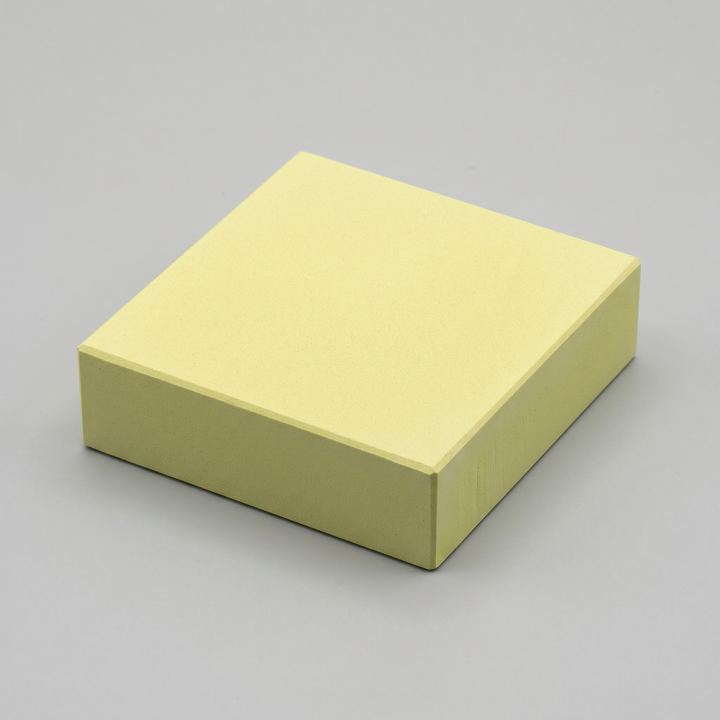
A neutral off-white body that reads as a plain fired silicate tile in daylight — the praseodymium oxide content is dilute enough that the usual pale-green rare-earth cast is suppressed, leaving a body close to ordinary stoneware colour. At 4.558 g/cm³ and 85×85×30 mm the slab sits firmly in the single-hand lift, close to a dense architectural tile in weight register. Surface reads vitrified matte with the fine grain of a well-sintered oxide body; edges come cold-cut with a clean white kerf bloom. Under 365 nm UV the emission lifts quietly from inside the face — a soft held glow rather than a bright signal, the camera's challenge rather than its gift.
Recipe
100 g batch · peak 1200 °C| element | precursor | formula | mass | safety |
|---|---|---|---|---|
| Ca | calcium carbonate / limestone | CaCO3 | 12.68 g | safe |
| Pr | praseodymium oxide | Pr6O11 | 21.57 g | moderate |
| Si | quartz flour / silica | SiO2 | 22.84 g | safe |
| Y | yttrium oxide | Y2O3 | 42.91 g | moderate |
- 1Ramp
- 2Hold
- 3Ramp
- 4Ramp
- 5Hold
- 6Ramp
- 7Ramp
UV-luminescent — emits visible light under 365 nm UV