Fe₅O₂₄P₆Sr₂W
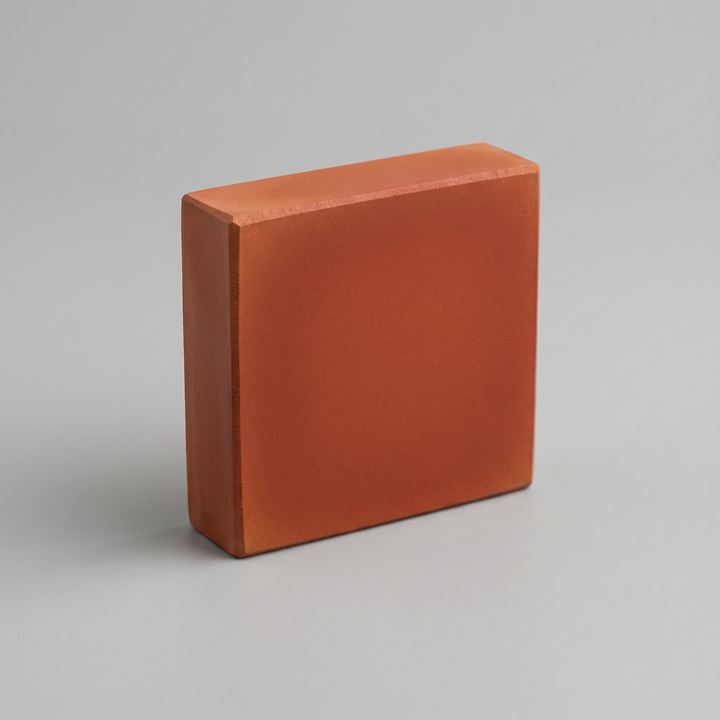
heavy oxide ceramic · thermal mass ceramicFe5O24P6Sr2W1 is a heavy oxide ceramic suitable as thermal mass ceramic. Color: amber-brown. Fired at 1250°C from 4 precursors (Ca3(PO4)2, Fe2O3, SrCO3). Workshop batch: 200g at €21.29. Compressive strength ~100 MPa; estimated 0.94 kg CO₂/kg (+326% vs clay brick). Notable: electrochromic tungstate, magnetic ferrite. Confidence: medium.
- forms at
- 1250 °C · high-fire
- replaces
- clay brick
- CO₂
- 326% higher than clay brick (0.94 vs 0.22 kg CO₂/kg; 4.3× higher)
- energy
- 108% higher than clay brick (6.25 vs 3.00 MJ/kg; 2.1× higher)
- compressive
- 100 MPa
- density
- 4.08 g/cm³
- crystal
- monoclinic
- band gap
- 2.69 eV
- cost
- €106.45/kg · €21.29 / 200 g batch
- confidence
- medium (synthesis route)
- potential
- 0.35 · env 0.00 · novel 1.00 · struct 0.20 · lineage 0.50 · supply 0.00
- flags
- electrochromic tungstate: A voltage-switchable optical chemistry. In thin-film form a small DC signal shifts transmission from clear to tinted blue, opening the door to dimmable glazing and responsive partitions that do not need mechanical shading. magnetic ferrite: Permanent-magnetic behaviour embedded in the material itself. Hardware-free fastening, mountable tile surfaces, reconfigurable partitions that hold by magnetism — a niche but specific tectonic opening.
Architectural potential
A strontium-iron-phosphate-tungstate heavy-oxide ceramic fired at 1250 °C, 100 MPa of compression, and a dual functional layer that does not exist elsewhere in this batch: electrochromic tint-switching on a DC signal plus a permanent magnetic response from the iron fraction. Natural placements are hardware-free mountable cladding tiles that hold to a steel substrate by magnetism alone — changeable signage panels in a transit hall, reconfigurable partition tiles in an open-plan workspace, modular trombe-wall patches that can be rearranged seasonally without drilling. The thermal-mass base role stays intact: these are absorbing, re-radiating tiles that shift colour register through the daily cycle while remaining demountable. Against clay brick the embodied CO₂ runs 326 per cent higher, so the specification is signature-element only, and the amber-brown body carries a visible-absorber cast that makes the thermal argument legible by eye. The caveat is supply: the supply-chain score sits at zero, the precursor list crosses four separate rare streams, and 200 g workshop batches at €21.29 keep production at the demonstration scale. A single reconfigurable wall is plausible; a whole façade is not, and any specification should commit explicitly to the demonstration register rather than drift toward bulk cladding.
Material character
An amber-brown body characteristic of iron-phosphate-tungstate chemistry — warmer than the pure-tungstate siblings, deeper than an ordinary strontium-iron tile. At 4.09 g/cm³ and 85×85×34 mm the slab sits firm two-handed, close in lift register to the purple-brown iron-oxide block from the same batch. Surface vitrified skin, satin-matte, with a faint iridescent cast where the tungstate phase sits near the outer surface. Edges cold-cut, kerf-powdered. A small steel offcut held to the face sticks on contact — the magnetic signature is immediately legible by hand rather than by instrument. Against a plain iron-phosphate ceramic the body runs warmer and the post-switched state tints a clear blue-grey.
Recipe
200 g batch · peak 1250 °C| element | precursor | formula | mass | safety |
|---|---|---|---|---|
| Fe | iron(III) oxide (red) | Fe2O3 | 21.5 g | safe |
| P | tricalcium phosphate | Ca3(PO4)2 | 50.11 g | safe |
| Sr | strontium carbonate | SrCO3 | 15.9 g | safe |
| W | tungsten trioxide (yellow) | WO3 | 12.49 g | moderate |
- 1Ramp
- 2Hold
- 3Ramp
- 4Ramp
- 5Hold
- 6Ramp
- 7Ramp
Electrochromic — color switches under applied voltage (thin-film chemistry)
Magnetic — room-temperature magnetism from ferrite phase