Ca₄FeMn₃O₁₆Si₄
calcium silicate · cement alternativeCa4Fe1Mn3O16Si4 is a calcium silicate suitable as cement-alternative. Color: purple-brown. Fired at 1100°C from 4 precursors (CaCO3, SiO2, Fe2O3). Workshop batch: 1000g at €4.48. Compressive strength ~50 MPa; estimated 0.68 kg CO₂/kg (-19% vs Portland cement). Notable: no special functions flagged. Confidence: medium.
- forms at
- 1100 °C · high-fire
- replaces
- portland cement
- CO₂
- 18.7% lower than Portland cement (0.68 vs 0.83 kg CO₂/kg)
- energy
- 18.2% lower than Portland cement (4.50 vs 5.50 MJ/kg)
- compressive
- 50 MPa
- density
- 3.38 g/cm³
- crystal
- triclinic
- band gap
- 2.64 eV
- cost
- €4.48/kg · €4.48 / 1000 g batch
- confidence
- medium (synthesis route)
- potential
- 0.31 · env 0.23 · novel 0.00 · struct 0.15 · lineage 0.80 · supply 0.65
Architectural potential
A manganese-dominant iron-doped calcium silicate, fired at 1100 °C to a wollastonite-type binder body at 3.38 g/cm³ and 50 MPa of compression. Structurally the envelope is thin — mortar, screed, non-reinforced slab work — but the manganese-iron chemistry carries a deep purple-brown through the body that sits closer to weathered stone than to dyed concrete. Natural placements are earth-toned screed floors in craft workshops and potteries, prefab cladding panels for landscape walls in gardens, site-cast foundation plinths for pavilion structures, and render work on garden-room enclosures. Supplements Portland cement in the light-load register. Against Portland the embodied CO₂ falls nineteen per cent and the supply-chain score is a full 1.0 — both iron and manganese are mature precursor markets with no rare-earth pressure, which makes this a more defensible specification than the cobalt-coloured sibling. At €4.48 per 1 kg batch the unit economics also sit in reach of real specification, not just the demonstrator patch. The caveat is firing: 1100 °C is still a kiln fire, so the zero-kiln argument that a sulfide-cast binder can make does not apply here. The trade is environmental-over-Portland rather than firing-free.
Material character
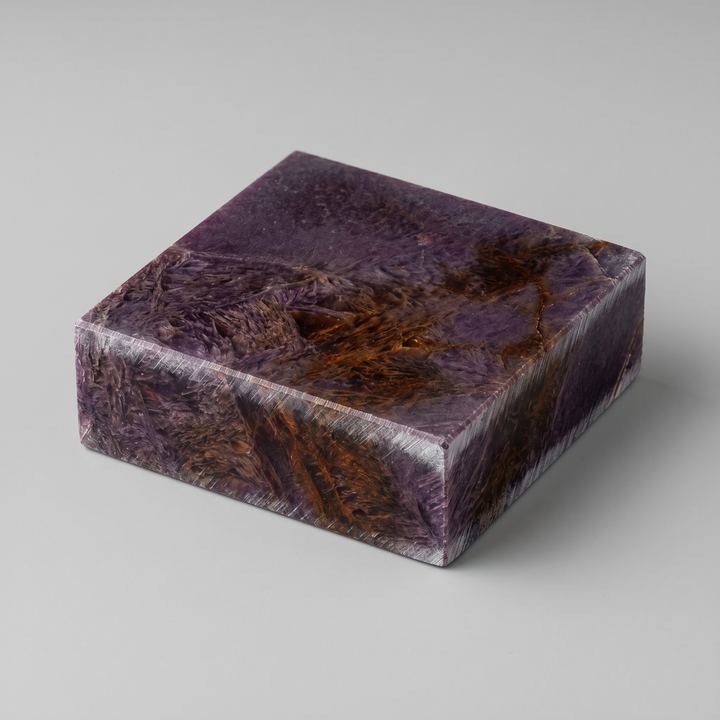
The face reads a deep purple-brown across the body, the manganese dominant with iron lending a warmer terracotta undertone in the shadow relief. At 3.38 g/cm³ in an 85×85×41 mm block the slab is distinctly lighter than its iron-oxide ceramic cousins of the same footprint, firming comfortably single-handed. Surface vitrified semi-matte from the 1100 °C fire, the calcium silicate skin carrying a faint glassy sheen without crossing into full glaze. Edges cold-cut, the kerf showing a paler mauve where the saw exposes the fresh grain. A warmer-bodied sibling to the cobalt-blue calcium-silicate from the same batch — closer in colour register to a weathered manganese-rich brick than to any tinted cement.
Recipe
1000 g batch · peak 1100 °C| element | precursor | formula | mass | safety |
|---|---|---|---|---|
| Ca | calcium carbonate / limestone | CaCO3 | 40.8 g | safe |
| Fe | iron(III) oxide (red) | Fe2O3 | 8.14 g | safe |
| Mn | manganese dioxide | MnO2 | 26.58 g | moderate |
| Si | quartz flour / silica | SiO2 | 24.49 g | safe |
- 1Ramp
- 2Hold
- 3Ramp
- 4Hold
- 6Ramp
- 7Hold