Co₂Fe₆O₁₆Sb₂Zn₂
iron oxide ceramic · structural ceramicCo2Fe6O16Sb2Zn2 is a iron oxide ceramic suitable as structural-ceramic. Color: blue. Fired at 1100°C from 4 precursors (Sb2O3, ZnO, CoO). Workshop batch: 1000g at €38.20. Compressive strength ~100 MPa; estimated 0.79 kg CO₂/kg (+258% vs clay brick). Notable: no special functions flagged. Confidence: medium.
- forms at
- 1100 °C · high-fire
- replaces
- clay brick
- CO₂
- 258% higher than clay brick (0.79 vs 0.22 kg CO₂/kg; 3.6× higher)
- energy
- 75% higher than clay brick (5.25 vs 3.00 MJ/kg; 1.8× higher)
- compressive
- 100 MPa
- density
- 0.54 g/cm³
- crystal
- monoclinic
- band gap
- 1.05 eV
- cost
- €38.20/kg · €38.20 / 1000 g batch
- confidence
- medium (synthesis route)
- potential
- 0.17 · env 0.00 · novel 0.00 · struct 0.30 · lineage 0.80 · supply 0.00
Architectural potential
A cobalt-antimony-zinc-iron oxide tuned for the load-bearing fired-ceramic register — pushed toward the higher-strength end of the family, offering block-work, structural tile, and compressive vaulting candidate geometry. At 100 MPa the body sits squarely in the descendant-of-structural-brick register: vault voussoirs, pier-block infills, structural-tile cladding on load-bearing walls, and fire-resistance-critical elements in institutional architecture. Natural placements are compressive-vault blocks in experimental workshop buildings, structural-tile cladding over CLT columns in fire-regulated programmes, pier-block units in pavilion architecture where the saturated cobalt-blue body is part of the argument, and hearth or flue-lining elements in kitchen and fireplace construction. The five-kilogram workshop ceiling makes full-block specification feasible without specialist scaling. The environmental caveat is the dominant one: embodied CO₂ runs 3.5 times a fired clay brick and firing energy runs 75 per cent higher, so any bulk specification has to pay the carbon bill with the cobalt-blue register and the fire-resistance argument together. The supply-chain score at zero is the other caveat: cobalt and antimony procurement sits inside ethically fraught extractive chains with deep human-rights concerns, and specification demands verified sourcing before the first block is fired.
Material character
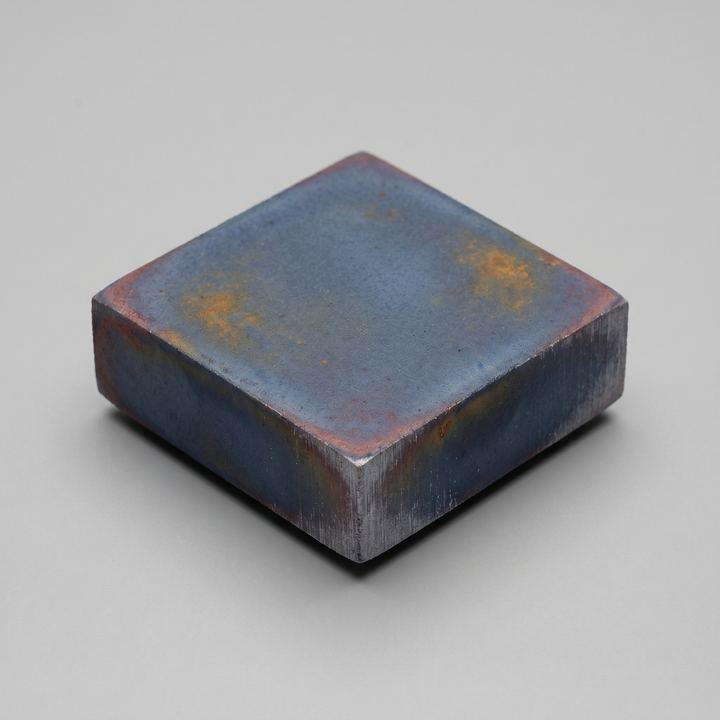
The 120×120×128 mm block reads a saturated deep cobalt-blue driven by the Co²⁺ chromophore, with faint green-black shadow angles where the iron-oxide matrix cools the hue. Surface vitrified-matte from the 1100 °C fire, with the typical fired-ceramic skin — fine-grained, slightly glassy at grazing light where the antimony flux has approached partial melt. Edges cold-cut, kerf-whitened, showing the transition from the blue body to a paler sub-surface. At 0.544 g/cm³ over this block size the body is markedly under-densified — a porous or foamed ceramic variant rather than a fully sintered block, which pulls the 100 MPa number to upper-bound and lets the block lift more easily than its size suggests.
Recipe
1000 g batch · peak 1100 °C| element | precursor | formula | mass | safety |
|---|---|---|---|---|
| Co | cobalt(II) oxide | CoO | 13.83 g | moderate |
| Fe | iron(III) oxide (red) | Fe2O3 | 44.23 g | safe |
| Sb | antimony trioxide | Sb2O3 | 26.91 g | moderate |
| Zn | zinc oxide | ZnO | 15.03 g | safe |
- 1Ramp
- 2Hold
- 3Ramp
- 4Hold
- 6Ramp
- 7Hold