K₄O₄₂Si₁₆V₄
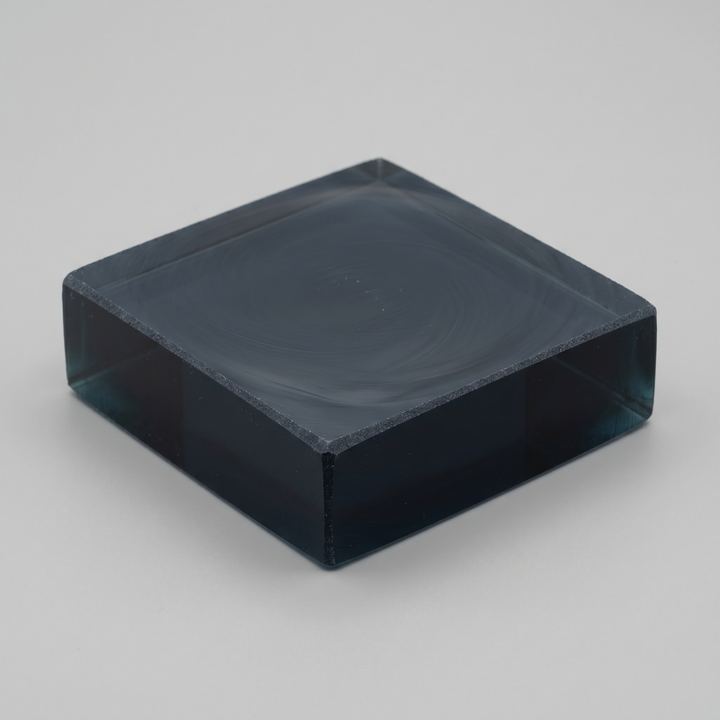
alkali silicate glass · structural translucent glassK4O42Si16V4 is a alkali silicate glass suitable as structural translucent glass. Color: grey-blue. Fired at 1150°C from 4 precursors (SiO2, V2O5, K2CO3). Workshop batch: 400g at €11.48. Compressive strength ~500 MPa; estimated 0.84 kg CO₂/kg (-2% vs float glass). Notable: no special functions flagged. Confidence: high.
- forms at
- 1150 °C · high-fire
- replaces
- float glass
- CO₂
- 1.9% lower than float glass (0.84 vs 0.86 kg CO₂/kg)
- energy
- 62.5% lower than float glass (5.62 vs 15.00 MJ/kg)
- compressive
- 500 MPa
- density
- 2.41 g/cm³
- crystal
- orthorhombic
- band gap
- —
- cost
- €28.70/kg · €11.48 / 400 g batch
- confidence
- high (synthesis route)
- potential
- 0.64 · env 0.78 · novel 0.00 · struct 1.00 · lineage 0.70 · supply 1.00
Architectural potential
A vanadium-doped potassium silicate glass fired at 1150 °C, reaching 500 MPa of compression at 2.41 g/cm³ — the same load-bearing translucent register as its pure potassium-magnesium sibling but with vanadium lending a distinctive grey-blue colouration throughout the body. The slab format is larger at 100×100×41 mm, which shifts the architectural placement toward the panel scale rather than the beam. Natural placements are coloured transparent floor panels in gallery mezzanines where daylight is wanted filtered rather than clear, grey-blue stair-tread inserts in ceremonial stairs, column-like light-admitting piers in bath-house interiors where the cool cast belongs to the programme, and pressed-glass partitions for north-facing offices where the body softens already-cool daylight. Substitutes for the steel-plus-tinted-glazing assembly. Against float glass the embodied CO₂ is effectively flat at minus two per cent and energy is sixty-two per cent lower — the argument for specification is thermal and chromatic, not carbonaceous. The vanadium content also means the slab filters a narrow band of the visible spectrum, colouring the light that passes through rather than the surface of the slab itself. The caveat is vanadium supply, which has industrial-steel priorities, and the 400 g batch ceiling that keeps specification at the single-panel scale.
Material character
The slab carries a distinct grey-blue body colour that deepens with sight-line — pale slate through the 41 mm face, deeper storm-blue along the 100 mm long edge where the glass thickens. At 2.41 g/cm³ in the full 100×100×41 mm format the piece is firm-but-manageable in two hands. Surface pressed-glass finish with anneal striae legible close to one edge; the top face crown is subtle. Cold-cut edges carry the usual lapidary bloom with the kerf faintly bluer than the body. A visual sibling to tinted architectural float but with thickness-colour gradation that sheet glass cannot produce — the colour lives in the mass, not the surface.
Recipe
400 g batch · peak 1150 °C| element | precursor | formula | mass | safety |
|---|---|---|---|---|
| K | potassium carbonate / potash | K2CO3 | 17.26 g | safe |
| Si | quartz flour / silica | SiO2 | 60.03 g | safe |
| V | vanadium pentoxide | V2O5 | 22.71 g | moderate |
- 1Ramp
- 2Hold
- 3Ramp
- 4Hold
- 5Ramp
- 6Hold