Ca₅O₁₆Si₄Sr₃
calcium silicate · cement alternativeCa5O16Si4Sr3 is a calcium silicate suitable as cement-alternative. Color: white-grey. Fired at 1100°C from 3 precursors (CaCO3, SrCO3, SiO2). Workshop batch: 1000g at €10.59. Compressive strength ~50 MPa; estimated 0.68 kg CO₂/kg (-19% vs Portland cement). Notable: no special functions flagged. Confidence: high.
- forms at
- 1100 °C · high-fire
- replaces
- portland cement
- CO₂
- 18.7% lower than Portland cement (0.68 vs 0.83 kg CO₂/kg)
- energy
- 18.2% lower than Portland cement (4.50 vs 5.50 MJ/kg)
- compressive
- 50 MPa
- density
- 3.27 g/cm³
- crystal
- monoclinic
- band gap
- 4.04 eV
- cost
- €10.59/kg · €10.59 / 1000 g batch
- confidence
- high (synthesis route)
- potential
- 0.35 · env 0.23 · novel 0.00 · struct 0.15 · lineage 0.70 · supply 1.00
Architectural potential
A strontium-substituted calcium silicate fired at 1100 °C, 50 MPa of compression, and a nineteen-per-cent cut in embodied CO₂ against Portland cement — a non-structural binder in the mortar-and-render register rather than the slab-and-panel register. The compression figure closes off load-bearing use and opens up the finishing trades: jointing mortar for low-carbon block-work, render coats on straw-bale and hempcrete walls, repair and patch work on heritage lime-bound masonry, and site-cast decorative elements where the strontium brings a particular whiteness to the mix. Against Portland cement the pouring and trowelling logic stay familiar, and the full supply-chain and safety scores (both 1.0) make this one of the easier binders in this batch to specify at real workshop size — 5 kg ceilings support a full pavilion's jointing work. The HIGH-confidence rating on the compression figure makes the specification legible, so the inevitable question is what the nineteen-per-cent CO₂ reduction is worth against the structural ceiling. The caveat is honest: this is a render and mortar, not a load path, and a project that wants concrete-register performance has to look elsewhere in the calcium-silicate family rather than scaling this one up.
Material character
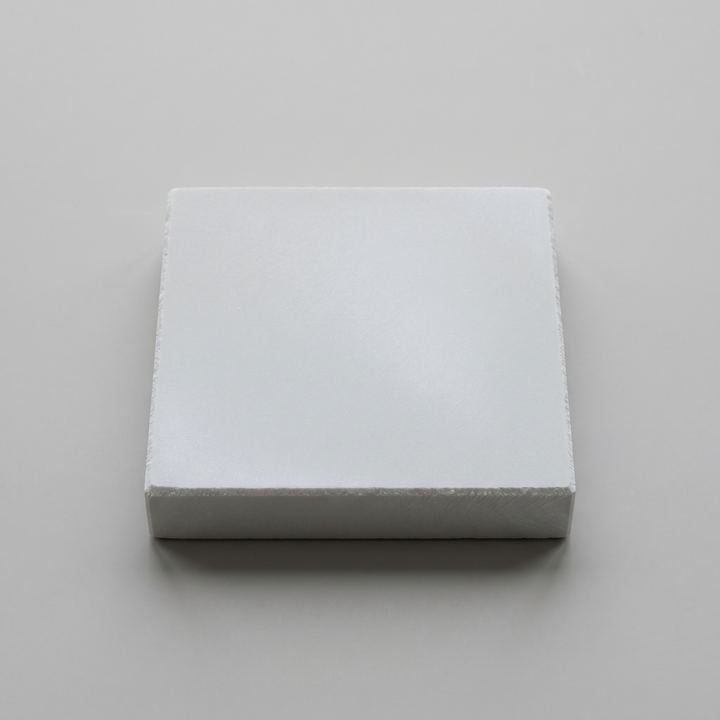
A clean bright white body, slightly cooler than the iron-tinged calcium-silicate siblings — strontium pulls the whiteness toward a mineral rather than a creamy register, close in tone to a high-grade marble slab. At 3.27 g/cm³ and 85×85×42 mm the slab is firm two-handed, slightly less dense-feeling than the vanadate siblings in the same family. Surface vitrified skin but stopping short of a gloss — the strontium flux does not push the fire as hard as the potassium-heavy exemplars do. Edges cold-cut, the kerf white-dusted and fine. Against a plain calcium-silicate body the ring under tap is brighter and the face holds a subtle pearlescent cast under direct light.
Recipe
1000 g batch · peak 1100 °C| element | precursor | formula | mass | safety |
|---|---|---|---|---|
| Ca | calcium carbonate / limestone | CaCO3 | 42.28 g | safe |
| Si | quartz flour / silica | SiO2 | 20.3 g | safe |
| Sr | strontium carbonate | SrCO3 | 37.42 g | safe |
- 1Ramp
- 2Hold
- 3Ramp
- 4Hold
- 6Ramp
- 7Hold