Fe₄Mo₅O₃₀Sr₁₀Ti
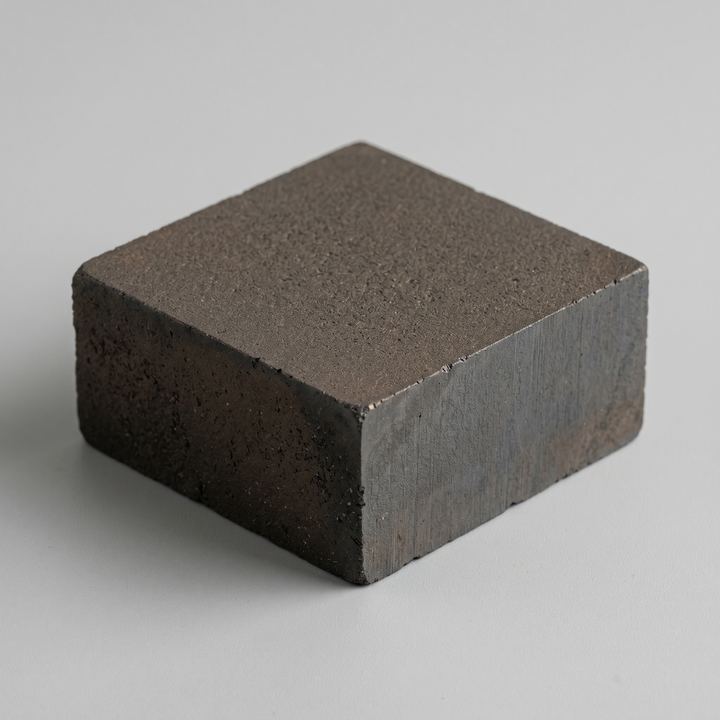
perovskite ceramic · functional ceramicFe4Mo5O30Sr10Ti1 is a perovskite ceramic suitable as functional-ceramic. Color: amber-brown. Fired at 1300°C from 4 precursors (SrCO3, MoO3, Fe2O3). Workshop batch: 200g at €12.79. Compressive strength ~100 MPa; estimated 0.97 kg CO₂/kg (+343% vs clay brick). Notable: ferroelectric. Confidence: medium.
- forms at
- 1300 °C · extreme-fire
- replaces
- clay brick
- CO₂
- 343% higher than clay brick (0.97 vs 0.22 kg CO₂/kg; 4.4× higher)
- energy
- 117% higher than clay brick (6.50 vs 3.00 MJ/kg; 2.2× higher)
- compressive
- 100 MPa
- density
- 5.46 g/cm³
- crystal
- tetragonal
- band gap
- inf eV
- cost
- €63.95/kg · €12.79 / 200 g batch
- confidence
- medium (synthesis route)
- potential
- 0.18 · env 0.00 · novel 0.30 · struct 0.20 · lineage 0.50 · supply 0.00
- flags
- ferroelectric: Piezoelectric or similar coupled-field behaviour — the material converts mechanical load to charge (and back). Floor tiles that harvest footfall, panels that sense vibration, façade elements that log wind load are the architectural reach.
Architectural potential
A strontium-molybdate perovskite ceramic carrying piezoelectric behaviour — the material converts mechanical load into electrical charge and back again, and this is the sole argument for its specification. At 100 MPa of compression and 1300 °C firing the material has load-bearing ceramic vocabulary but its embodied CO₂ runs four and a half times clay brick, so volume use is unjustifiable; the architectural case lives entirely in the sensor and harvesting register. Natural placements are footfall-harvesting tile fields in high-traffic public interiors — museum entry halls, transport-hub concourses, civic atria — where the embedded piezoelectric response converts walking load into usable micro-current for LED wayfinding or low-power sensing. Other placements: vibration-sensing panels on bridge decks and gymnasium floors, façade elements that log wind load as charge signal for structural monitoring, stair-nosing tiles that register usage patterns across the day. The amber-brown body colour signals the iron-molybdate content and sits the tile in a warm earth register rather than as a technical specialty element. The caveat stack is the heaviest in the batch: supply-chain score 0.0 from strontium-molybdate precursor logistics, €12.79 per 200 g batch, 1300 °C firing with its own energy cost, and the piezoelectric circuit integration is untested in architectural production — specification needs genuine prototype verification, not catalogue trust.
Material character
An amber-brown body with a cooler, slightly darker cast than the iron-tin thermal-mass sibling — the molybdate contribution shifts the body toward a drier, more mineralised surface reading, closer to an oxide pigment than to a fired terracotta. At 5.456 g/cm³ and 70×70×37 mm the slab sits firmly in the single-hand grip, denser-feeling than its smaller dimensions would suggest. Surface reads vitrified matte from the 1300 °C peak, the grain tighter and glassier than the 1250 °C heavy-oxide cousins. Edges come cold-cut with a clean, slightly darkened kerf. Against the Ca-Fe-Sn sibling the body is visibly cooler and drier in character.
Recipe
200 g batch · peak 1300 °C| element | precursor | formula | mass | safety |
|---|---|---|---|---|
| Fe | iron(III) oxide (red) | Fe2O3 | 12.31 g | safe |
| Mo | molybdenum trioxide | MoO3 | 27.73 g | moderate |
| Sr | strontium carbonate | SrCO3 | 56.88 g | safe |
| Ti | titanium dioxide (rutile) | TiO2 | 3.08 g | safe |
- 1Ramp
- 2Hold
- 3Ramp
- 4Ramp
- 5Hold
- 6Ramp
- 7Ramp
Ferroelectric — spontaneous electric polarization, switchable