Co₄Fe₆O₁₆Sb₂
iron oxide ceramic · structural ceramicCo4Fe6O16Sb2 is a iron oxide ceramic suitable as structural-ceramic. Color: blue. Fired at 1100°C from 3 precursors (CoO, Sb2O3, Fe2O3). Workshop batch: 1000g at €65.13. Compressive strength ~100 MPa; estimated 0.79 kg CO₂/kg (+258% vs clay brick). Notable: no special functions flagged. Confidence: high.
- forms at
- 1100 °C · high-fire
- replaces
- clay brick
- CO₂
- 258% higher than clay brick (0.79 vs 0.22 kg CO₂/kg; 3.6× higher)
- energy
- 75% higher than clay brick (5.25 vs 3.00 MJ/kg; 1.8× higher)
- compressive
- 100 MPa
- density
- 0.54 g/cm³
- crystal
- monoclinic
- band gap
- inf eV
- cost
- €65.13/kg · €65.13 / 1000 g batch
- confidence
- high (synthesis route)
- potential
- 0.20 · env 0.00 · novel 0.00 · struct 0.30 · lineage 1.00 · supply 0.00
Architectural potential
A cobalt-iron-antimonate ceramic fired at 1100 °C — a structural ceramic with the saturated blue colour that cobalt delivers in oxide form, at one hundred megapascals of compression. Placements are the same structural-brick register as the lithium-iron sibling: block-work in load-bearing walls, extruded posts in garden architecture, structural tile in compressive vaults, and thin-section infill in brick-grid façades where the cobalt blue is the specific architectural argument — a saturated colour that fired ceramic can carry but paint cannot match for permanence. The natural placement is a blue structural wall in a courtyard, a chapel, or a civic entrance, where the mass and the colour do the same work. Embodied CO₂ runs nearly three and a half times that of clay brick, so the chromatic argument has to carry the specification; the material is a signature element, not a bulk block. The low apparent density at 0.54 g/cm³ on a 120×120×130 mm slab points to a substantially porous sintered body, which means the thermal-mass argument is weaker than the lithium-iron variant — this body insulates more than it stores. The 1000 g batch with a five-kilogram ceiling supports a small wall or a courtyard insert. The caveat is toxicity: antimony in the lattice demands careful handling in cutting and drilling, and the €65.13 kilogram-batch price keeps it in signature-element register.
Material character
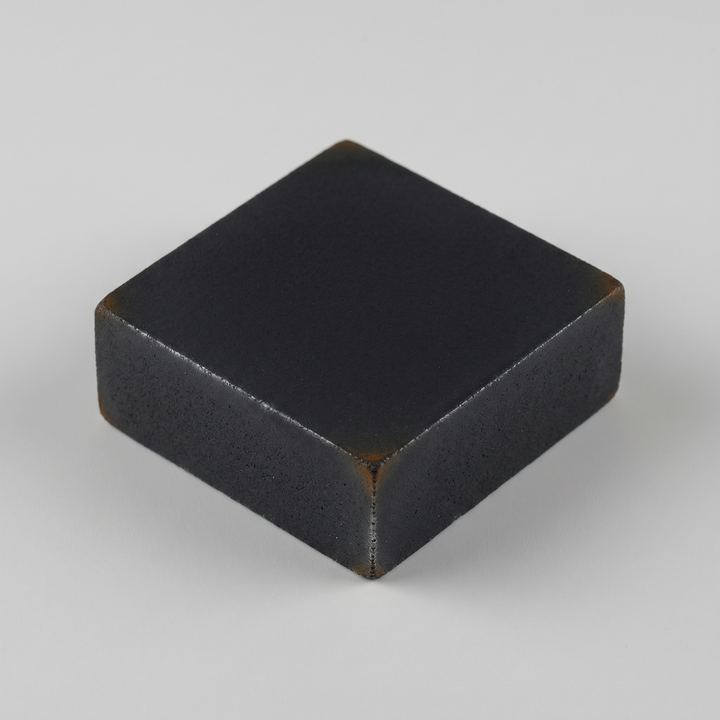
The body reads a deep saturated blue, the cobalt-antimonate combination sitting more toward ultramarine than toward the greener cobalt-aluminate blues of traditional ceramic glazes — a distinctly mineral, almost lapis-like tone. At 0.54 g/cm³ over 120×120×130 mm the slab is startlingly light for its size, registering a high-porosity sintered body rather than a dense ceramic — closer in hand-feel to a fired aerated concrete block than to a standard structural tile. Surface matte from the sinter, with visible coarse grain in raking light; edges cold-cut, kerf-whitened. Fully opaque. Rings short and muffled under a tap, the specific acoustic of a porous body.
Recipe
1000 g batch · peak 1100 °C| element | precursor | formula | mass | safety |
|---|---|---|---|---|
| Co | cobalt(II) oxide | CoO | 28.0 g | moderate |
| Fe | iron(III) oxide (red) | Fe2O3 | 44.76 g | safe |
| Sb | antimony trioxide | Sb2O3 | 27.24 g | moderate |
- 1Ramp
- 2Hold
- 3Ramp
- 4Hold
- 6Ramp
- 7Hold