Ca₆Mn₂O₁₆Si₄
calcium silicate · cement alternativeCa6Mn2O16Si4 is a calcium silicate suitable as cement-alternative. Color: purple-brown. Fired at 1100°C from 3 precursors (CaCO3, SiO2, MnO2). Workshop batch: 1000g at €4.27. Compressive strength ~50 MPa; estimated 0.68 kg CO₂/kg (-19% vs Portland cement). Notable: no special functions flagged. Confidence: high.
- forms at
- 1100 °C · high-fire
- replaces
- portland cement
- CO₂
- 18.7% lower than Portland cement (0.68 vs 0.83 kg CO₂/kg)
- energy
- 18.2% lower than Portland cement (4.50 vs 5.50 MJ/kg)
- compressive
- 50 MPa
- density
- 3.12 g/cm³
- crystal
- monoclinic
- band gap
- —
- cost
- €4.27/kg · €4.27 / 1000 g batch
- confidence
- high (synthesis route)
- potential
- 0.39 · env 0.23 · novel 0.00 · struct 0.15 · lineage 1.00 · supply 0.95
Architectural potential
A calcium-silicate binder in the post-Portland register, with a nineteen-per-cent CO₂ cut against Portland — modest but real, and paid at normal workshop temperatures. The manganese content drives the body toward a warm purple-brown rather than the cold grey of Portland, which changes the architectural conversation: this is a pigmented binder, useful where a pavilion wall or a landscape retaining wall wants a colour register without an added pigment pass. Natural placements are garden-wall blocks, thin cladding panels in rural and retrofit work, non-reinforced slab screeds in workshop floors, repair mortars in masonry restoration, and prefab pavilion infills where the material is both binder and visible surface. Compression at 50 MPa is in the same band as a good Portland mortar, so structural reach is limited to non-reinforced and low-load work — this supplements the concrete or masonry frame rather than replacing it. The 1 kg batch scaling to 5 kg gives it real workshop viability, unlike most of the palette. The caveat is vitrification temperature: 1100 °C means the kiln-free argument does not apply to the binder itself, only to the post-fire use of it. Against a fully ambient binder, this trades energy for colour and for structural predictability, and the project has to be clear about which trade it is making.
Material character
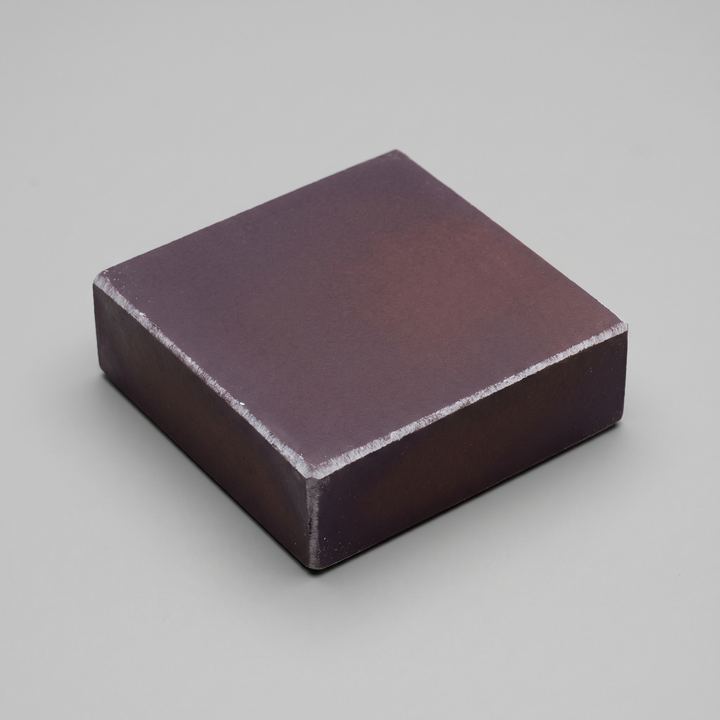
The slab reads a distinct purple-brown with an iron-plum undertone, pulled directly from the manganese-oxide phase — warmer than a Portland grey, cooler than a terracotta, closer in register to a manganese-blackened brick or to the darker bands of a pisé wall. At 3.12 g/cm³ and 85×85×44 mm the tile lifts with a confident two-hand grip at full kilo weight, a touch lighter in the hand than the lanthanum-bearing white-grey sibling. Surface finishes vitrified-matte from the 1100 °C fire, the manganese skin slightly darker than the body underneath; edges cold-cut, kerf-whitened. The pigment runs uniformly through the slab, so cut edges read the same colour as the face — useful for exposed-edge detailing.
Recipe
1000 g batch · peak 1100 °C| element | precursor | formula | mass | safety |
|---|---|---|---|---|
| Ca | calcium carbonate / limestone | CaCO3 | 59.18 g | safe |
| Mn | manganese dioxide | MnO2 | 17.14 g | moderate |
| Si | quartz flour / silica | SiO2 | 23.68 g | safe |
- 1Ramp
- 2Hold
- 3Ramp
- 4Hold
- 6Ramp
- 7Hold