O₂₀Sr₁₀TiV₄
perovskite ceramic · functional ceramicO20Sr10Ti1V4 is a perovskite ceramic suitable as functional-ceramic. Color: grey-blue. Fired at 1300°C from 3 precursors (SrCO3, V2O5, TiO2). Workshop batch: 200g at €8.45. Compressive strength ~100 MPa; estimated 0.97 kg CO₂/kg (+343% vs clay brick). Notable: thermochromic VO2. Confidence: medium.
- forms at
- 1300 °C · extreme-fire
- replaces
- clay brick
- CO₂
- 343% higher than clay brick (0.97 vs 0.22 kg CO₂/kg; 4.4× higher)
- energy
- 117% higher than clay brick (6.50 vs 3.00 MJ/kg; 2.2× higher)
- compressive
- 100 MPa
- density
- 4.92 g/cm³
- crystal
- tetragonal
- band gap
- 0.62 eV
- cost
- €42.25/kg · €8.45 / 200 g batch
- confidence
- medium (synthesis route)
- potential
- 0.33 · env 0.00 · novel 0.90 · struct 0.20 · lineage 0.50 · supply 0.00
- flags
- thermochromic VO2: Passive thermal-optical switching: transmission shifts near 68 °C without any driving signal. At building scale this gives a window that darkens as it heats, reducing solar gain without wiring or sensors.
Architectural potential
A strontium-vanadium perovskite fired at 1300 °C, carrying 100 MPa of compression and a vanadium-dioxide thermochromic layer. The CO₂ runs more than four times that of a fired clay brick and the extreme-fire peak adds to the energy bill, so any argument for its use has to be paid for by the chromism rather than by mass. Above 68 °C the vanadium site switches from semiconductor to metal and the body darkens; below it, the body clears again — a self-regulating solar-control tile without wiring, sensors or mechanical shading. Natural placements are small-area overlays on south-facing greenhouse and conservatory glazing, patch-scale tiles around skylight perimeters in atria to modulate hottest-hour gain, accent courses in double-skin façades, and ceiling-tile patterns in day-lit halls that shift register through the warming day. At 200 g per batch, specification sits at the signature-accent scale rather than the envelope scale. Against the V-doped perovskite sibling of the atlas the grey-blue resting colour is cooler and denser. The caveat is the CO₂ and energy ledger plus the supply-chain score at zero — vanadium availability and 1300 °C kiln logistics together forbid any use beyond the small patch or the signature element.
Material character
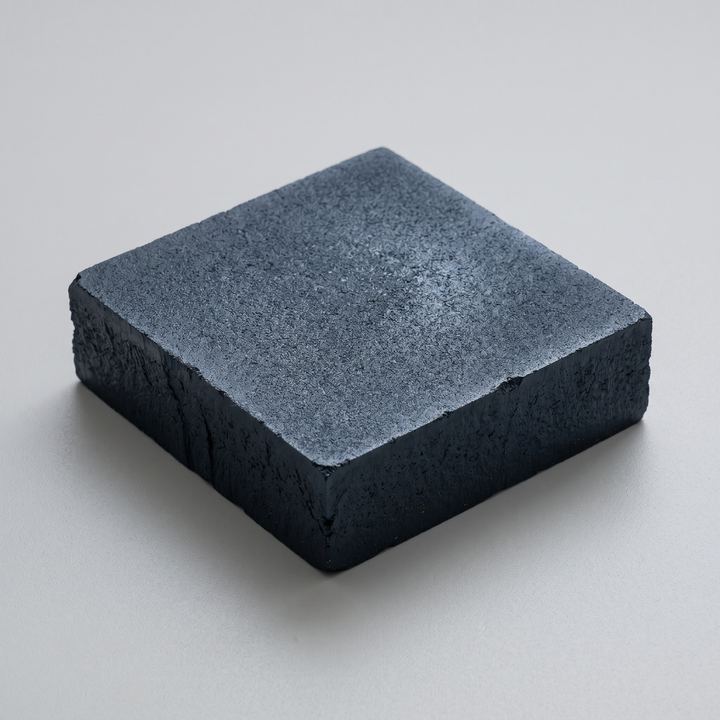
At room temperature the slab reads a deep grey-blue, cooler and more mineral than the V-titanate sibling of the atlas. A 0.62 eV absorption edge sits deep in the infrared, so the visible colour is carried by the titanate lattice rather than by the vanadium fraction itself. At 4.92 g/cm³ in an 85×85×28 mm format the slab is heavy for its thinness, resisting the single-handed lift. Surface vitrified matte from the 1300 °C fire; edges cold-cut with diamond-saw kerf powder. The room-temperature state is what the camera records; the post-transition darker state belongs in a heated companion shot taken above 68 °C.
Recipe
200 g batch · peak 1300 °C| element | precursor | formula | mass | safety |
|---|---|---|---|---|
| Sr | strontium carbonate | SrCO3 | 76.89 g | safe |
| Ti | titanium dioxide (rutile) | TiO2 | 4.16 g | safe |
| V | vanadium pentoxide | V2O5 | 18.95 g | moderate |
- 1Ramp
- 2Hold
- 3Ramp
- 4Ramp
- 5Hold
- 6Ramp
- 7Ramp
Thermochromic — VO₂ metal-insulator switch at ~68 °C