Ca₈O₁₆Si₃V
calcium silicate · cement alternativeCa8O16Si3V1 is a calcium silicate suitable as cement-alternative. Color: white-grey. Fired at 1100°C from 3 precursors (CaCO3, SiO2, V2O5). Workshop batch: 1000g at €15.79. Compressive strength ~50 MPa; estimated 0.68 kg CO₂/kg (-19% vs Portland cement). Notable: no special functions flagged. Confidence: high.
- forms at
- 1100 °C · high-fire
- replaces
- portland cement
- CO₂
- 18.7% lower than Portland cement (0.68 vs 0.83 kg CO₂/kg)
- energy
- 18.2% lower than Portland cement (4.50 vs 5.50 MJ/kg)
- compressive
- 50 MPa
- density
- 2.93 g/cm³
- crystal
- monoclinic
- band gap
- —
- cost
- €15.79/kg · €15.79 / 1000 g batch
- confidence
- high (synthesis route)
- potential
- 0.35 · env 0.23 · novel 0.00 · struct 0.15 · lineage 0.70 · supply 1.00
Architectural potential
A vanadium-doped calcium-silicate fired at 1100 °C, offering an eighteen-per-cent cut in embodied CO₂ against Portland cement but only 50 MPa of compression — modest for a post-Portland binder and well short of the structural calcium-silicate exemplar. The decisive placement is therefore the non-reinforced and thin-section end of the binder canon: mortar-scale repair work, floor-screed toppings in retrofit, prefabricated cladding panels, landscape walls, and pavilion-wall infills where reinforcement is minimal and the compressive envelope is light. Against Portland cement the pouring logic and formwork stay familiar; the kiln stays, which is the honest caveat for a 1100 °C peak, but the embodied-carbon argument still lands at roughly one-fifth less than the reference. Natural placements are non-reinforced floor screeds in housing retrofits, prefab cladding panels for pavilion skins, garden-room block-work, and landscape-wall plinths in climate-adaptive public projects. The vanadium fraction shifts the body toward a warmer white-grey than un-doped siblings. The 1 kg batch size and 5 kg workshop ceiling match the binder-of-the-post-Portland-workshop brief: site-cast at repair scale rather than structural-pour scale. The caveat is cost — at €15.79 per kilogram the economic comparison with Portland cement collapses, and the material earns its place through its environmental ledger, not its price.
Material character
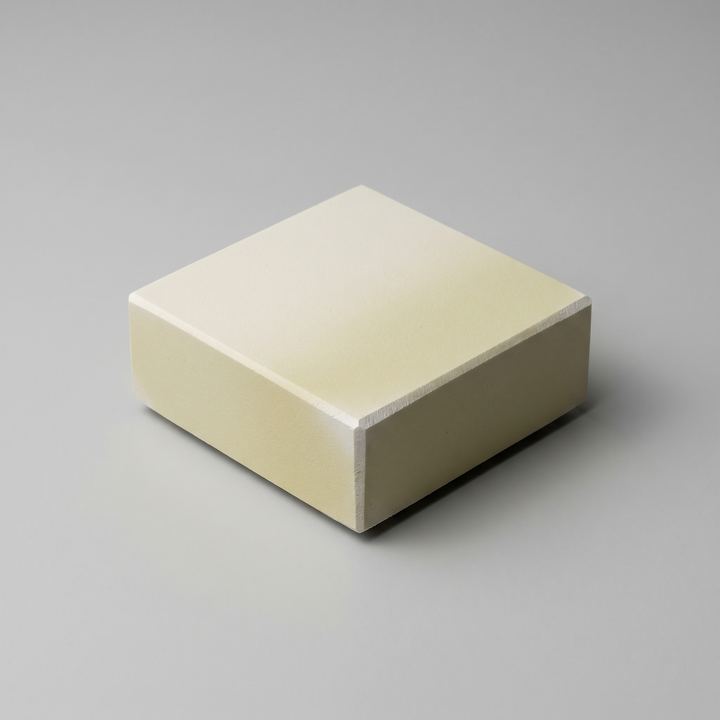
The slab reads a clean white-grey with a subtle warm tinge from the vanadium — lighter than a V-bearing heavy-oxide ceramic would suggest, because the calcium-silicate matrix dilutes the chromophore. At 2.93 g/cm³ in an 85×85×47 mm format the piece takes a firm two-handed lift, in the hand-feel register of a thick architectural paver rather than a floor tile. Surface vitrified matte from the 1100 °C fire, edging toward a partial glaze without crossing into melt; edges cold-cut, kerf-whitened against the body. Rings less cleanly than the K-fluxed calcium-silicate exemplar when tapped — a duller, more stone-like acoustic signature.
Recipe
1000 g batch · peak 1100 °C| element | precursor | formula | mass | safety |
|---|---|---|---|---|
| Ca | calcium carbonate / limestone | CaCO3 | 74.7 g | safe |
| Si | quartz flour / silica | SiO2 | 16.82 g | safe |
| V | vanadium pentoxide | V2O5 | 8.48 g | moderate |
- 1Ramp
- 2Hold
- 3Ramp
- 4Hold
- 6Ramp
- 7Hold