Fe₈Li₂O₁₆Sn₂
iron oxide ceramic · structural ceramicFe8Li2O16Sn2 is a iron oxide ceramic suitable as structural-ceramic. Color: amber-brown. Fired at 1100°C from 3 precursors (SnO2, Fe2O3, Li2CO3). Workshop batch: 1000g at €17.40. Compressive strength ~100 MPa; estimated 0.79 kg CO₂/kg (+258% vs clay brick). Notable: visible absorber. Confidence: high.
- forms at
- 1100 °C · high-fire
- replaces
- clay brick
- CO₂
- 258% higher than clay brick (0.79 vs 0.22 kg CO₂/kg; 3.6× higher)
- energy
- 75% higher than clay brick (5.25 vs 3.00 MJ/kg; 1.8× higher)
- compressive
- 100 MPa
- density
- 5.03 g/cm³
- crystal
- hexagonal
- band gap
- 1.60 eV
- cost
- €17.40/kg · €17.40 / 1000 g batch
- confidence
- high (synthesis route)
- potential
- 0.27 · env 0.00 · novel 0.46 · struct 0.30 · lineage 0.70 · supply 0.00
- flags
- visible absorber: A real-colour solar-gain control layer. Where the body takes visible light into itself rather than reflecting it, the material becomes a selective heat collector — useful on thermal-mass walls, absorber panels, and warm-toned cladding.
Architectural potential
An iron-oxide structural ceramic in the load-bearing brick register, carrying a real-colour solar-absorber overlay that turns the wall itself into a thermal collector. At 100 MPa it sits below the flagship structural ceramics but well within the compressive band of a good fired brick, so block-work, extruded post and compressive-vault experiments are within reach. The visible-absorber chemistry is the architectural opening: the amber-brown face takes visible light into itself rather than reflecting it, warming the mass by several degrees above an insulated wall of the same envelope. Natural placements are south-facing thermal-mass walls in passive-solar houses where the absorber-plus-storage logic is built into the single element, rammed-earth-adjacent pavilion walls where the iron colour reads as geological, hypocaust-style floor slabs in gallery and chapel interiors, and trombe-wall infills where the warm tone is part of the visible surface rather than hidden behind a glazed cavity. Compression is enough for two- or three-storey masonry; beyond that, a reinforced frame takes over. The caveat is CO₂: 258 per cent above clay brick, which forbids bulk use and pushes specification to signature thermal-wall work rather than to repeated brick runs. Supply-chain score is zero on the tin-oxide content, which also limits scale; the material belongs in prototype passive-solar work.
Material character
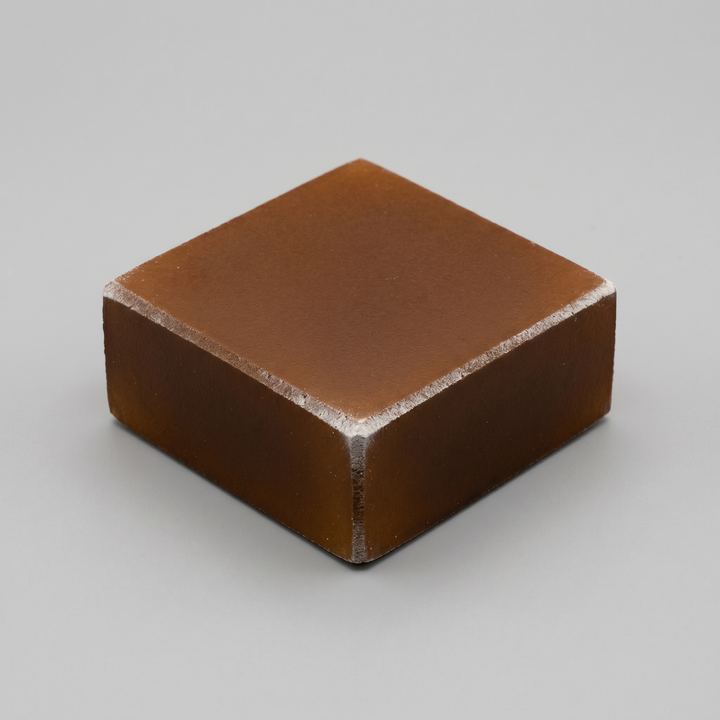
The body reads a saturated amber-brown pulled from the iron-oxide matrix, warmer and more umber than a standard clay brick and darker along the solar-absorbing face — a deliberate heat-capturing tone, closer in register to a weathered cor-ten panel than to a standard fired brick. At 5.03 g/cm³ and 70×70×41 mm the slab handles with real structural-brick heft, a firm two-hand lift that reads closer to a dense terracotta than to ordinary fired clay. Surface finishes vitrified-matte from the 1100 °C fire, the iron-oxide skin slightly darker than the body underneath; edges cold-cut, kerf-whitened. The colour runs uniformly through the slab so cut edges read the same amber-brown as the face, useful for exposed-arris detailing.
Recipe
1000 g batch · peak 1100 °C| element | precursor | formula | mass | safety |
|---|---|---|---|---|
| Fe | iron(III) oxide (red) | Fe2O3 | 62.99 g | safe |
| Li | lithium carbonate | Li2CO3 | 7.29 g | safe |
| Sn | tin(IV) oxide | SnO2 | 29.72 g | safe |
- 1Ramp
- 2Hold
- 3Ramp
- 4Hold
- 6Ramp
- 7Hold
Visible absorber — saturated color from bandgap in the visible range