Co₁₂Fe₂Mn₄Si₆
metal pm only · sintered metalCo12Fe2Mn4Si6 is a metal pm only suitable as sintered-metal. Color: neutral. Fired at 1100°C from 4 precursors (Co, Mn, Si). Workshop batch: 200g at €7.33. Compressive strength ~250 MPa; estimated 0.84 kg CO₂/kg (-53% vs structural steel). Notable: shape memory FeMnSi. Confidence: medium.
- forms at
- 1100 °C · high-fire
- replaces
- structural steel
- CO₂
- 53.1% lower than structural steel (0.84 vs 1.80 kg CO₂/kg)
- energy
- 74.4% lower than structural steel (5.62 vs 26.00 MJ/kg)
- compressive
- 250 MPa
- density
- 7.47 g/cm³
- crystal
- orthorhombic
- band gap
- 0.00 eV
- cost
- €36.65/kg · €7.33 / 200 g batch
- confidence
- medium (synthesis route)
- potential
- 0.62 · env 0.74 · novel 0.80 · struct 0.60 · lineage 0.20 · supply 0.50
- flags
- shape memory FeMnSi: Deforms on cue and snaps back to a remembered shape when warmed. Deployable canopies, self-tensioning fasteners, seismic-damping brackets, and geometry-changing envelopes all become mechanically possible.
Architectural potential
This is a material for deployable and shape-changing hardware — the small, highly-loaded metal parts that make the difference between a fixed façade and a morphing one. The iron-manganese-silicon shape-memory chemistry gives the part a built-in memory of a trained geometry: deform it cold, heat it through the transformation near 170 °C, and it snaps back. The twelve-cobalt ratio adds weak permanent-magnetic behaviour, a rare pairing that enables mechanical hardware and magnetic coupling in one element. Natural placements are self-tensioning seismic brackets that re-tighten after an event rather than requiring replacement; deployable canopy hinges that fold flat for transport and unfold on heated erection; morphing façade clips whose open and closed states are programmed in at fabrication; and façade-panel fixings that hold by a combination of shape-locked geometry and magnetic latch. A fifty-three-per-cent reduction in embodied CO₂ against structural steel at 250 MPa compression means the environmental argument is real as soon as the sintering scales. The caveat is that scale: the atlas entry is a 200 g press, and architectural-component supply will need a partnered industrial sintering line.
Material character
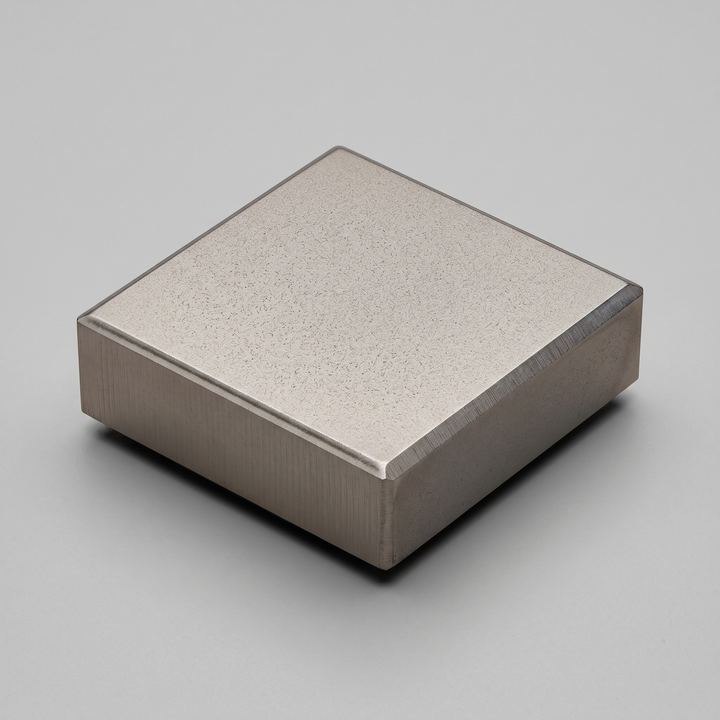
The body is a neutral warm grey, tilting slightly blue under tungsten light as the cobalt catches oblique angles, resolving back to neutral in daylight. The pressed top face carries a fine grain speckle and a narrow shrink ring where the die rim pulled during sintering; three edges come off the diamond saw clean, the fourth retains its die-draft taper. At 7.47 g/cm³ the 70×70×27 mm slab sits at steel-density weight — a two-handed lift from the bench, concentrated mass for its footprint. Opaque; a diffuse metallic sheen terminates the ambient light on the top face without any directional highlight.
Recipe
200 g batch · peak 1100 °C| element | precursor | formula | mass | safety |
|---|---|---|---|---|
| Co | cobalt powder | Co | 58.58 g | moderate |
| Fe | iron powder -325 mesh | Fe | 9.25 g | moderate |
| Mn | manganese flakes | Mn | 18.2 g | moderate |
| Si | silicon granules | Si | 13.96 g | safe |
- 1Ramp
- 2Hold
- 3Ramp
- 4Hold
- 5Ramp
- 6Ramp
- 7END
Shape-memory — deformed body recovers on heating (Fe-Mn-Si)