S₁₆SrTi₁₂
sulfide polysulfide · sulfide low tempS16Sr1Ti12 is a sulfide polysulfide suitable as sulfide low temp. Color: yellow-orange. Fired at 130°C from 3 precursors (TiO2, S, SrCO3). Workshop batch: 500g at €8.21. Compressive strength ~150 MPa; estimated 0.09 kg CO₂/kg (-89% vs Portland cement). Notable: forms without a kiln. Confidence: high.
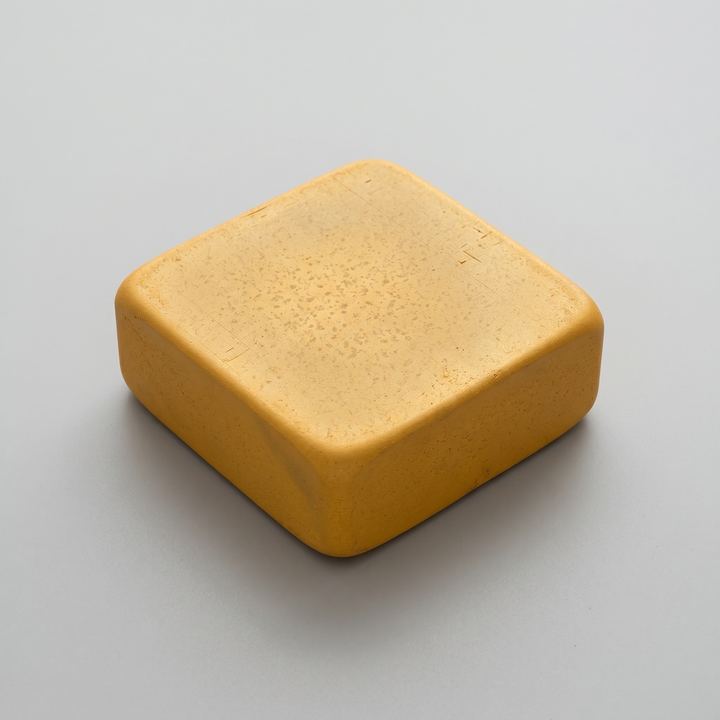
- forms at
- 130 °C · hotplate · no kiln
- replaces
- portland cement
- CO₂
- 89.1% lower than Portland cement (0.09 vs 0.83 kg CO₂/kg)
- energy
- 89.1% lower than Portland cement (0.60 vs 5.50 MJ/kg)
- compressive
- 150 MPa
- density
- 3.70 g/cm³
- crystal
- triclinic
- band gap
- 0.00 eV
- cost
- €16.42/kg · €8.21 / 500 g batch
- confidence
- high (synthesis route)
- potential
- 0.74 · env 1.00 · novel 1.00 · struct 0.30 · lineage 0.70 · supply 0.27
- flags
- zero kiln: Forming happens without firing — the material cures through chemistry at ambient or hotplate temperature. At building scale this removes the kiln from the supply chain: on-site casting, regional workshops, cold-country fabrication all become available.
Architectural potential
A strontium-titanium polysulfide cast at 130 °C on a hotplate, delivering 150 MPa of compression and an eighty-nine-per-cent cut in embodied CO₂ against Portland cement. That combination puts it squarely in the detail and tile register, where the firing is replaced by chemistry and the supply chain shortens to a studio bench. Natural placements are drop-cast floor tile in exhibition fit-outs, thick inlay panels in acoustic walls, cast thresholds and sill plates for retrofit carpentry, and yellow-orange accent courses in pavilion skins where the sulfur palette is wanted as part of the architecture. At 500 g per batch and a two-kilogram workshop ceiling, the material sits at detail scale rather than slab scale — a run of tiles, a cast stair nosing, a sequence of skirting pieces rather than a continuous floor. The cement comparison makes the environmental argument legible without forcing reinforced-scale claims the chemistry cannot yet support. The caveat is workshop logistics: cutting and grinding the cured body releases sulfide odour, the batch ceiling limits any one piece to the size of a large floor tile, and precursor availability (TiO₂, strontium carbonate) keeps the supply-chain score at 0.29, well below the alkali-silicate baseline.
Material character
The slab reads a deep yellow-orange, warmed by the titanium fraction into a honey register rather than the brass yellow of pure polysulfide siblings. At 3.70 g/cm³ in an 85×85×37 mm format the piece lifts with a firm two-handed grip — denser than a fired clay tile of the same footprint, slightly lighter than the copper-heavy sulfides of the atlas. Surface mold-matte with a faint meniscus sheen along the upper face; edges as-cast, sharp and slightly reflective. A fine α→β sulfur bloom settles across the face under raking light. Against the Cu-Mn-Na sulfide baseline, the body is noticeably less saturated and cooler in tone.
Recipe
500 g batch · peak 130 °C| element | precursor | formula | mass | safety |
|---|---|---|---|---|
| Sr | strontium carbonate | SrCO3 | 13.35 g | safe |
| Ti | titanium dioxide (rutile) | TiO2 | 86.65 g | safe |
- Pre-heatHotplate to 150 °C
- MeltSulfur liquefies at 115 °C; full liquid at 130 °C
- CastPour at 140–145 °C
- SetRoom temperature 30 min (firm) → 24 h (full strength)
Zero-kiln process — 130 °C hotplate cast only