CoCu₃Er₄Mg₂
metal pm only · sintered metalCo1Cu3Er4Mg2 is a metal pm only suitable as sintered-metal. Color: green-red-copper. Fired at 1100°C from 4 precursors (Er, Cu, Co). Workshop batch: 200g at €8.81. Compressive strength ~350 MPa; estimated 0.84 kg CO₂/kg (-53% vs structural steel). Notable: no special functions flagged. Confidence: medium.
- forms at
- 1100 °C · high-fire
- replaces
- structural steel
- CO₂
- 53.1% lower than structural steel (0.84 vs 1.80 kg CO₂/kg)
- energy
- 74.4% lower than structural steel (5.62 vs 26.00 MJ/kg)
- compressive
- 350 MPa
- density
- 0.78 g/cm³
- crystal
- orthorhombic
- band gap
- 0.01 eV
- cost
- €44.05/kg · €8.81 / 200 g batch
- confidence
- medium (synthesis route)
- potential
- 0.45 · env 0.74 · novel 0.00 · struct 0.84 · lineage 0.20 · supply 0.50
Architectural potential
A powder-pressed erbium-copper-cobalt sinter with an unusual trait for a metal: density of just 0.78 g/cm³, a factor of ten below structural steel, opening the door to lightweight brackets and connectors where every gram costs money on transport or on hoist lines. At 350 megapascals of compression this carries serious mechanical load despite the low density — a real argument for aerospace-register brackets, long-span deployable-canopy hinges, high-level façade clips where worker-lift weight matters, and hardware for temporary pavilion and exhibition architecture where repeated assembly and disassembly demand light metal parts. Against structural steel the embodied CO₂ drops fifty-three per cent and firing energy drops seventy-four per cent. Because the sinter accepts machining and finish-work cleanly, the part moves from furnace to site without the complications of casting. The bandgap of 0.01 eV keeps the body electrically conductive, preserving grounding and shielding behaviour where hardware meets electronics. The caveat is that confidence on the very low density is medium — the value sits well outside the typical metal-matrix range and flags a potential porosity structure that would need verification before specification, particularly for any load-path-critical bracket where fatigue behaviour at that density has not been characterised in architectural production.
Material character
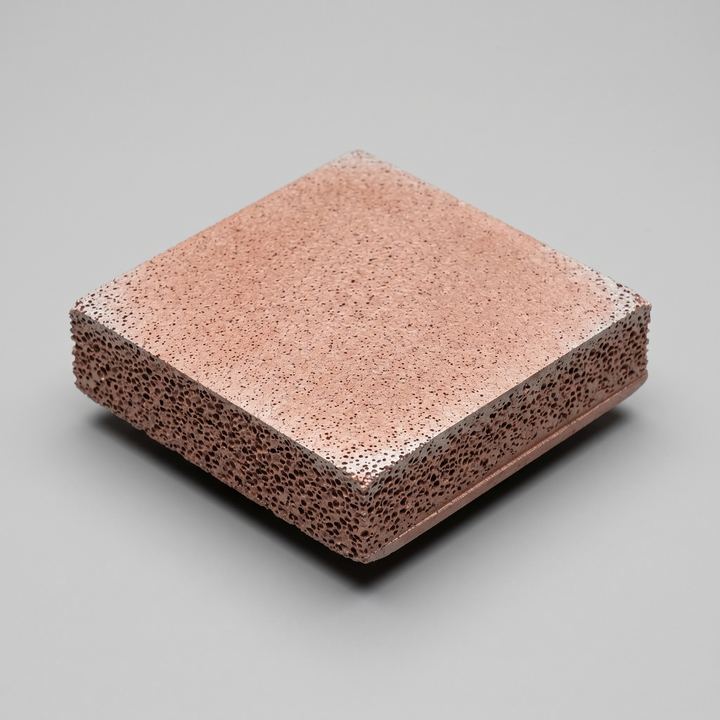
At 0.78 g/cm³ in a 120×120×89 mm slab the piece lifts single-handed with a weight register closer to softwood than to any expected metal — a hand-feel that contradicts the visible metallic surface. The body reads green-red copper with erbium pinking the grain under direct light: a warm oxidised chromium-green matrix crossed by copper veins. Surface sits as a sintered matte powder-grain, finer than cast work, slightly more porous than a wrought face. Edges come die-crisp from the press. Against a conventional sintered steel sibling of the same geometry the weight step is so dramatic that the hand repeatedly questions what it is holding.
Recipe
200 g batch · peak 1100 °C| element | precursor | formula | mass | safety |
|---|---|---|---|---|
| Co | cobalt powder | Co | 6.09 g | moderate |
| Cu | copper shot/powder | Cu | 19.71 g | safe |
| Er | erbium metal | Er | 69.17 g | moderate |
| Mg | magnesium powder | Mg | 5.03 g | moderate |
- 1Ramp
- 2Hold
- 3Ramp
- 4Hold
- 5Ramp
- 6Ramp
- 7END