NaS₄Y₃
sulfide polysulfide · sulfide low tempNa1S4Y3 is a sulfide polysulfide suitable as sulfide low temp. Color: yellow-orange. Fired at 130°C from 3 precursors (Y2O3, S, Na2CO3). Workshop batch: 500g at €13.05. Compressive strength ~50 MPa; estimated 0.09 kg CO₂/kg (-89% vs Portland cement). Notable: forms without a kiln. Confidence: high.
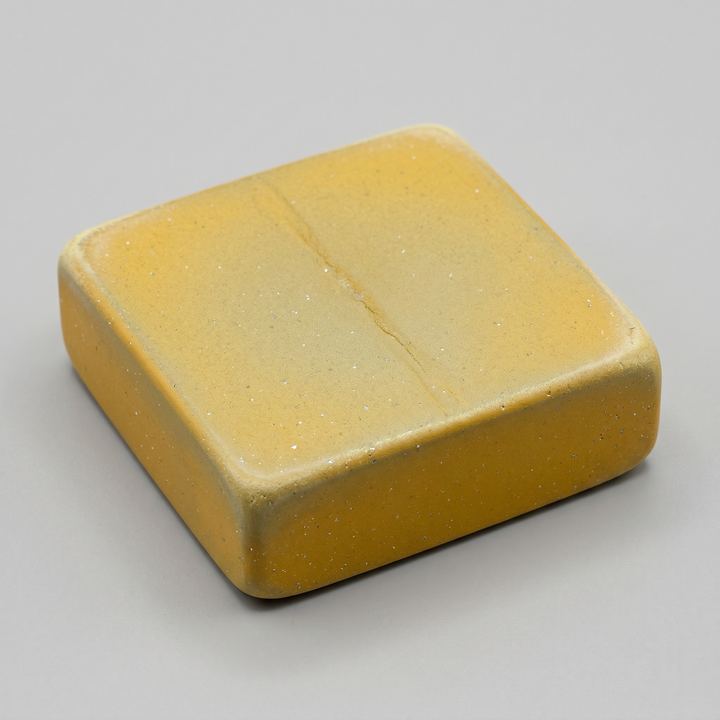
- forms at
- 130 °C · hotplate · no kiln
- replaces
- portland cement
- CO₂
- 89.1% lower than Portland cement (0.09 vs 0.83 kg CO₂/kg)
- energy
- 89.1% lower than Portland cement (0.60 vs 5.50 MJ/kg)
- compressive
- 50 MPa
- density
- 4.03 g/cm³
- crystal
- orthorhombic
- band gap
- —
- cost
- €26.10/kg · €13.05 / 500 g batch
- confidence
- high (synthesis route)
- potential
- 0.71 · env 1.00 · novel 1.00 · struct 0.10 · lineage 0.70 · supply 0.27
- flags
- zero kiln: Forming happens without firing — the material cures through chemistry at ambient or hotplate temperature. At building scale this removes the kiln from the supply chain: on-site casting, regional workshops, cold-country fabrication all become available.
Architectural potential
A yttrium-sodium polysulfide formed at hotplate temperature, reaching 50 MPa of compression with an eighty-nine-per-cent cut in embodied CO₂ against Portland cement. The chemistry cures at 130 °C without a kiln, which keeps the whole forming process on a bench: drop-cast tiles, hand-poured laminates over timber, pressed inlays for carpentry. Natural placements sit in the detail and surface register — decorative wall tiles in studios and workshop spaces, cast threshold strips in residential retrofit, signage inlays and wayfinding panels in cultural buildings, and small feature tiles in foyers and corridors. The yttrium content shifts the warm palette toward a slightly cooler yellow-orange than its chromium or copper siblings, which reads cleanly against pale plaster and softens into white rendered surfaces. Against Portland cement the argument is straightforward: similar non-structural surface mass at a fraction of the carbon cost, with the kiln gone entirely. The caveat is supply and cost: yttrium is a rare-earth oxide with a supply-chain score under 0.3, and at €13.05 per 500 g the material sits toward the upper end of the polysulfide palette — a specification for signature surfaces rather than a scalable finish for bulk wall area.
Material character
The slab reads a pale, cool yellow-orange with a faint silver cast from the yttrium content, lighter and more bleached than the copper- or chromium-heavy polysulfide siblings. At 4.03 g/cm³ in an 85×85×34 mm piece, the body sits in a two-handed but not heavy register — firm single-handed once lifted, but wanting a second hand at the catch. Surface mold-matte with the characteristic meniscus sheen of a hotplate cast; edges come as-cast with a faint sulfur bloom along the kerf. Fully opaque. The tap-note is softer than a fired ceramic of equivalent dimensions, closer to a dense cast polymer than to brick.
Recipe
500 g batch · peak 130 °C| element | precursor | formula | mass | safety |
|---|---|---|---|---|
| Na | sodium carbonate / soda ash | Na2CO3 | 13.53 g | safe |
| Y | yttrium oxide | Y2O3 | 86.47 g | moderate |
- Pre-heatHotplate to 150 °C
- MeltSulfur liquefies at 115 °C; full liquid at 130 °C
- CastPour at 140–145 °C
- SetRoom temperature 30 min (firm) → 24 h (full strength)
Zero-kiln process — 130 °C hotplate cast only