Co₂Na₄O₁₆Si₆
alkali silicate glass · structural translucent glassCo2Na4O16Si6 is a alkali silicate glass suitable as structural translucent glass. Color: blue. Fired at 1150°C from 4 precursors (SiO2, Na2CO3, CoO). Workshop batch: 400g at €19.91. Compressive strength ~500 MPa; estimated 0.84 kg CO₂/kg (-2% vs float glass). Notable: no special functions flagged. Confidence: high.
- forms at
- 1150 °C · high-fire
- replaces
- float glass
- CO₂
- 1.9% lower than float glass (0.84 vs 0.86 kg CO₂/kg)
- energy
- 62.5% lower than float glass (5.62 vs 15.00 MJ/kg)
- compressive
- 500 MPa
- density
- 2.82 g/cm³
- crystal
- monoclinic
- band gap
- 3.15 eV
- cost
- €49.77/kg · €19.91 / 400 g batch
- confidence
- high (synthesis route)
- potential
- 0.68 · env 0.78 · novel 0.00 · struct 1.00 · lineage 1.00 · supply 1.00
Architectural potential
A cobalt-coloured soda-lime-silicate glass fired at 1150 °C to 500 MPa, 2.82 g/cm³, sitting in the same structural-translucent register as its amber-brown sibling but carrying the opposite end of the visible spectrum. Natural placements are pressed-glass piers in bath-house screens where cobalt blue historically belongs, translucent stair treads in gallery foyers where the descent-through-blue is a deliberate atmospheric choice, light-well panels pressed into floor slabs in atria, and transparent partition modules in crematoria and chapels where the colour carries ritual weight. The float-glass comparison holds on carbon to within 2 per cent with a sixty-two-per-cent cut in firing energy, so the environmental argument is process-based rather than chemistry-based. Where this entry departs from the amber-iron version is cost and colour: cobalt oxide is an order of magnitude more expensive than iron oxide per kilogram of batch, which brings the workshop batch to €19.91 against €1.74 for the amber. Specification therefore sits with the signature element — the pressed pier in the main entry, the floor insert below the oculus — rather than with repeated bulk modules. Annealing and edge conditioning belong to the tectonic as with any soda-lime glass, and walking-surface placements need a post-annealing polish.
Material character
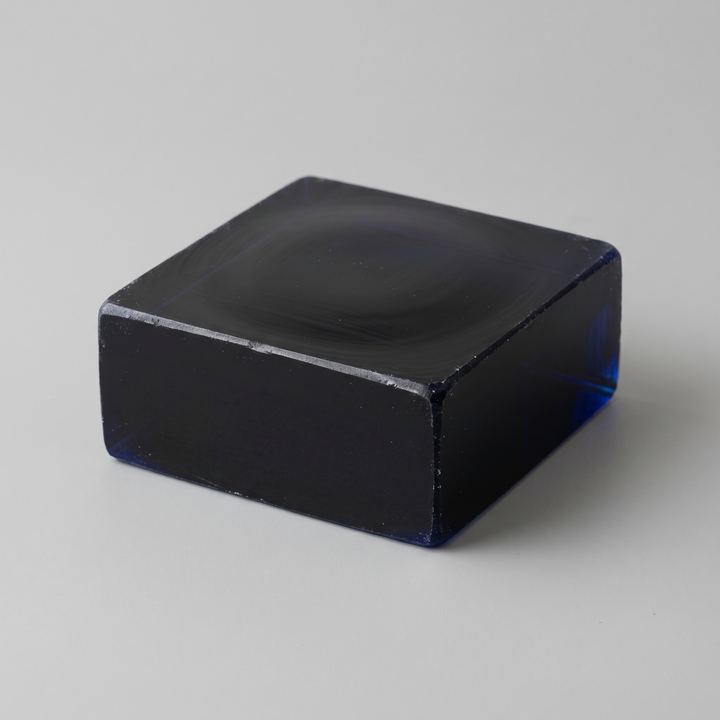
Deep saturated cobalt blue through the 49 mm depth, read as a clean sea-blue on the face and deepening to a near-indigo when sighted along the 85 mm long edge where the slab thickens into full body. Pressed-glass surface with a shallow gravity crown and the quiet anneal striae that any soda-lime piece carries close to its long axis. Cold-cut edges lap-white, with the characteristic glassy chip that cobalt-coloured glass shows along a fresh cut. At 2.82 g/cm³ and 85×85×49 mm the slab sits one-handed but insists on it, slightly denser and firmer in hand than the iron-amber sibling of the same family. A distinct colour and weight step from the iron-amber variant — same glass bones, quite different room.
Recipe
400 g batch · peak 1150 °C| element | precursor | formula | mass | safety |
|---|---|---|---|---|
| Co | cobalt(II) oxide | CoO | 20.75 g | moderate |
| Na | sodium carbonate / soda ash | Na2CO3 | 29.35 g | safe |
| Si | quartz flour / silica | SiO2 | 49.91 g | safe |
- 1Ramp
- 2Hold
- 3Ramp
- 4Hold
- 5Ramp
- 6Hold