Cr₂La₂O₁₂TeW
heavy oxide ceramic · thermal mass ceramicCr2La2O12Te1W1 is a heavy oxide ceramic suitable as thermal mass ceramic. Color: green. Fired at 1250°C from 3 precursors (La2O3, WO3, Cr2O3). Workshop batch: 200g at €25.50. Compressive strength ~100 MPa; estimated 0.94 kg CO₂/kg (+326% vs clay brick). Notable: electrochromic tungstate. Confidence: medium.
- forms at
- 1250 °C · high-fire
- replaces
- clay brick
- CO₂
- 326% higher than clay brick (0.94 vs 0.22 kg CO₂/kg; 4.3× higher)
- energy
- 108% higher than clay brick (6.25 vs 3.00 MJ/kg; 2.1× higher)
- compressive
- 100 MPa
- density
- 0.59 g/cm³
- crystal
- trigonal
- band gap
- 2.79 eV
- cost
- €127.50/kg · €25.50 / 200 g batch
- confidence
- medium (synthesis route)
- potential
- 0.35 · env 0.00 · novel 1.00 · struct 0.20 · lineage 0.50 · supply 0.00
- flags
- electrochromic tungstate: A voltage-switchable optical chemistry. In thin-film form a small DC signal shifts transmission from clear to tinted blue, opening the door to dimmable glazing and responsive partitions that do not need mechanical shading.
Architectural potential
A lanthanum-chromium-tungsten-tellurium oxide fired at 1250 °C — a heavy-oxide ceramic whose architectural case rests on the electrochromic tungstate chemistry it carries, not on mass or compression. The embodied CO₂ runs more than four times that of clay brick and compression tops out at one hundred megapascals, so bulk use is foreclosed; every square metre of this surface has to be paid for by what the surface can do. Its natural placement is the responsive partition and the dimmable interior tile: voltage-switchable wall inserts in operating-theatre anterooms and intensive-care units where glare has to be tuned without mechanical louvres; thin-film cladding patches on south-facing office façades where a small DC signal can shift transmission from clear to tinted blue across a meeting-room glass panel; accent tiles in gallery cases that darken on cue for conservation-sensitive objects. Untested at building scale in production architecture — the material is a laboratory candidate and the first architectural use is a prototype, not a specification. The 200 g workshop batch at €25.50 and a supply-chain score at zero means every square centimetre is precious. The caveat is straight: this is a signal-carrying surface, not a volume material, and first deployment requires both electrical integration and electrochromic-cycle verification over realistic architectural service life.
Material character
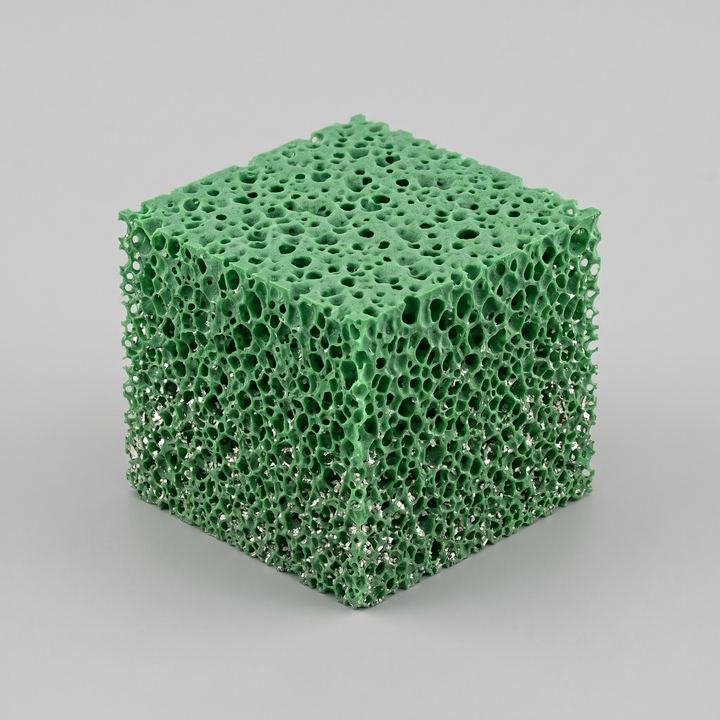
The body reads a deep saturated green from the chromium-tungstate combination, darker and more olive than the V-titanate greens of the perovskite family — a specific lanthanum-heavy-oxide signature. At 0.59 g/cm³ over 120×120×117 mm the slab is surprisingly light for its size and carries the register of a high-porosity body rather than a dense ceramic: the apparent density points to substantial residual voids from the sinter. Surface matte with fine sinter grain; edges cold-cut, kerf-whitened. Fully opaque in the unswitched state. Against a clay-brick sibling of the same volume it reads markedly lighter, greener and chalkier in the hand — a body that looks heavy and weighs almost nothing.
Recipe
200 g batch · peak 1250 °C| element | precursor | formula | mass | safety |
|---|---|---|---|---|
| Cr | chromium(III) oxide | Cr2O3 | 21.42 g | safe |
| La | lanthanum oxide | La2O3 | 45.91 g | moderate |
| W | tungsten trioxide (yellow) | WO3 | 32.67 g | moderate |
- 1Ramp
- 2Hold
- 3Ramp
- 4Ramp
- 5Hold
- 6Ramp
- 7Ramp
Electrochromic — color switches under applied voltage (thin-film chemistry)