Cu₄P₈Zr₁₈
metal pm only · sintered metalCu4P8Zr18 is a metal pm only suitable as sintered-metal. Color: green-red-copper. Fired at 1100°C from 2 precursors (Fe3P, Cu). Workshop batch: 200g at €2.19. Compressive strength ~350 MPa; estimated 0.84 kg CO₂/kg (-53% vs structural steel). Notable: no special functions flagged. Confidence: medium.
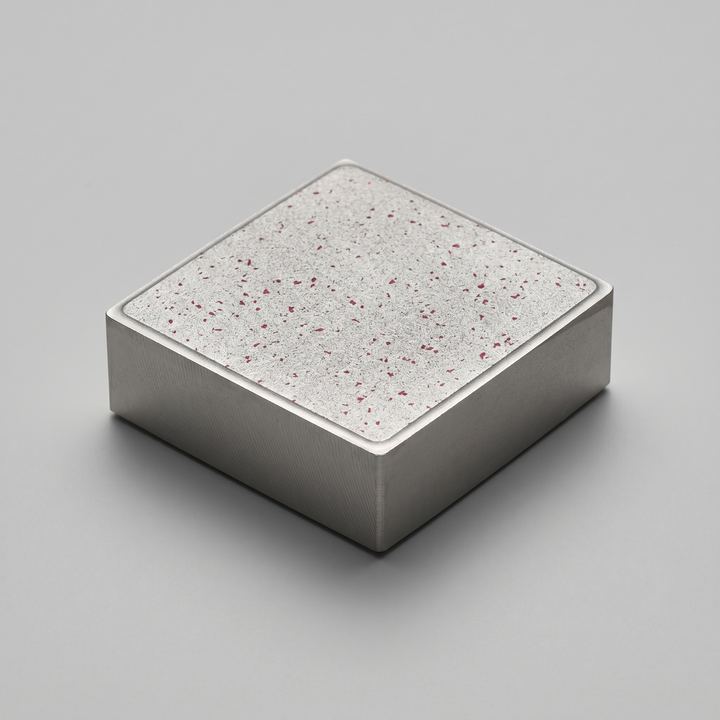
- forms at
- 1100 °C · high-fire
- replaces
- structural steel
- CO₂
- 53.1% lower than structural steel (0.84 vs 1.80 kg CO₂/kg)
- energy
- 74.4% lower than structural steel (5.62 vs 26.00 MJ/kg)
- compressive
- 350 MPa
- density
- 6.54 g/cm³
- crystal
- tetragonal
- band gap
- 0.00 eV
- cost
- €10.95/kg · €2.19 / 200 g batch
- confidence
- medium (synthesis route)
- potential
- 0.45 · env 0.74 · novel 0.00 · struct 0.84 · lineage 0.20 · supply 0.46
Architectural potential
A zirconium-copper phosphide sintered at 1100 °C, dense and mechanically serious — the same hardware register as other sintered metals but in a small, heavy slab that points toward high-stress fittings rather than broad brackets. Three hundred and fifty megapascals of compression paired with a fifty-three-per-cent cut in embodied CO₂ against structural steel gives it a direct argument against cast-steel in seismic brackets, bearing pads under column bases, pile-cap dowels in timber hybrid structures, and heavy hinge pivots or threshold plates where the detail carries cyclic load. At 6.54 g/cm³ the billet sits firmly in the hand; the 70×70×31 mm slab at 200 g is a single connector-sized piece rather than a plate. Cost is the real competitive argument in this batch at €2.19 per unit — cheaper than erbium variants by a factor of five — so specification can move from one-off signature piece toward small-run replicated hardware. Tooling the die is the capital cost; once made, a run of identical brackets is feasible within the 500 g workshop ceiling. The caveat is the narrow batch ceiling: scaling beyond several hundred grams per pour demands an industrial sinter furnace rather than a studio kiln, so workshop prototyping and external production have to be planned from the start.
Material character
The slab reads a dense green-red copper surface with the phosphorus content dulling the matte into a dark patina-like finish — closer in tone to aged bronze than to freshly pressed copper. At 6.54 g/cm³ and 70×70×31 mm, the piece sits firmly on the bench and resists the one-handed lift; the density-to-size ratio is distinctly heavier than either the erbium variant or a typical cast-bronze sibling of the same volume. Surface sintered matte with a fine regular grain from the press die; edges pressed rather than cold-cut, slightly burred where the die parted. Rings short and high when tapped — the hard, dense ring of a sintered phosphide.
Recipe
200 g batch · peak 1100 °C| element | precursor | formula | mass | safety |
|---|---|---|---|---|
| Cu | copper shot/powder | Cu | 13.8 g | safe |
| P | ferrophosphorus (liquid-phase sintering aid) | Fe3P | 86.2 g | safe |
- 1Ramp
- 2Hold
- 3Ramp
- 4Hold
- 5Ramp
- 6Ramp
- 7END