Co₃Mn₅Na₄S₁₆
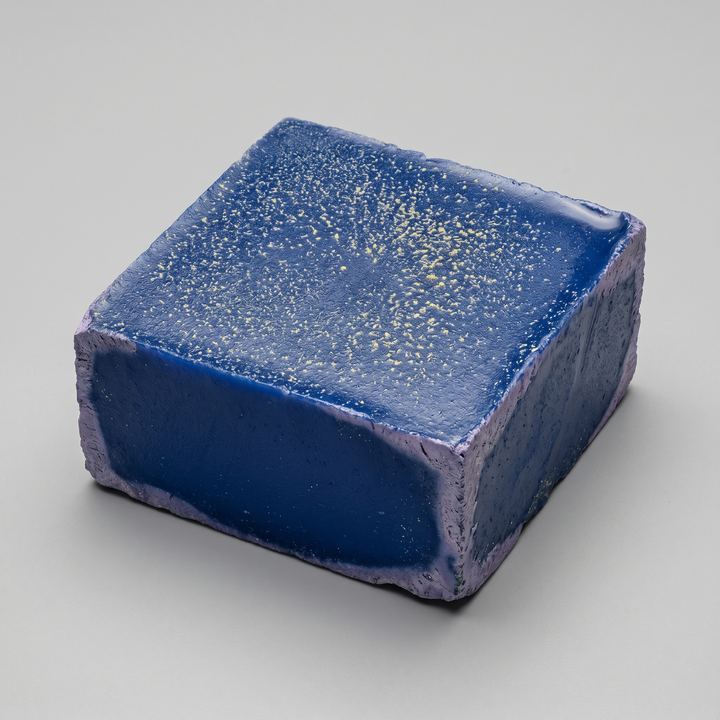
sulfide polysulfide · sulfide low tempCo3Mn5Na4S16 is a sulfide polysulfide suitable as sulfide low temp. Color: blue. Fired at 130°C from 4 precursors (S, MnO2, CoO). Workshop batch: 500g at €26.81. Compressive strength ~150 MPa; estimated 0.09 kg CO₂/kg (-89% vs Portland cement). Notable: forms without a kiln. Confidence: high.
- forms at
- 130 °C · hotplate · no kiln
- replaces
- portland cement
- CO₂
- 89.1% lower than Portland cement (0.09 vs 0.83 kg CO₂/kg)
- energy
- 89.1% lower than Portland cement (0.60 vs 5.50 MJ/kg)
- compressive
- 150 MPa
- density
- 3.19 g/cm³
- crystal
- triclinic
- band gap
- 0.00 eV
- cost
- €53.62/kg · €26.81 / 500 g batch
- confidence
- high (synthesis route)
- potential
- 0.79 · env 1.00 · novel 1.00 · struct 0.30 · lineage 1.00 · supply 0.27
- flags
- zero kiln: Forming happens without firing — the material cures through chemistry at ambient or hotplate temperature. At building scale this removes the kiln from the supply chain: on-site casting, regional workshops, cold-country fabrication all become available.
Architectural potential
A blue zero-kiln cast-sulphide at 150 MPa, this pushes the family beyond its usual yellow-orange register and into a genuine architectural blue — rare in cold-cast materials. The eighty-nine-per-cent CO₂ cut against Portland cement is what makes the argument legible, but the colour is what carries the specification. Natural placements are bathroom-scale cladding in residential retrofits, pool-surround thresholds, drop-cast signage blocks in schools and civic buildings, acoustic-tile patches in studios, and accent-wall panels in gallery fit-out where a saturated ceramic-blue is wanted without the cost or kiln-logistics of a cobalt-fired glaze. Compression at 150 MPa means the material sits as a thick decorative tile or cladding plate rather than a structural block; it works in supplement to timber or steel framing, not in replacement of it. The cobalt-manganese pair drives both colour and hardness, giving the tile a stiffer feel than the potassium-silicate yellow variants. The caveat is environmental rather than structural: saw-cutting releases sulphide odour, the cobalt content pushes workshop PPE requirements up, and at €26.81 per 500 g the material is not a bulk cladding option — it belongs in the small-area accent register where the colour justifies the per-tile cost.
Material character
The face reads a deep, slightly dusty architectural blue with faint green undertones where the sodium-sulphide skin catches the light — a cobalt-blue signature, but darker and softer than a fired cobalt glaze, and quite unlike the yellow-orange register that dominates the rest of the family. At 3.19 g/cm³ and 85×85×43 mm the slab handles with real mass but not stone-weight, a confident two-finger lift that settles heavier than the lithium-silicate sibling. Surface mould-matte with the meniscus gloss of a hotplate pour; edges as-cast, slightly glassy where the sulphide-rich skin formed against the mould wall. The α→β sulphur bloom develops as a faint silver veil within a week, most visible along the darker shadow planes.
Recipe
500 g batch · peak 130 °C| element | precursor | formula | mass | safety |
|---|---|---|---|---|
| Co | cobalt(II) oxide | CoO | 25.79 g | moderate |
| Mn | manganese dioxide | MnO2 | 49.88 g | moderate |
| Na | sodium carbonate / soda ash | Na2CO3 | 24.32 g | safe |
- Pre-heatHotplate to 150 °C
- MeltSulfur liquefies at 115 °C; full liquid at 130 °C
- CastPour at 140–145 °C
- SetRoom temperature 30 min (firm) → 24 h (full strength)
Zero-kiln process — 130 °C hotplate cast only