Nb₁₂S₁₆Sr
sulfide polysulfide · sulfide low tempNb12S16Sr1 is a sulfide polysulfide suitable as sulfide low temp. Color: yellow-orange. Fired at 130°C from 3 precursors (Nb2O5, S, SrCO3). Workshop batch: 500g at €94.40. Compressive strength ~150 MPa; estimated 0.09 kg CO₂/kg (-89% vs Portland cement). Notable: forms without a kiln. Confidence: high.
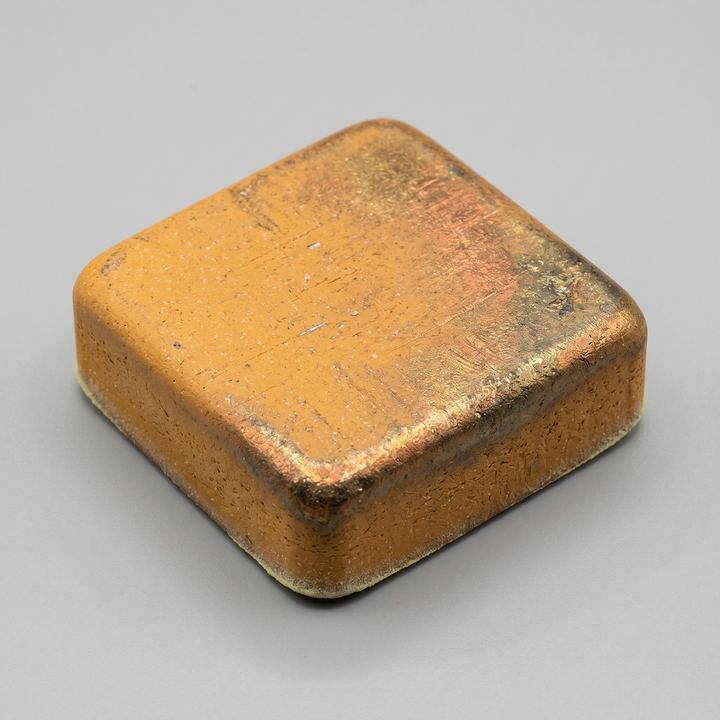
- forms at
- 130 °C · hotplate · no kiln
- replaces
- portland cement
- CO₂
- 89.1% lower than Portland cement (0.09 vs 0.83 kg CO₂/kg)
- energy
- 89.1% lower than Portland cement (0.60 vs 5.50 MJ/kg)
- compressive
- 150 MPa
- density
- 5.16 g/cm³
- crystal
- triclinic
- band gap
- 0.02 eV
- cost
- €188.80/kg · €94.40 / 500 g batch
- confidence
- high (synthesis route)
- potential
- 0.72 · env 1.00 · novel 1.00 · struct 0.30 · lineage 0.70 · supply 0.14
- flags
- zero kiln: Forming happens without firing — the material cures through chemistry at ambient or hotplate temperature. At building scale this removes the kiln from the supply chain: on-site casting, regional workshops, cold-country fabrication all become available.
Architectural potential
A niobium-rich strontium polysulfide cast at 130 °C, this pushes the zero-kiln compression argument up to 150 MPa — three times the iron-sulfide sibling — bringing it into the range where non-reinforced pavement blocks, cast cladding panels for gallery interiors, and stair-tread inlays become structurally reasonable. Like its family, the body forms through chemistry rather than firing, so the eighty-nine-per-cent cut in embodied CO₂ against Portland cement is the lead argument. Natural placements are signature cast slabs in zero-kiln workshops, heavy gallery thresholds where weight-in-the-hand is part of the curatorial register, and cast sills or plinths in retrofit interventions where a kiln cannot be lit but a geological presence is wanted. Two kilograms of workshop ceiling constrains it to detail and insert scale rather than whole-wall work. The real caveat is cost: at €94.40 for a 500 g batch, niobium drives the price roughly twenty times higher than the iron-sulfide sibling, and the supply-chain score sits at 0.29 because niobium comes from a small number of producing regions. Specification belongs in the signature-element register — a single threshold, a named bench, a plinth with a story — rather than repeated bulk tiling.
Material character
The 70×70×40 mm slab reads a deeper yellow-orange than the iron-sulfide siblings — the niobium pulls the matrix toward a mustard-amber with subtle olive shadows at the edge. Surface mold-matte with a finer meniscus than the coarser iron polysulfides; the denser niobium-strontium matrix casts a tighter, more even skin. Edges come as-cast, with a small bead where the mold parting left a seam. At 5.16 g/cm³ the slab resists a single-handed lift and sits firmly on the bench — noticeably heavier for its size than the 4.0 g/cm³ iron sibling, and the density difference is legible in the hand rather than only on paper.
Recipe
500 g batch · peak 130 °C| element | precursor | formula | mass | safety |
|---|---|---|---|---|
| Nb | niobium pentoxide | Nb2O5 | 91.53 g | moderate |
| Sr | strontium carbonate | SrCO3 | 8.47 g | safe |
- Pre-heatHotplate to 150 °C
- MeltSulfur liquefies at 115 °C; full liquid at 130 °C
- CastPour at 140–145 °C
- SetRoom temperature 30 min (firm) → 24 h (full strength)
Zero-kiln process — 130 °C hotplate cast only