Co₄Na₄O₁₄Si₄
alkali silicate glass · structural translucent glassCo4Na4O14Si4 is a alkali silicate glass suitable as structural translucent glass. Color: blue. Fired at 1150°C from 4 precursors (CoO, SiO2, Na2CO3). Workshop batch: 400g at €36.85. Compressive strength ~500 MPa; estimated 0.84 kg CO₂/kg (-2% vs float glass). Notable: no special functions flagged. Confidence: high.
- forms at
- 1150 °C · high-fire
- replaces
- float glass
- CO₂
- 1.9% lower than float glass (0.84 vs 0.86 kg CO₂/kg)
- energy
- 62.5% lower than float glass (5.62 vs 15.00 MJ/kg)
- compressive
- 500 MPa
- density
- 3.28 g/cm³
- crystal
- orthorhombic
- band gap
- —
- cost
- €92.12/kg · €36.85 / 400 g batch
- confidence
- high (synthesis route)
- potential
- 0.64 · env 0.78 · novel 0.00 · struct 1.00 · lineage 0.70 · supply 1.00
Architectural potential
A structural cobalt-blue glass slab — the one-shot combination of load-bearing capacity and saturated historic colour that ordinary cobalt stained glass cannot offer. Five hundred megapascals of compression at 3.282 g/cm³ lifts this above sheet glazing into the pressed-glass element register: coloured glass-floor panels in exhibition architecture, cobalt-blue stair treads in civic interiors, light-wells that cast a deliberately coloured daylight into the space below, pressed-glass beam inserts where both structural and chromatic presence are wanted. Against float glass the CO₂ balance is nearly neutral (-1.9%) but the energy reduction in the melt is sixty-two per cent, and the cobalt content is doing the architectural work that no clear float product can deliver. Natural placements are sacred, memorial, and civic interiors — a space where the Chartres-blue quality of a walked-on floor panel, or the transmitted cobalt wash of an inhabited glass pier, is the defining spatial argument. Workshop batch reaches 5 kg, supply-chain score is 1.0. The caveat is cost: €36.85 per 400 g batch from cobalt oxide precursor shifts the specification away from bulk glazing toward signature placements, and the melt-tank logistics require cobalt-specific ventilation and personal-protection discipline that a clear soda-lime production line does not.
Material character
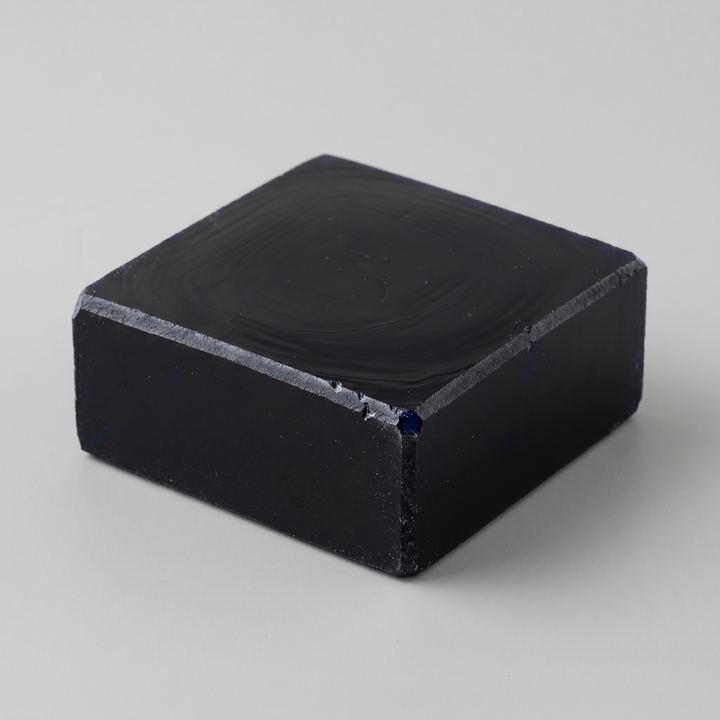
A deep saturated cobalt-blue body — the old stained-glass register translated into a pressed structural form, darker at the long-edge sighting than at the face view. At 3.282 g/cm³ and 85×85×42 mm the slab reads heavier than clear soda-lime stock of the same geometry, a two-hand lift with the weight of a thick paving slab. The top face carries a shallow pressed-glass crown and faint anneal striae near the long edges, standard soda-lime tectonics. Edges come cold-cut with the usual lapidary kerf bloom; the blue deepens noticeably along the thickness, translating a three-centimetre look into a four-centimetre read when sighted edge-on.
Recipe
400 g batch · peak 1150 °C| element | precursor | formula | mass | safety |
|---|---|---|---|---|
| Co | cobalt(II) oxide | CoO | 39.86 g | moderate |
| Na | sodium carbonate / soda ash | Na2CO3 | 28.19 g | safe |
| Si | quartz flour / silica | SiO2 | 31.96 g | safe |
- 1Ramp
- 2Hold
- 3Ramp
- 4Hold
- 5Ramp
- 6Hold