K₄O₁₈Si₆W₂
alkali silicate glass · structural translucent glassK4O18Si6W2 is a alkali silicate glass suitable as structural translucent glass. Color: clear. Fired at 1150°C from 4 precursors (WO3, SiO2, K2CO3). Workshop batch: 400g at €77.39. Compressive strength ~500 MPa; estimated 0.84 kg CO₂/kg (-2% vs float glass). Notable: electrochromic tungstate. Confidence: high.
- forms at
- 1150 °C · high-fire
- replaces
- float glass
- CO₂
- 1.9% lower than float glass (0.84 vs 0.86 kg CO₂/kg)
- energy
- 62.5% lower than float glass (5.62 vs 15.00 MJ/kg)
- compressive
- 500 MPa
- density
- 3.77 g/cm³
- crystal
- hexagonal
- band gap
- 2.86 eV
- cost
- €193.47/kg · €77.39 / 400 g batch
- confidence
- high (synthesis route)
- potential
- 0.81 · env 0.78 · novel 1.00 · struct 1.00 · lineage 0.70 · supply 0.50
- flags
- electrochromic tungstate: A voltage-switchable optical chemistry. In thin-film form a small DC signal shifts transmission from clear to tinted blue, opening the door to dimmable glazing and responsive partitions that do not need mechanical shading.
Architectural potential
A potassium-tungstate silicate glass fired at 1150 °C, 500 MPa of compression, and an electrochromic tungstate chemistry carried in the glass body itself rather than as a coating. A small DC signal shifts transmission from clear to deep tinted blue, and the structural strength means the element can both carry load and dim itself. Natural placements are switchable glass partitions in open-plan offices where privacy states are programmed rather than assembled, dimmable skylight panes over gallery bays where lux levels need to track the hanging schedule, transparent stair treads that can be tinted during cleaning hours, and responsive-tint piers in an atrium curtain wall that step down brightness in response to a single building-management signal. Against float glass the embodied CO₂ is within two per cent and the energy budget sixty-two per cent lower, so for the signature switchable-glazing element the environmental trade is legible. The caveat is tungsten cost: €77.39 per 400 g batch is by far the highest in the translucent-structural group, and the switching chemistry demands a DC feed and a control layer integrated into the fabrication — specification commits to an electrical detail, not only a glazing detail.
Material character
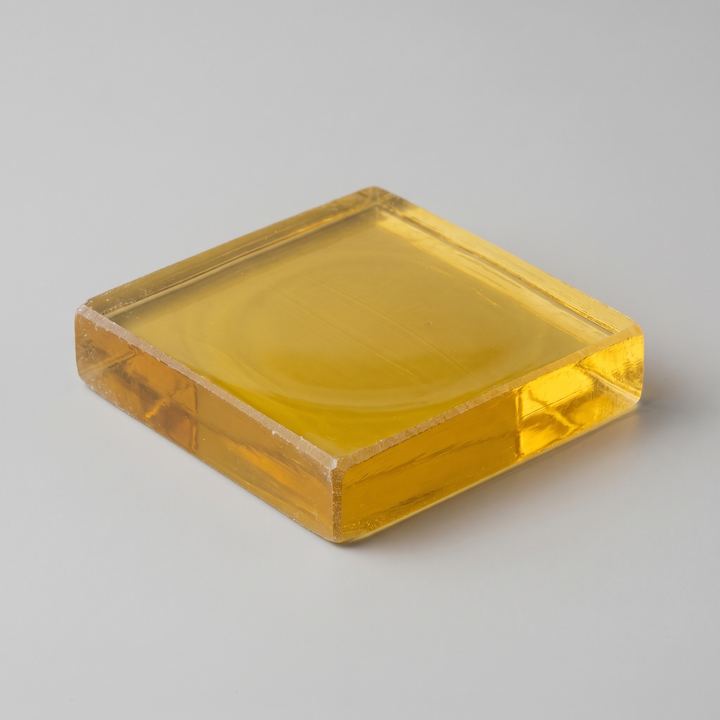
Clear in the resting state, with a very faint green-tungstate tint legible only against a white reference card — the body reads as ordinary glass until a voltage arrives. At 3.77 g/cm³ and 85×85×37 mm the slab sits firm two-handed, denser than the soda-silicate siblings and close in lift register to a lead-crystal block. Surface pressed-glass with two fine anneal striae near one long edge; crown low and even. Edges cold-cut, the lapidary bloom clean. Against a conventional potassium-silicate glass the body rings heavier and holds a slightly cooler cast, and the post-switched state shifts to a saturated cobalt-blue face under a driving signal.
Recipe
400 g batch · peak 1150 °C| element | precursor | formula | mass | safety |
|---|---|---|---|---|
| K | potassium carbonate / potash | K2CO3 | 25.12 g | safe |
| Si | quartz flour / silica | SiO2 | 32.75 g | safe |
| W | tungsten trioxide (yellow) | WO3 | 42.13 g | moderate |
- 1Ramp
- 2Hold
- 3Ramp
- 4Hold
- 5Ramp
- 6Hold
Electrochromic — color switches under applied voltage (thin-film chemistry)