Cr₂Nd₂O₁₆Sr₆Ti₂
perovskite ceramic · functional ceramicCr2Nd2O16Sr6Ti2 is a perovskite ceramic suitable as functional-ceramic. Color: green. Fired at 1300°C from 4 precursors (SrCO3, Nd2O3, TiO2). Workshop batch: 200g at €13.81. Compressive strength ~100 MPa; estimated 0.97 kg CO₂/kg (+343% vs clay brick). Notable: uv luminescent. Confidence: medium.
- forms at
- 1300 °C · extreme-fire
- replaces
- clay brick
- CO₂
- 343% higher than clay brick (0.97 vs 0.22 kg CO₂/kg; 4.4× higher)
- energy
- 117% higher than clay brick (6.50 vs 3.00 MJ/kg; 2.2× higher)
- compressive
- 100 MPa
- density
- 5.51 g/cm³
- crystal
- orthorhombic
- band gap
- 2.33 eV
- cost
- €69.05/kg · €13.81 / 200 g batch
- confidence
- medium (synthesis route)
- potential
- 0.26 · env 0.00 · novel 0.57 · struct 0.20 · lineage 0.50 · supply 0.10
- flags
- uv luminescent: Converts invisible ultraviolet into visible light. Signage panels, low-energy wayfinding tiles, emergency markings that draw their illumination from daylight rather than mains power.
Architectural potential
A neodymium-strontium-chromium-titanate perovskite fired at 1300 °C — a functional ceramic whose architectural argument is ultraviolet luminescence carried on a classic perovskite lattice. Embodied CO₂ runs nearly four and a half times that of clay brick and compression sits at one hundred megapascals, so the material is ruled out as a volume body and every placement has to be paid for by the UV-to-visible conversion. Natural placements are signage tiles in cinema foyers and club architecture where UV lighting is already part of the environment; emergency wayfinding markers in underground corridors and tunnels that draw their illumination from daylight excitation rather than mains power; accent inserts in gallery cases where a dedicated 365 nm source can light a specific object without visible lamp infrastructure; and threshold tiles in theatre lobbies where the transition into darker space is signalled by a glowing strip. Untested at building scale in production architecture. The 200 g workshop batch at €13.81 sits at the lower end of the rare-capability cost range in this batch — a rare case where the functional chemistry does not carry an extreme unit price. The caveat is firing itself: 1300 °C is the upper edge of workshop kiln capacity, and the 500 g ceiling means any run has to be planned as multiple firings with batch-to-batch emission verification.
Material character
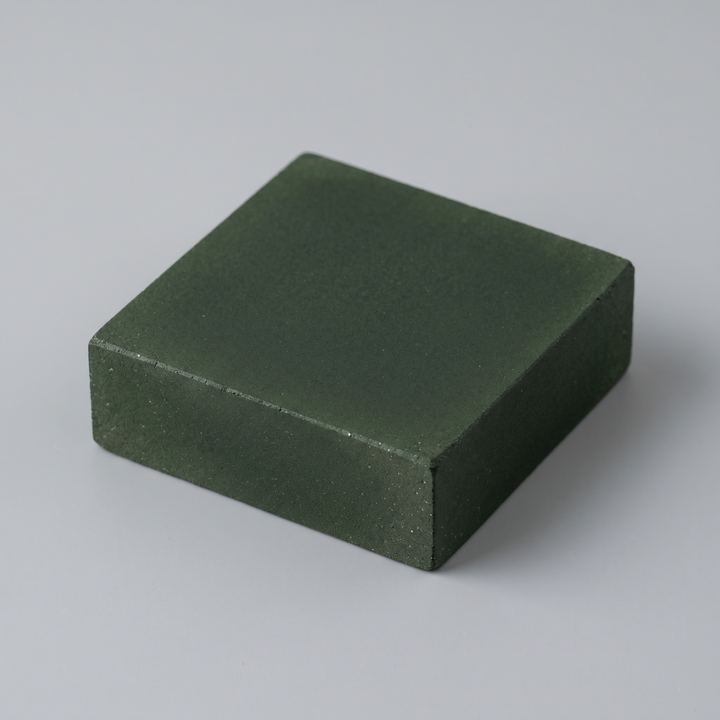
The body reads a deep green, the neodymium adding a characteristic pink-shifted undertone that flickers through the matrix under incandescent light — a slight chromatic shimmer specific to neodymium ceramics, absent from pure chromium greens. At 5.51 g/cm³ over 70×70×37 mm the slab is heavy for its modest footprint, close in hand-feel to a dense architectural stone and resisting a one-handed lift. Surface matte from the sinter, finely grained with the particular crystalline roughness of a 1300 °C fire; edges cold-cut, kerf-whitened. Under a 365 nm excitation source the body emits a sharp amber-pink, visible without a darkened room and distinct from the chartreuse of praseodymium siblings.
Recipe
200 g batch · peak 1300 °C| element | precursor | formula | mass | safety |
|---|---|---|---|---|
| Cr | chromium(III) oxide | Cr2O3 | 9.91 g | safe |
| Nd | neodymium oxide | Nd2O3 | 21.93 g | moderate |
| Sr | strontium carbonate | SrCO3 | 57.74 g | safe |
| Ti | titanium dioxide (rutile) | TiO2 | 10.41 g | safe |
- 1Ramp
- 2Hold
- 3Ramp
- 4Ramp
- 5Hold
- 6Ramp
- 7Ramp
UV-luminescent — emits visible light under 365 nm UV