Cr₆Na₂S₆
sulfide polysulfide · sulfide low tempCr6Na2S6 is a sulfide polysulfide suitable as sulfide low temp. Color: yellow-orange. Fired at 130°C from 3 precursors (Cr2O3, S, Na2CO3). Workshop batch: 500g at €11.42. Compressive strength ~50 MPa; estimated 0.09 kg CO₂/kg (-89% vs Portland cement). Notable: forms without a kiln. Confidence: high.
- forms at
- 130 °C · hotplate · no kiln
- replaces
- portland cement
- CO₂
- 89.1% lower than Portland cement (0.09 vs 0.83 kg CO₂/kg)
- energy
- 89.1% lower than Portland cement (0.60 vs 5.50 MJ/kg)
- compressive
- 50 MPa
- density
- 3.81 g/cm³
- crystal
- hexagonal
- band gap
- —
- cost
- €22.84/kg · €11.42 / 500 g batch
- confidence
- high (synthesis route)
- potential
- 0.71 · env 1.00 · novel 1.00 · struct 0.10 · lineage 0.70 · supply 0.27
- flags
- zero kiln: Forming happens without firing — the material cures through chemistry at ambient or hotplate temperature. At building scale this removes the kiln from the supply chain: on-site casting, regional workshops, cold-country fabrication all become available.
Architectural potential
A hotplate-formed polysulfide with a modest 50 MPa of compression and an eighty-nine-per-cent cut in embodied CO₂ against Portland cement, placing it in the non-structural detail register rather than in load-bearing work. The chromium-sodium-sulfide body cures at 130 °C, so forming happens on a bench rather than in a kiln, and the 500 g batch scales cleanly to two kilograms in a workshop — enough for small tile runs, inlay panels, and cast laminate surfaces. Natural placements are acoustic wall tiles in studios and recording rooms where mass without structural burden is wanted, decorative threshold strips and sill inlays, drop-cast signage panels in cultural buildings, and warm-toned feature tiles in foyers. Because the compressive register is light, it belongs on surfaces rather than within them: a skin over a stud wall, a facing over timber, a shallow tile on a structural substrate. The environmental argument carries the specification: cement-scale making logic with the kiln removed. The caveat is hygiene and legibility — saw-cutting releases sulphide odour and calls for workshop ventilation, and the 50 MPa ceiling forbids any use in which footfall, knocks, or impact load the piece directly.
Material character
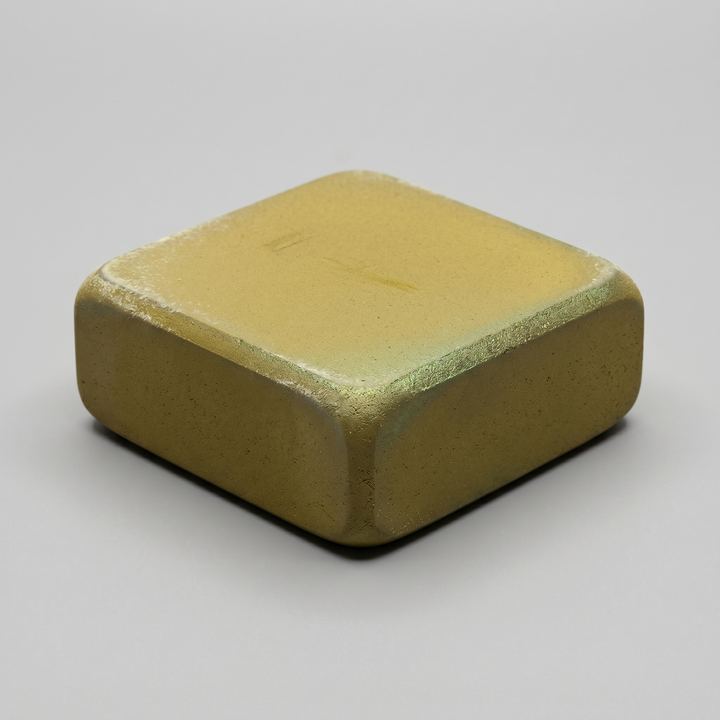
The slab reads a muted yellow-orange with a faint olive undertone from the chromium–polysulfide chemistry, cooler and more desaturated than the copper-heavy polysulfide siblings. At 3.81 g/cm³ in an 85×85×36 mm piece, the slab fits into a comfortable single-hand grip — firm rather than heavy, softer to lift than a fired ceramic of the same footprint. Surface mold-matte with the meniscus sheen characteristic of a hotplate cast; edges come as-cast, with a faint sulfur bloom accumulating along the long kerf. Fully opaque. Tapped, the body answers with a dull rather than a ringing note, a softer acoustic signature than vitrified ceramic of comparable dimensions.
Recipe
500 g batch · peak 130 °C| element | precursor | formula | mass | safety |
|---|---|---|---|---|
| Cr | chromium(III) oxide | Cr2O3 | 81.14 g | safe |
| Na | sodium carbonate / soda ash | Na2CO3 | 18.86 g | safe |
- Pre-heatHotplate to 150 °C
- MeltSulfur liquefies at 115 °C; full liquid at 130 °C
- CastPour at 140–145 °C
- SetRoom temperature 30 min (firm) → 24 h (full strength)
Zero-kiln process — 130 °C hotplate cast only