CuNb₉Se₁₆
metal pm only · sintered metalCu1Nb9Se16 is a metal pm only suitable as sintered-metal. Color: green-red-copper. Fired at 1100°C from 1 precursors (Cu). Workshop batch: 200g at €0.18. Compressive strength ~350 MPa; estimated 0.84 kg CO₂/kg (-53% vs structural steel). Notable: no special functions flagged. Confidence: medium.
- forms at
- 1100 °C · high-fire
- replaces
- structural steel
- CO₂
- 53.1% lower than structural steel (0.84 vs 1.80 kg CO₂/kg)
- energy
- 74.4% lower than structural steel (5.62 vs 26.00 MJ/kg)
- compressive
- 350 MPa
- density
- 6.47 g/cm³
- crystal
- trigonal
- band gap
- 0.00 eV
- cost
- €0.90/kg · €0.18 / 200 g batch
- confidence
- medium (synthesis route)
- potential
- 0.49 · env 0.74 · novel 0.00 · struct 0.84 · lineage 0.50 · supply 0.43
Architectural potential
This is a powder-pressed metal candidate for the bracket and connector register, sitting closer to structural steel than to any ceramic in the palette. Three hundred and fifty megapascals of compression paired with a fifty-three-per-cent cut in embodied CO₂ against rolled steel lifts it into a credible post-steel register for small- to medium-sized hardware: façade clips, curtain-wall shoulder brackets, moment-connector nodes in timber-hybrid frames, furniture-scale hinges, balustrade fittings, and the kind of machined seismic bracket that normally arrives as cast steel. The niobium-selenide matrix with its thin copper wetting phase takes machining and post-finish work cleanly, so the part leaves the furnace close to its final geometry and receives its bearing faces on a mill. Natural placements are office fit-out hardware where the emissions argument is visible, exhibition-architecture joinery where the copper-flecked surface becomes part of the detail, and retrofit brackets in schools and civic buildings where a smaller carbon budget is specified. The caveat is batch ceiling: 200 g per pour with a 500 g workshop maximum means this is not a material for bulk rolled-section work. Specification has to stay at the connector, bracket and fitting scale, where a single piece weighs less than a kilogram and the design register is about repeated small elements rather than continuous runs of structure.
Material character
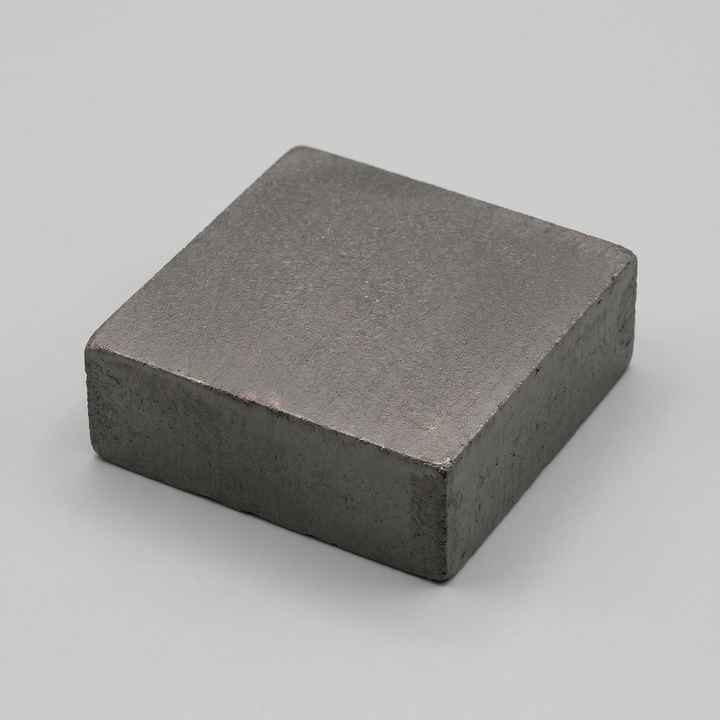
Pressed and sintered at 1100 °C, the slab reads as a mottled green-red-copper surface, with the copper-rich phase migrating to the skin during the hold and leaving a thin wetting film over the darker niobium-selenide matrix. At 6.47 g/cm³ and 70×70×32 mm the slab sits firm under a two-finger pinch and needs a confident one-hand lift, a distinct step down from the denser Pr-Sn variant. Surface is a sintered matte grain, not the mirror of a cast piece; edges arrive sharp from the die and carry a faint oxide bloom along the press line. Rings dull and low when tapped — a metallic register but damped, nothing like the high clean tone of a bronze or a bell-casting.
Recipe
200 g batch · peak 1100 °C| element | precursor | formula | mass | safety |
|---|---|---|---|---|
| Cu | copper shot/powder | Cu | 100.0 g | safe |
- 1Ramp
- 2Hold
- 3Ramp
- 4Hold
- 5Ramp
- 6Ramp
- 7END