Cu₂La₆S₁₄Ti₂
sulfide metal composite · sulfide low tempCu2La6S14Ti2 is a sulfide metal composite suitable as sulfide low temp. Color: green-red-copper. Fired at 130°C from 4 precursors (La2O3, S, TiO2). Workshop batch: 300g at €11.93. Compressive strength ~50 MPa; estimated 0.09 kg CO₂/kg (-89% vs Portland cement). Notable: forms without a kiln. Confidence: medium.
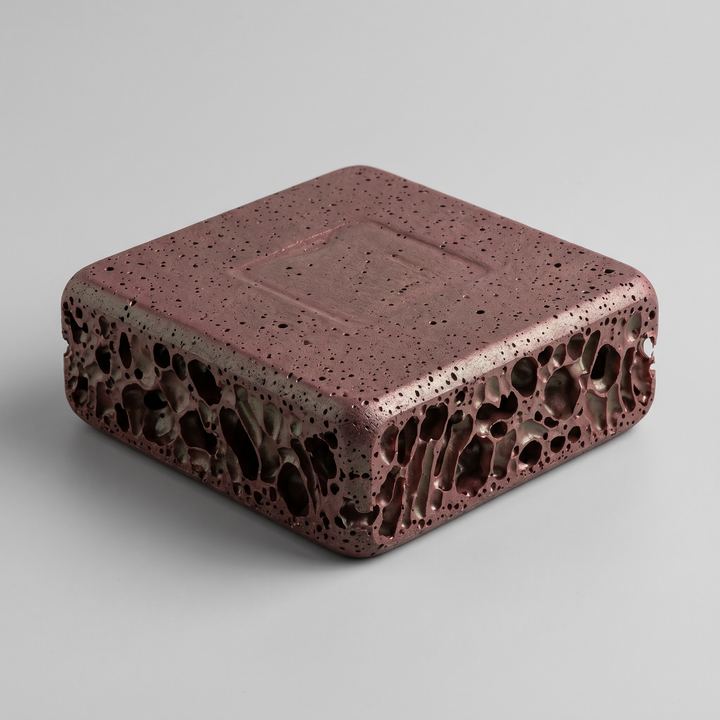
- forms at
- 130 °C · hotplate · no kiln
- replaces
- portland cement
- CO₂
- 89.1% lower than Portland cement (0.09 vs 0.83 kg CO₂/kg)
- energy
- 89.1% lower than Portland cement (0.60 vs 5.50 MJ/kg)
- compressive
- 50 MPa
- density
- 0.45 g/cm³
- crystal
- hexagonal
- band gap
- 1.59 eV
- cost
- €39.77/kg · €11.93 / 300 g batch
- confidence
- medium (synthesis route)
- potential
- 0.71 · env 1.00 · novel 1.00 · struct 0.10 · lineage 0.50 · supply 0.46
- flags
- zero kiln: Forming happens without firing — the material cures through chemistry at ambient or hotplate temperature. At building scale this removes the kiln from the supply chain: on-site casting, regional workshops, cold-country fabrication all become available.
Architectural potential
A radically light lanthanum-titanium-copper sulphide whose 0.446 g/cm³ density and 120×120×156 mm slab make it behave architecturally as a foam or insulating block rather than as a cast tile. At 50 MPa compression the role is firmly non-structural: partition infill, acoustic panel cores, decorative light-weight blocks for interior room divisions, and thermal-break inserts in cladding sub-structure. The 130 °C hotplate cure and eighty-nine-per-cent CO₂ cut against Portland cement give it the zero-kiln environmental argument at a scale where few cast cement products can match — casting insulating masonry-scale blocks without ever firing, in a regional workshop rather than a kiln yard. Natural placements are interior partition cores in retrofit residential work, acoustic-core panels for music-room and recording-studio interiors, stair-underside soffit blocks where weight matters, and backing blocks behind heavy-material cladding where the facing carries the loads. The lanthanum adds a faint pale cast that takes paint and surface finishes cleanly. The caveat is mechanical: at 0.446 g/cm³ the block is too soft for direct-traffic surfaces and requires facing material at any edge condition that sees regular hand contact, so the architectural specification is firmly core-and-skin rather than monolithic, and the finish tectonic belongs closer to timber-framed partition than to masonry.
Material character
The block is extraordinarily light for its 120×120×156 mm size — a near-2.25-litre volume weighing under a kilogram, softwood register in the hand rather than stone or cement. Colour sits in the muted green-red-copper family but pales under the lanthanum loading, reading closer to a weathered verdigris than to the saturated mottles of the dense sulphide siblings. Surface mould-matte with a slightly chalky open-pore texture; edges come as-cast, soft enough to feather under thumbnail pressure. Tap response is dull and fibrous, closer to lightweight concrete block than to cast stone. Against its 4 g/cm³ cousins the hand-feel difference is an order of magnitude.
Recipe
300 g batch · peak 130 °C| element | precursor | formula | mass | safety |
|---|---|---|---|---|
| Cu | copper(II) oxide (black) | CuO | 12.27 g | safe |
| La | lanthanum oxide | La2O3 | 75.4 g | moderate |
| Ti | titanium dioxide (rutile) | TiO2 | 12.32 g | safe |
- Pre-heatHotplate to 150 °C
- MeltSulfur liquefies at 115 °C; full liquid at 130 °C
- CastPour at 140–145 °C
- SetRoom temperature 30 min (firm) → 24 h (full strength)
Zero-kiln process — 130 °C hotplate cast only