Fe₄Mn₇Si₄V
metal pm only · sintered metalFe4Mn7Si4V1 is a metal pm only suitable as sintered-metal. Color: grey-blue. Fired at 1100°C from 3 precursors (Mn, Fe, Si). Workshop batch: 200g at €3.16. Compressive strength ~250 MPa; estimated 0.84 kg CO₂/kg (-53% vs structural steel). Notable: shape memory FeMnSi. Confidence: medium.
- forms at
- 1100 °C · high-fire
- replaces
- structural steel
- CO₂
- 53.1% lower than structural steel (0.84 vs 1.80 kg CO₂/kg)
- energy
- 74.4% lower than structural steel (5.62 vs 26.00 MJ/kg)
- compressive
- 250 MPa
- density
- 0.73 g/cm³
- crystal
- trigonal
- band gap
- 0.00 eV
- cost
- €15.80/kg · €3.16 / 200 g batch
- confidence
- medium (synthesis route)
- potential
- 0.61 · env 0.74 · novel 0.80 · struct 0.60 · lineage 0.20 · supply 0.46
- flags
- shape memory FeMnSi: Deforms on cue and snaps back to a remembered shape when warmed. Deployable canopies, self-tensioning fasteners, seismic-damping brackets, and geometry-changing envelopes all become mechanically possible.
Architectural potential
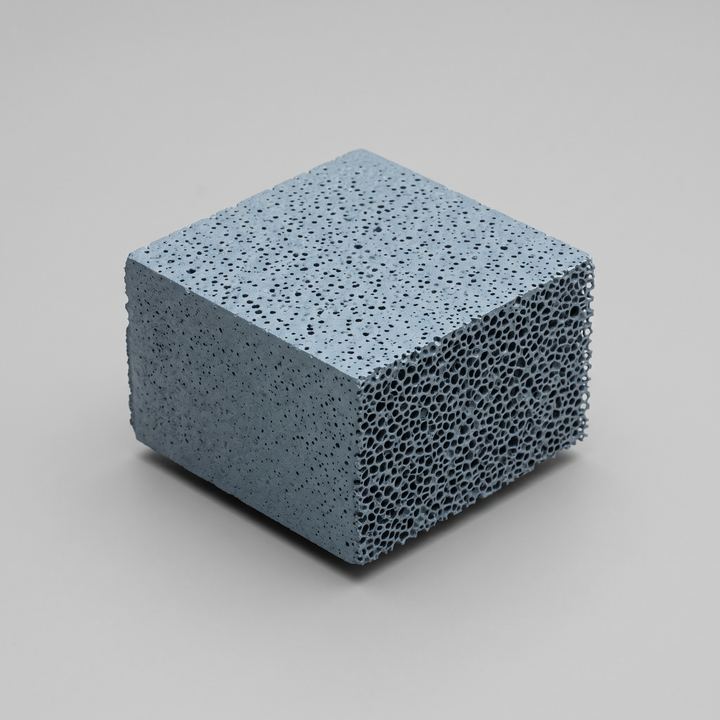
A vanadium-stabilised shape-memory sintered metal formed at 120×120×96 mm — a markedly larger format than its niobium sibling and a different architectural instrument because of it. The same FeMnSi shape-memory chemistry carries through, so the piece deforms on cue and snaps back when warmed, but at this block-scale it steps out of hardware and into the register of seismic-brace cores, self-resetting column-base connectors, and deployable-geometry hinges at primary-element size. Fifty-three per cent less embodied CO₂ than structural steel and a seventy-four-per-cent drop in firing energy make the environmental argument legible against conventional welded steelwork; the five-hundred-gram workshop ceiling means the block must be specified as a signature structural moment rather than a repeated detail. Natural placements are the bracket that holds a roof diaphragm and yields during a tremor, the column-base shoe in a retrofit of a masonry building in seismic country, and the reconfigurable connection in a demountable pavilion. The caveat is the density figure: at 0.727 g/cm³ the sintered body is porous and under-densified — a pressed green body or a lightweight variant, not a fully closed alloy — so the 250 MPa compressive strength should be read as upper-bound, with fatigue and creep behaviour verified before any seismic specification.
Material character
The 120×120×96 mm block reads a cool grey-blue with the faint warm undertone that vanadium brings to an iron-manganese sinter. Surface shows the coarse sintered grain characteristic of a pressed-metal green body — visible inter-particle porosity, matte throughout, with no mill finish. Edges are die-pressed with a generous radius and the parting line from the press tool still legible. At 0.727 g/cm³ the block lifts surprisingly easily for its size — lighter in hand than a clay brick of the same footprint, closer to a dense hardwood register than to a steel node. Rings low and muted under a tap, confirming an open-pore structure under the matte skin.
Recipe
200 g batch · peak 1100 °C| element | precursor | formula | mass | safety |
|---|---|---|---|---|
| Fe | iron powder -325 mesh | Fe | 31.01 g | moderate |
| Mn | manganese flakes | Mn | 53.39 g | moderate |
| Si | silicon granules | Si | 15.6 g | safe |
- 1Ramp
- 2Hold
- 3Ramp
- 4Hold
- 5Ramp
- 6Ramp
- 7END
Shape-memory — deformed body recovers on heating (Fe-Mn-Si)