Cu₃Te₁₉
metal pm only · sintered metalCu3Te19 is a metal pm only suitable as sintered-metal. Color: green-red-copper. Fired at 1100°C from 1 precursors (Cu). Workshop batch: 200g at €0.44. Compressive strength ~350 MPa; estimated 0.84 kg CO₂/kg (-53% vs structural steel). Notable: no special functions flagged. Confidence: medium.
- forms at
- 1100 °C · high-fire
- replaces
- structural steel
- CO₂
- 53.1% lower than structural steel (0.84 vs 1.80 kg CO₂/kg)
- energy
- 74.4% lower than structural steel (5.62 vs 26.00 MJ/kg)
- compressive
- 350 MPa
- density
- 5.90 g/cm³
- crystal
- triclinic
- band gap
- 0.01 eV
- cost
- €2.20/kg · €0.44 / 200 g batch
- confidence
- medium (synthesis route)
- potential
- 0.45 · env 0.74 · novel 0.00 · struct 0.84 · lineage 0.20 · supply 0.46
Architectural potential
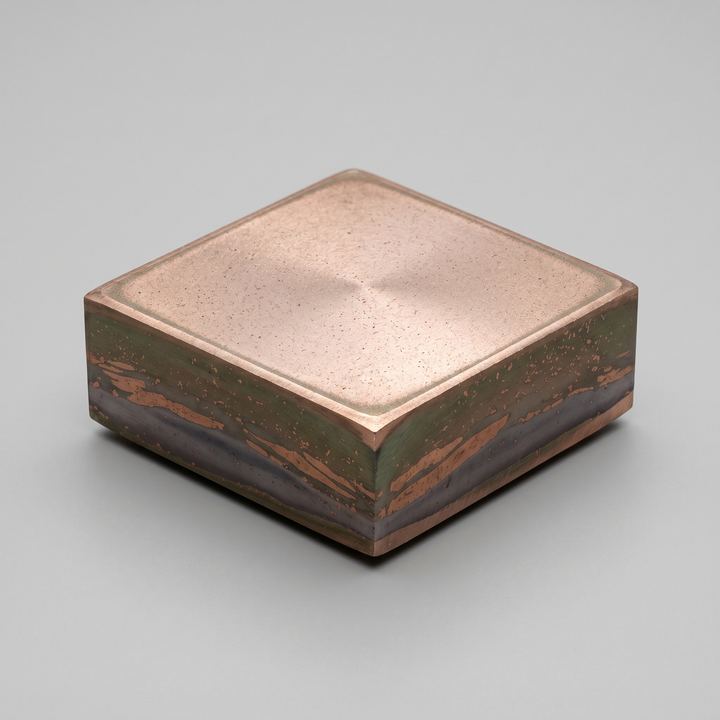
A copper-telluride sintered compact fired at 1100 °C — telluride-heavy rather than copper-heavy, which pushes density up and colour toward a green-red shift that does not exist in the conventional bronze palette. Compression at 350 MPa puts it firmly in the structural-connector register: custom column bases for a signature gallery stair, cast-in-place hardware for timber-to-timber moment joints, poured pivot nodes for a swing-glass partition, monolithic bracket sets for heavy shelving in an archive. Against welded structural steel the embodied CO₂ is fifty-three per cent lower and the energy budget seventy-four per cent lower, so at hardware scale the environmental trade is real. €0.44 per 200 g batch makes this the cheapest metal in the atlas to prototype, and the 500 g workshop ceiling keeps specification honest: node-scale and bracket-scale, not beam-scale. Natural placements are museum-fitting hardware where the green-red patina reads as considered rather than accidental, and retrofit connectors in heritage timber where a visible bronze-register knuckle is wanted. The caveat is tellurium: the element is a by-product of copper refining, supply is tied to that parent stream, and a large-footprint specification would quickly outrun available feedstock.
Material character
A green-red copper shift unique to the high-telluride ratio — the copper face is there, but shadowed by a verdigris-green cast that deepens in recessed mould detail. At 5.9 g/cm³ and 70×70×35 mm the slab sits decisively two-handed — the densest metal in this sub-family and close in lift register to a brass block of the same footprint. Surface carries the sintered matte grain typical of powder-pressed parts; edges cold-cut, the kerf bright. Against a pure copper sibling the body is duller, harder, and more brittle in the ring under tap, and the patina forms faster in humid interiors — a living surface rather than a stable one.
Recipe
200 g batch · peak 1100 °C| element | precursor | formula | mass | safety |
|---|---|---|---|---|
| Cu | copper shot/powder | Cu | 100.0 g | safe |
- 1Ramp
- 2Hold
- 3Ramp
- 4Hold
- 5Ramp
- 6Ramp
- 7END