Er₂Li₂Mn₂O₁₂W₂
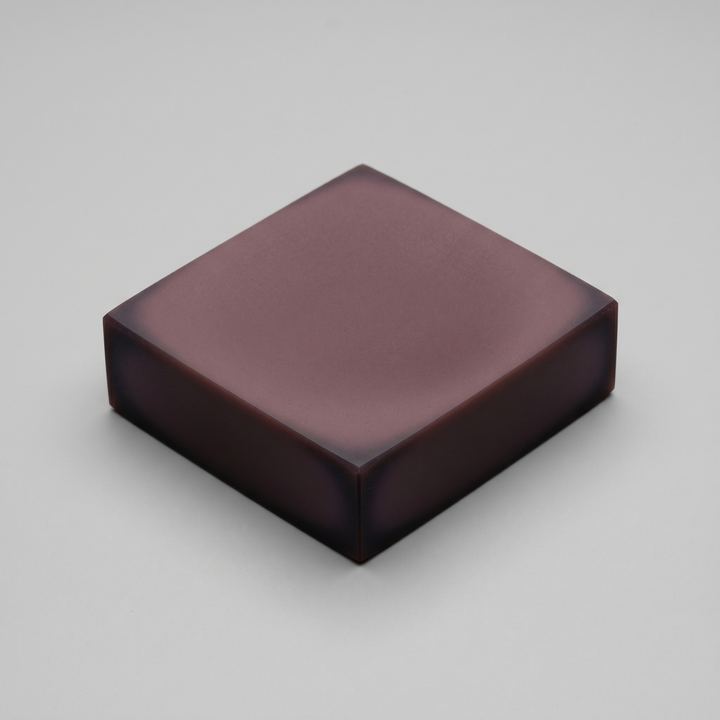
rare earth oxide · rare earth ceramicEr2Li2Mn2O12W2 is a rare earth oxide suitable as rare earth ceramic. Color: purple-brown. Fired at 1200°C from 4 precursors (WO3, Er2O3, MnO2). Workshop batch: 100g at €86.92. Compressive strength ~100 MPa; estimated 0.90 kg CO₂/kg (+309% vs clay brick). Notable: uv luminescent, electrochromic tungstate. Confidence: medium.
- forms at
- 1200 °C · high-fire
- replaces
- clay brick
- CO₂
- 309% higher than clay brick (0.90 vs 0.22 kg CO₂/kg; 4.1× higher)
- energy
- 100% higher than clay brick (6.00 vs 3.00 MJ/kg; 2.0× higher)
- compressive
- 100 MPa
- density
- 7.12 g/cm³
- crystal
- monoclinic
- band gap
- 2.68 eV
- cost
- €869.20/kg · €86.92 / 100 g batch
- confidence
- medium (synthesis route)
- potential
- 0.36 · env 0.00 · novel 1.00 · struct 0.20 · lineage 0.50 · supply 0.05
- flags
- uv luminescent: Converts invisible ultraviolet into visible light. Signage panels, low-energy wayfinding tiles, emergency markings that draw their illumination from daylight rather than mains power. electrochromic tungstate: A voltage-switchable optical chemistry. In thin-film form a small DC signal shifts transmission from clear to tinted blue, opening the door to dimmable glazing and responsive partitions that do not need mechanical shading.
Architectural potential
An erbium-tungstate ceramic with a dual-optical signature: UV-luminescent emission under near-ultraviolet excitation and electrochromic switching under a small DC bias. At 100 MPa and 7.12 g/cm³ the compression register is tile-and-patch scale, and the embodied CO₂ sits over three times a clay brick, so any architectural argument must rest on the two switched behaviours rather than on mass. Natural placements are active signage panels in public interiors — emergency-exit markers that glow from ambient UV, wayfinding strips along gallery and museum routes, and corridor threshold tiles that read dark under daylight and emit when evening shifts into near-UV. The electrochromic capability opens a secondary register: dimmable overlay panels in double-skin façades, responsive partition inserts where a small DC signal shifts tint from clear to amber, and sensor-tile patches that darken in response to building-management-system cues. Against clay brick the CO₂ penalty is prohibitive for volume work. The caveat is real: €86.92 per 100 g workshop batch, a supply-chain score near zero for erbium and tungsten together, and a 300 g workshop ceiling. Specification belongs in the signature-patch register — the tile that emits or dims at a precise moment in the plan.
Material character
The 70×70×29 mm slab reads a deep purple-brown under daylight, the erbium pushing the body into a saturated wine tone that darkens perceptibly along the long edge. At 7.12 g/cm³ the piece is dense for its tile footprint, firm two-handed and closer in register to a cast stone than to a standard fired ceramic. Surface fires to a smooth sintered matte with a faint rare-earth grain visible under raking light; edges cold-cut with the diamond-saw dust left along the kerf. Against the bismuth-thulium cousin the Er body reads cooler and more wine-toned, and under 365 nm UV excitation the surface emits a characteristic erbium green — a second colour state invisible in daylight.
Recipe
100 g batch · peak 1200 °C| element | precursor | formula | mass | safety |
|---|---|---|---|---|
| Er | erbium oxide | Er2O3 | 34.97 g | moderate |
| Li | lithium carbonate | Li2CO3 | 6.75 g | safe |
| Mn | manganese dioxide | MnO2 | 15.89 g | moderate |
| W | tungsten trioxide (yellow) | WO3 | 42.39 g | moderate |
- 1Ramp
- 2Hold
- 3Ramp
- 4Ramp
- 5Hold
- 6Ramp
- 7Ramp
UV-luminescent — emits visible light under 365 nm UV
Electrochromic — color switches under applied voltage (thin-film chemistry)