Fe₄O₈SbV
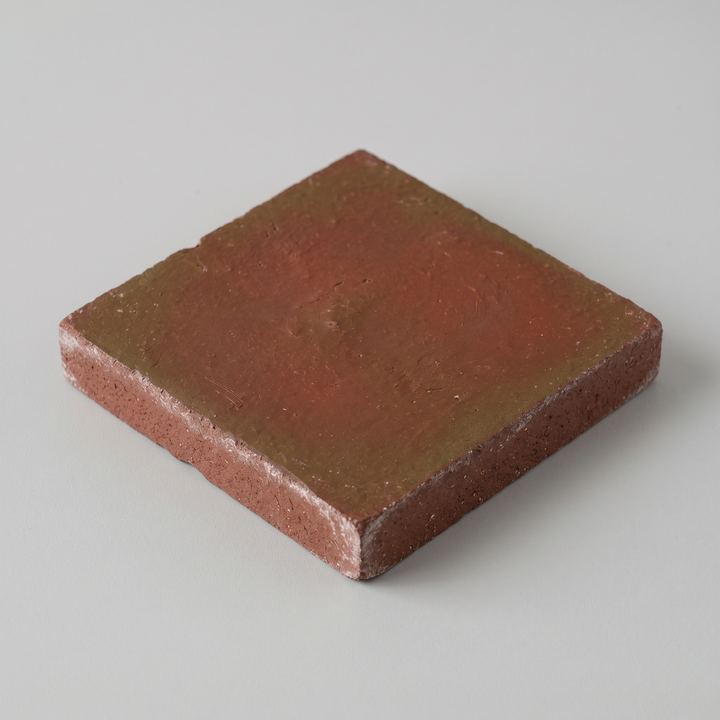
iron oxide ceramic · structural ceramicFe4O8Sb1V1 is a iron oxide ceramic suitable as structural-ceramic. Color: amber-brown. Fired at 1100°C from 3 precursors (Sb2O3, V2O5, Fe2O3). Workshop batch: 1000g at €26.65. Compressive strength ~100 MPa; estimated 0.79 kg CO₂/kg (+258% vs clay brick). Notable: thermochromic VO2. Confidence: high.
- forms at
- 1100 °C · high-fire
- replaces
- clay brick
- CO₂
- 258% higher than clay brick (0.79 vs 0.22 kg CO₂/kg; 3.6× higher)
- energy
- 75% higher than clay brick (5.25 vs 3.00 MJ/kg; 1.8× higher)
- compressive
- 100 MPa
- density
- 5.12 g/cm³
- crystal
- monoclinic
- band gap
- 0.96 eV
- cost
- €26.65/kg · €26.65 / 1000 g batch
- confidence
- high (synthesis route)
- potential
- 0.38 · env 0.00 · novel 0.90 · struct 0.30 · lineage 0.70 · supply 0.00
- flags
- thermochromic VO2: Passive thermal-optical switching: transmission shifts near 68 °C without any driving signal. At building scale this gives a window that darkens as it heats, reducing solar gain without wiring or sensors.
Architectural potential
An iron-oxide ceramic with antimony and vanadium as functional modifiers, fired at 1100 °C to 100 MPa at 5.12 g/cm³, carrying a thermochromic vanadium-dioxide chemistry that flips the body's optical state at 68 °C. The load-bearing register is nominal at 100 MPa — this is not a block-work candidate — so the placements follow the thermochromic flag. Natural use is as a south-facing cladding tile on warm-toned brick façades where the body darkens visibly through the hottest afternoon hours and clears as evening cools, as a roof-tile insert over south-facing sun-rooms where summer over-heating is a live problem, and as a perimeter band around skylights in conservatories and double-skin façades that reads its own heat. Against clay brick the carbon trade is more than two-and-a-half-times negative, so the thermochromic capability has to earn the specification on its own — the building is buying self-regulation, not bulk. The amber-brown iron-oxide base colour suits warm brickwork and terracotta contexts rather than cool stone palettes. The caveat is supply: a supply-chain score of zero on antimony-vanadium-iron triples, 1100 °C peak, and a 1 kg batch-to-5 kg ceiling that allows a pattern band across a modest façade but not a full envelope.
Material character
Warm amber-brown through the 40 mm depth — iron-oxide matrix saturated to a terracotta register, with the faint tin-grey undertone that antimony brings into the matrix under shadow. At 5.12 g/cm³ and 70×70×40 mm the slab sits two-handed on the bench, denser than an ordinary fired-earthenware tile of the same face and closer in hand to a fired stoneware paver. Skin vitrified matte from the 1100 °C fire, edging into a partial glaze on the upper rim where the vanadium fraction concentrates during cooling. Edges cold-cut, kerf powder-ochre. Fully opaque. Above 68 °C the face shifts to a darker near-black state as the vanadium-dioxide transition completes — the photographic record wants the paired thermal shot alongside the ambient frame.
Recipe
1000 g batch · peak 1100 °C| element | precursor | formula | mass | safety |
|---|---|---|---|---|
| Fe | iron(III) oxide (red) | Fe2O3 | 57.43 g | safe |
| Sb | antimony trioxide | Sb2O3 | 26.21 g | moderate |
| V | vanadium pentoxide | V2O5 | 16.35 g | moderate |
- 1Ramp
- 2Hold
- 3Ramp
- 4Hold
- 6Ramp
- 7Hold
Thermochromic — VO₂ metal-insulator switch at ~68 °C