Fe₁₂Mn₃RuSi₇Zr₆
metal pm only · sintered metalFe12Mn3Ru1Si7Zr6 is a metal pm only suitable as sintered-metal. Color: neutral. Fired at 1100°C from 3 precursors (Fe, Si, Mn). Workshop batch: 200g at €1.66. Compressive strength ~250 MPa; estimated 0.84 kg CO₂/kg (-53% vs structural steel). Notable: shape memory FeMnSi. Confidence: medium.
- forms at
- 1100 °C · high-fire
- replaces
- structural steel
- CO₂
- 53.1% lower than structural steel (0.84 vs 1.80 kg CO₂/kg)
- energy
- 74.4% lower than structural steel (5.62 vs 26.00 MJ/kg)
- compressive
- 250 MPa
- density
- 7.28 g/cm³
- crystal
- trigonal
- band gap
- 0.00 eV
- cost
- €8.30/kg · €1.66 / 200 g batch
- confidence
- medium (synthesis route)
- potential
- 0.61 · env 0.74 · novel 0.80 · struct 0.60 · lineage 0.20 · supply 0.43
- flags
- shape memory FeMnSi: Deforms on cue and snaps back to a remembered shape when warmed. Deployable canopies, self-tensioning fasteners, seismic-damping brackets, and geometry-changing envelopes all become mechanically possible.
Architectural potential
This is the atlas's shape-memory sintered hardware candidate, and its natural scale is the connector rather than the span. Two hundred and fifty megapascals of compressive capacity puts it firmly in the bracket-and-node register: façade clips, curtain-wall brackets, timber-to-timber joint plates, furniture connectors, balustrade feet, prefabricated panel anchors. Against structural steel the embodied CO₂ drops by fifty-three per cent and the energy budget by nearly three-quarters, so where a project is specifying a repeated detail-scale metal part — a thousand identical façade clips, a set of stair brackets, a balustrade bracket series — the replacement argument is genuine. The Fe-Mn-Si shape-memory content is what lifts this formula out of the ordinary powder-metal economy: a bracket that deforms on cue and snaps back when warmed opens seismic-damping joints, self-tensioning fasteners, and canopies that redeploy under solar heating. Ruthenium and zirconium additions stabilise the martensitic transition against repeat cycling. Industrial making-culture applies — furnace sintering, then machining and finish-work — so the tectonic is closer to hardware catalogue than to the foundry. The caveat is batch scale: 200 g standard, 500 g maximum per workshop run, which restricts specification to small connector series rather than structural steelwork at building scale. The shape-memory performance itself carries medium confidence, so deployable details need prototype verification before specification.
Material character
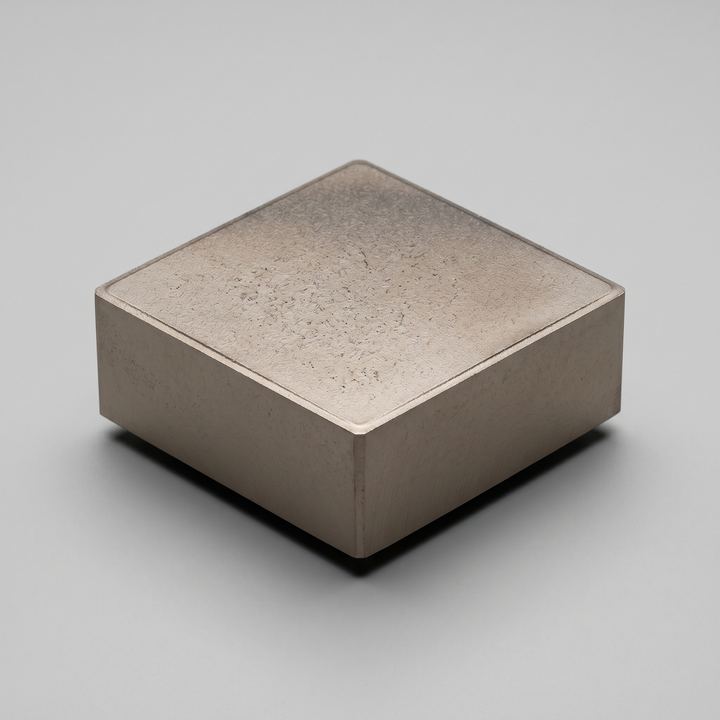
A neutral steel-grey body with the faint warm tint that manganese-silicide sinters carry under raking light. At 7.275 g/cm³ the slab sits heavy but portable in the 70×70×28 mm format, a two-hand grip, close to hot-rolled steel plate in hand-feel but with a drier, drier-sounding tap. The surface reads sintered matte with the fine equiaxed grain visible at close range, not mirror-polished and not cast-rough. Edges come as-sintered or cleanly machined depending on the finishing step; both carry a slight burr at the ninety-degree angle. Against a cast-steel sibling the body is matter, quieter, with the characteristic powder-route porosity legible only as a faint speckle across the face.
Recipe
200 g batch · peak 1100 °C| element | precursor | formula | mass | safety |
|---|---|---|---|---|
| Fe | iron powder -325 mesh | Fe | 64.96 g | moderate |
| Mn | manganese flakes | Mn | 15.98 g | moderate |
| Si | silicon granules | Si | 19.06 g | safe |
- 1Ramp
- 2Hold
- 3Ramp
- 4Hold
- 5Ramp
- 6Ramp
- 7END
Shape-memory — deformed body recovers on heating (Fe-Mn-Si)