K₄O₂₃Si₈W₂
alkali silicate glass · structural translucent glassK4O23Si8W2 is a alkali silicate glass suitable as structural translucent glass. Color: clear. Fired at 1150°C from 4 precursors (SiO2, WO3, K2CO3). Workshop batch: 400g at €68.11. Compressive strength ~500 MPa; estimated 0.84 kg CO₂/kg (-2% vs float glass). Notable: electrochromic tungstate. Confidence: high.
- forms at
- 1150 °C · high-fire
- replaces
- float glass
- CO₂
- 1.9% lower than float glass (0.84 vs 0.86 kg CO₂/kg)
- energy
- 62.5% lower than float glass (5.62 vs 15.00 MJ/kg)
- compressive
- 500 MPa
- density
- 3.33 g/cm³
- crystal
- triclinic
- band gap
- 3.36 eV
- cost
- €170.27/kg · €68.11 / 400 g batch
- confidence
- high (synthesis route)
- potential
- 0.81 · env 0.78 · novel 1.00 · struct 1.00 · lineage 0.70 · supply 0.50
- flags
- electrochromic tungstate: A voltage-switchable optical chemistry. In thin-film form a small DC signal shifts transmission from clear to tinted blue, opening the door to dimmable glazing and responsive partitions that do not need mechanical shading.
Architectural potential
This composition is both a structural glass and a switchable glazing chemistry — the same recipe produces a load-bearing light-admitting solid at 42 mm thickness and, in thin-film form, a dimmable tinted layer driven by a small DC voltage. That pairing is the architectural argument: a single material class can handle a stair tread walked on from above, a window panel inserted into a curtain wall, and a switchable overlay inside an insulating glass unit. A light-well pier at the centre of an office floor could be specified from the bulk slab, while the electrochromic film rides on the outboard pane of the same assembly's vision glazing. Transparent partitions in meeting rooms gain on-demand privacy without mechanical blinds. Five hundred megapascals of compression plus a flat CO₂ balance against float glass — only two per cent over — means no carbon penalty, only a small densification penalty (3.33 g/cm³ instead of the 2.5 of soda-lime). The caveat is that the switching itself is a thin-film behaviour, not a bulk-slab one: bulk-specified, the slab is structural and clear; switching requires a separate thin-film deposition step at the glazing fabricator.
Material character
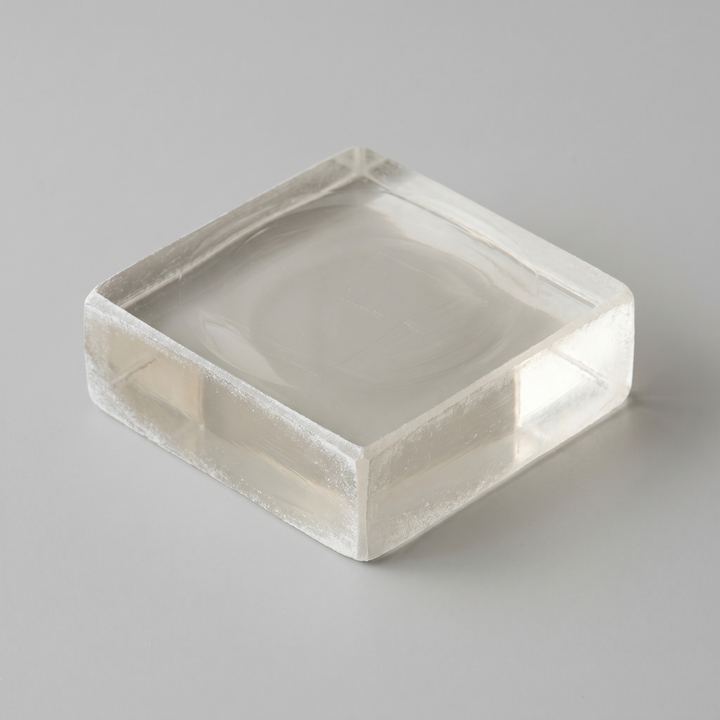
Bulk form reads nearly clear with a faint warm cast from the tungsten that shows most clearly when the slab sits against a pure-white ground. The top face carries a low convex crown and faint parallel anneal striae typical of pressed-glass cooling; cold-cut edges come powdery from the saw. At 3.33 g/cm³ the slab is perceptibly denser than ordinary window glass — a hand accustomed to 2.5-density float glass registers the difference immediately. The 42 mm depth reads fully transparent when backlit against the ambient grey, with only the warm tungsten cast distinguishing it from clear architectural glazing.
Recipe
400 g batch · peak 1150 °C| element | precursor | formula | mass | safety |
|---|---|---|---|---|
| K | potassium carbonate / potash | K2CO3 | 22.64 g | safe |
| Si | quartz flour / silica | SiO2 | 39.37 g | safe |
| W | tungsten trioxide (yellow) | WO3 | 37.98 g | moderate |
- 1Ramp
- 2Hold
- 3Ramp
- 4Hold
- 5Ramp
- 6Hold
Electrochromic — color switches under applied voltage (thin-film chemistry)