Fe₃MnRu₈Si₄
metal pm only · sintered metalFe3Mn1Ru8Si4 is a metal pm only (iron powder pm) suitable as sintered-metal. Color: neutral. Fired at 1100°C from 3 precursors (Fe, Si, Mn). Workshop batch: 200g at €0.89. Compressive strength ~250 MPa; estimated 0.84 kg CO₂/kg (-53% vs structural steel). Notable: shape memory FeMnSi. Confidence: medium.
- forms at
- 1100 °C · high-fire
- replaces
- structural steel
- CO₂
- 53.1% lower than structural steel (0.84 vs 1.80 kg CO₂/kg)
- energy
- 74.4% lower than structural steel (5.62 vs 26.00 MJ/kg)
- compressive
- 250 MPa
- density
- 9.17 g/cm³
- crystal
- cubic
- band gap
- 0.00 eV
- cost
- €4.45/kg · €0.89 / 200 g batch
- confidence
- medium (synthesis route)
- potential
- 0.61 · env 0.74 · novel 0.80 · struct 0.60 · lineage 0.20 · supply 0.46
- flags
- shape memory FeMnSi: Deforms on cue and snaps back to a remembered shape when warmed. Deployable canopies, self-tensioning fasteners, seismic-damping brackets, and geometry-changing envelopes all become mechanically possible.
Architectural potential
A ruthenium-rich sintered iron-manganese-silicon part, pressed from powder and fired at 1100 °C into a dense metallic body with 250 MPa of compressive strength. The Fe-Mn-Si chemistry is the canonical shape-memory composition: warmed past its transition it snaps back to a remembered geometry, and the architectural reach of that capability is specific. Self-tensioning masonry fasteners that re-tighten after the first seasonal cycle, seismic-damping brackets that dissipate energy through the forward-and-reverse transformation, deployable canopy hinges that open on solar gain, and retrofit tie-rod terminations that re-grip their anchor after grout shrinkage all belong in this register. It supplements welded steel rather than replacing it — the making-culture is industrial sintering, not casting, so batches stay in the 200–500 g range and geometries run complex-but-small: brackets, nodes, façade clips, hardware. Against structural steel the embodied CO₂ falls by fifty-three per cent. The caveat is scale and price: at €0.89 per 200 g the unit cost is real, but the workshop ceiling sits at half a kilogram, so this is the material of the signature connector, not of kilometres of rebar. Shape-memory cycling tolerance is also finite; each transition wears the grain boundaries a little.
Material character
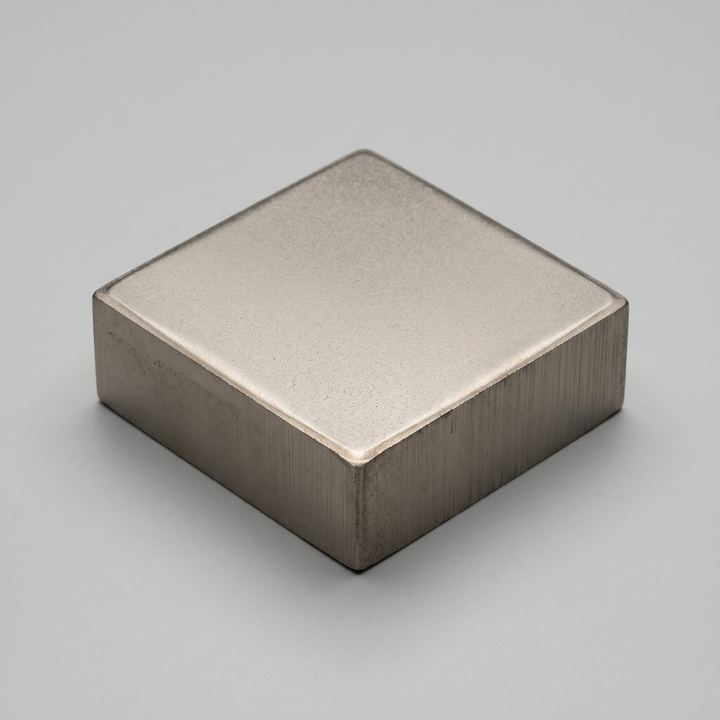
At 9.167 g/cm³ the slab is the densest in the batch — a 70×70×22 mm piece sits in the hand with the pure metallic heft of a cast bronze of half the footprint. Neutral cool-grey face with the faint lavender cast ruthenium brings to polished iron alloys; matte sintered grain across the top, the powder compact visible as a fine stipple under raking light. Edges cold-machined rather than as-pressed, the chamfer carrying a mirror register where the cutting wheel polished the grain closed. A close industrial sibling to cast steel but distinctly harder-ringing when tapped — the sinter closes porosity tighter than a cast body of the same chemistry.
Recipe
200 g batch · peak 1100 °C| element | precursor | formula | mass | safety |
|---|---|---|---|---|
| Fe | iron powder -325 mesh | Fe | 50.04 g | moderate |
| Mn | manganese flakes | Mn | 16.41 g | moderate |
| Si | silicon granules | Si | 33.55 g | safe |
- 1Ramp
- 2Hold
- 3Ramp
- 4Hold
- 5Ramp
- 6Ramp
- 7END
Shape-memory — deformed body recovers on heating (Fe-Mn-Si)