K₄O₂₀Si₈V₂
alkali silicate glass · structural translucent glassK4O20Si8V2 is a alkali silicate glass suitable as structural translucent glass. Color: grey-blue. Fired at 1150°C from 4 precursors (SiO2, K2CO3, V2O5). Workshop batch: 400g at €11.36. Compressive strength ~500 MPa; estimated 0.84 kg CO₂/kg (-2% vs float glass). Notable: no special functions flagged. Confidence: high.
- forms at
- 1150 °C · high-fire
- replaces
- float glass
- CO₂
- 1.9% lower than float glass (0.84 vs 0.86 kg CO₂/kg)
- energy
- 62.5% lower than float glass (5.62 vs 15.00 MJ/kg)
- compressive
- 500 MPa
- density
- 2.61 g/cm³
- crystal
- triclinic
- band gap
- —
- cost
- €28.40/kg · €11.36 / 400 g batch
- confidence
- high (synthesis route)
- potential
- 0.68 · env 0.78 · novel 0.00 · struct 1.00 · lineage 1.00 · supply 1.00
Architectural potential
A potassium-vanadium silicate glass fired at 1150 °C — a load-bearing translucent at five hundred megapascals of compression, with the vanadium tinting the body a cool grey-blue rather than delivering a switching behaviour at this ratio. Placements sit in the walked-on and leaned-on register: stair treads where the cool tint reads against warm timber nosings, balustrade panels and glass screens in public circulation, structural floor inserts in mezzanines and gallery cores, and pressed-glass beams in pavilion frames where the grey-blue colour is part of the spatial register. Against float glass the energy overhead drops by sixty-two per cent because the potassium flux lowers the melt viscosity, while embodied CO₂ is essentially unchanged — a thermal-argument substitution rather than a carbon one. The 400 g standard batch scales cleanly to a five-kilogram workshop ceiling, genuinely usable for a full set of treads or a short balustrade run rather than a single sample. Still firmly in the soda-silicate family, so anneal schedules and cold-edge finishing remain part of the detail. The caveat is colour specification: the grey-blue body is not a near-clear tint, so daylight passing through a tread sits cooler on the treads below, and architectural lighting studies should account for the cast rather than assume float-like neutrality.
Material character
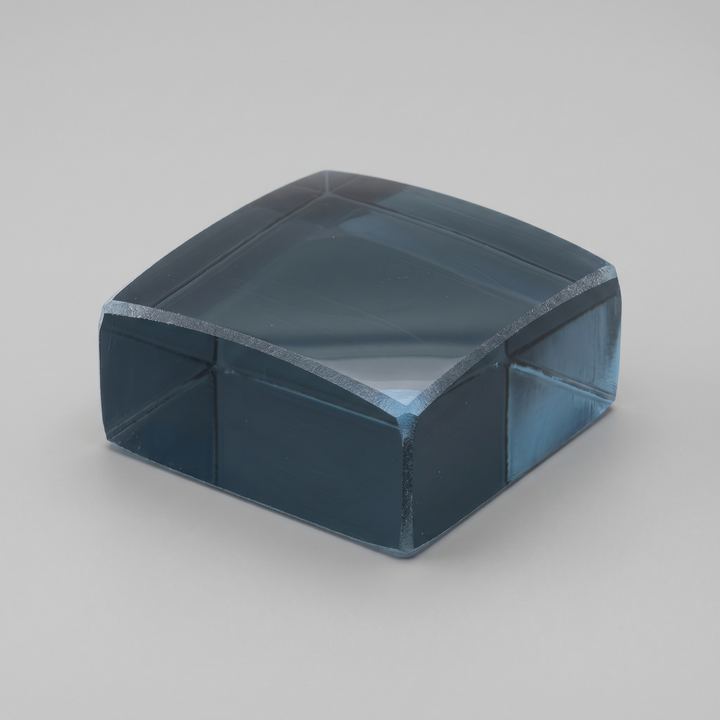
The slab reads a distinct cool grey-blue — more saturated than a tinted architectural float and closer to a pale sapphire than to a neutral grey, the vanadium sitting as a dissolved colourant in the silicate matrix rather than a particulate. At 2.61 g/cm³ over 85×85×53 mm the piece is firm in the hand and lifts two-handed for its thickness, closer in weight-feel to an ordinary soda-lime pane of the same dimensions but slightly denser. Surface pressed-glass with the characteristic convex crown of a cast pane; edges cold-cut, carrying the lapidary bloom of a slow saw. Rings clear and long under a tap.
Recipe
400 g batch · peak 1150 °C| element | precursor | formula | mass | safety |
|---|---|---|---|---|
| K | potassium carbonate / potash | K2CO3 | 29.44 g | safe |
| Si | quartz flour / silica | SiO2 | 51.19 g | safe |
| V | vanadium pentoxide | V2O5 | 19.37 g | moderate |
- 1Ramp
- 2Hold
- 3Ramp
- 4Hold
- 5Ramp
- 6Hold