K₁₂Na₄O₁₆Si₄
alkali silicate glass · structural translucent glassK12Na4O16Si4 is a alkali silicate glass suitable as structural translucent glass. Color: clear. Fired at 1150°C from 4 precursors (K2CO3, SiO2, Na2CO3). Workshop batch: 400g at €4.48. Compressive strength ~500 MPa; estimated 0.84 kg CO₂/kg (-2% vs float glass). Notable: no special functions flagged. Confidence: high.
- forms at
- 1150 °C · high-fire
- replaces
- float glass
- CO₂
- 1.9% lower than float glass (0.84 vs 0.86 kg CO₂/kg)
- energy
- 62.5% lower than float glass (5.62 vs 15.00 MJ/kg)
- compressive
- 500 MPa
- density
- 2.56 g/cm³
- crystal
- monoclinic
- band gap
- 3.23 eV
- cost
- €11.20/kg · €4.48 / 400 g batch
- confidence
- high (synthesis route)
- potential
- 0.68 · env 0.78 · novel 0.00 · struct 1.00 · lineage 1.00 · supply 1.00
Architectural potential
A high-potassium alkali-silicate glass sitting squarely in the load-bearing transparent-glass register — 500 MPa of compression at 2.57 g/cm³, fully clear, and firing at 1150 °C against float glass's standard palette. Natural placements are pressed-glass stair treads walked on from above, transparent floor panels over light-wells in retail and exhibition interiors, column-like light-admitting piers in atria and circulation cores, partition glazing that carries its own vertical load, and monolithic glass balustrades where the structural glass replaces the usual steel-plus-glazing assembly. The K:Na ratio pushes alkali content unusually high, so the glass accepts slower annealing and thicker pressings than standard soda-lime sheet — the tectonic register is pressed and cast glass rather than drawn sheet. Against float glass the CO₂ is essentially identical (minus two per cent) but the energy cost runs sixty-two per cent lower, which is the real argument: a structural glass at architectural scale with significantly less kiln time per kilogram. The caveat is chemical durability: high-alkali glasses are more susceptible to surface leaching and weathering than soda-lime, so exterior exposure requires either laminated skins or a lime-silicate glaze, keeping specification interior-biased unless the element is protected.
Material character
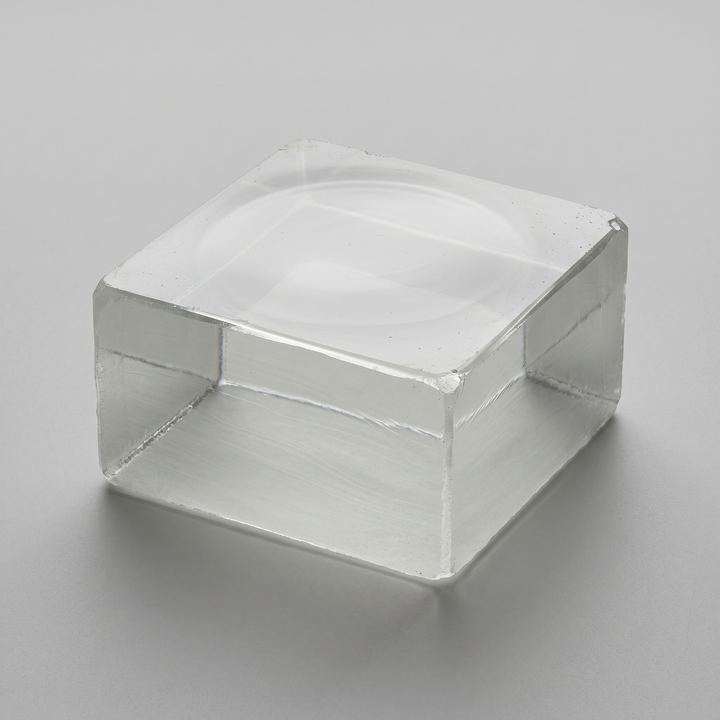
Clear with a faint warm potassium cast — the pressed 85×85×54 mm slab reads nearly water-white under daylight, with the depth of the 54 mm section giving a just-perceptible amber along the long edge. At 2.57 g/cm³ the piece is firm-handed but not heavy, a distinct weight step below the borosilicate and lead-bearing glasses. Top face carries a pressed-glass anneal texture with fine striae visible along one axis; edges come cold-cut with the lapidary dust left on the kerf. Against standard float glass the body reads a touch warmer and softer, and the pressed tectonic gives a top-face crown that conventional rolled sheet does not carry.
Recipe
400 g batch · peak 1150 °C| element | precursor | formula | mass | safety |
|---|---|---|---|---|
| K | potassium carbonate / potash | K2CO3 | 64.71 g | safe |
| Na | sodium carbonate / soda ash | Na2CO3 | 16.54 g | safe |
| Si | quartz flour / silica | SiO2 | 18.75 g | safe |
- 1Ramp
- 2Hold
- 3Ramp
- 4Hold
- 5Ramp
- 6Hold