O₄₈Sr₁₂Te₇WZn₁₂
heavy oxide ceramic · thermal mass ceramicO48Sr12Te7W1Zn12 is a heavy oxide ceramic suitable as thermal mass ceramic. Color: neutral. Fired at 1250°C from 3 precursors (SrCO3, ZnO, WO3). Workshop batch: 200g at €7.11. Compressive strength ~100 MPa; estimated 0.94 kg CO₂/kg (+326% vs clay brick). Notable: electrochromic tungstate. Confidence: medium.
- forms at
- 1250 °C · high-fire
- replaces
- clay brick
- CO₂
- 326% higher than clay brick (0.94 vs 0.22 kg CO₂/kg; 4.3× higher)
- energy
- 108% higher than clay brick (6.25 vs 3.00 MJ/kg; 2.1× higher)
- compressive
- 100 MPa
- density
- 5.52 g/cm³
- crystal
- trigonal
- band gap
- 2.10 eV
- cost
- €35.55/kg · €7.11 / 200 g batch
- confidence
- medium (synthesis route)
- potential
- 0.35 · env 0.00 · novel 1.00 · struct 0.20 · lineage 0.50 · supply 0.00
- flags
- electrochromic tungstate: A voltage-switchable optical chemistry. In thin-film form a small DC signal shifts transmission from clear to tinted blue, opening the door to dimmable glazing and responsive partitions that do not need mechanical shading.
Architectural potential
A heavy tungstate-zincate thermal-mass ceramic whose 100 MPa of compression and 5.52 g/cm³ density make it a credible candidate for south-facing thermal walls, trombe-wall infills, and hypocaust-style floor cores — the passive-battery role of absorbing daytime solar gain and releasing it slowly after dark. The electrochromic behaviour carried by the tungsten content opens a second architectural move: small-area glazed inserts that can be switched from clear to tinted blue under a low DC signal, dimmable partitions that do not need mechanical shading. Natural placements are therefore stacked: thermal mass in the body of a wall, responsive tinting at chosen inserts. Against fired clay brick the environmental balance is awful — 326 per cent more embodied CO₂ — so bulk wall use is forbidden. The specification argument runs the other way: a small, precisely-placed thermal-and-optical element that pays for its carbon through function. Natural projects are retrofit trombe-wall patches in cold-climate housing, atrium sill inserts in offices, and south-facing reveals in galleries. The caveat is supply and scale — 200 g per batch, supply-chain score of zero on tellurium, and a 1250 °C firing peak. Specification is for the signature insert, not the wall itself.
Material character
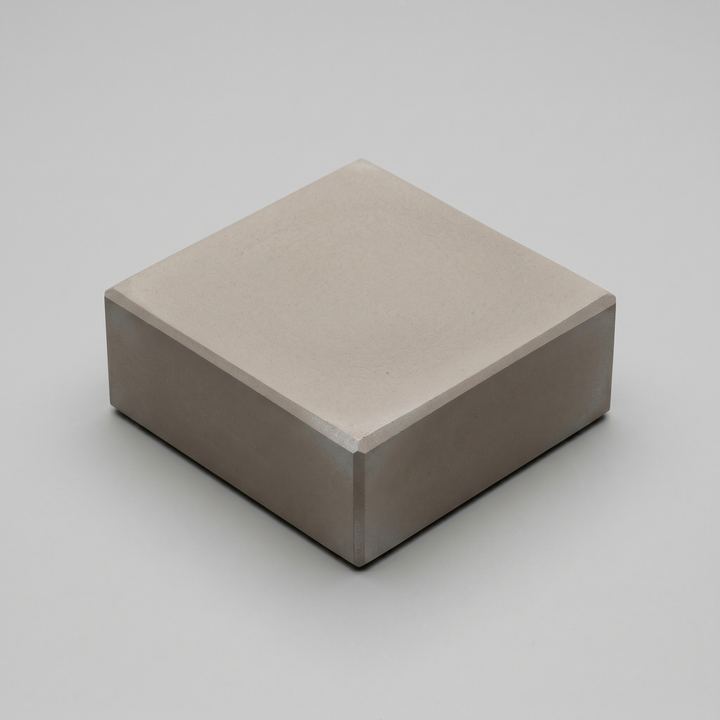
The slab reads as a cool neutral grey with a faint lilac cast from the tungstate-tellurate matrix, quieter and more even-toned than its iron-bearing sibling at the same density range. At 5.52 g/cm³ in a 70×70×37 mm piece, the body sits heavy in the palm — two-handed register, closer in feel to a dense architectural stone than to standard fired clay of similar footprint. Skin matte from the sinter, with a faint satin sheen catching under diffuse light. Edges cold-cut, diamond-kerf powder whitening the sawn faces. Fully opaque through the full depth. Tapped, the body returns the high, clean note characteristic of a well-vitrified heavy oxide.
Recipe
200 g batch · peak 1250 °C| element | precursor | formula | mass | safety |
|---|---|---|---|---|
| Sr | strontium carbonate | SrCO3 | 59.45 g | safe |
| W | tungsten trioxide (yellow) | WO3 | 7.78 g | moderate |
| Zn | zinc oxide | ZnO | 32.77 g | safe |
- 1Ramp
- 2Hold
- 3Ramp
- 4Ramp
- 5Hold
- 6Ramp
- 7Ramp
Electrochromic — color switches under applied voltage (thin-film chemistry)